



World Press Today, September 14 | BETH Eyes
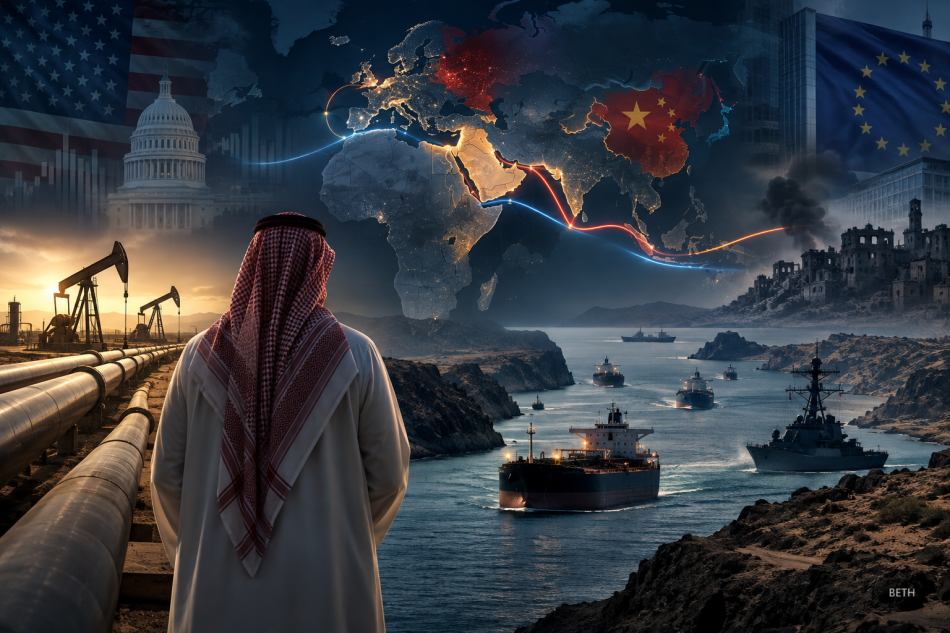
Oil and war push other files into the background; Hormuz, Saudi Arabia and Yemen dominate the Western press, while Washington is preoccupied with China and inflation, and Europe with Ukraine’s borders and the cost of energy
Monitoring and Analysis | Strategic Media Department – BETH Agency
Supervision: Abdullah Alomairah
A clear change has taken place in the angle of the global press this morning.
The main question is no longer: Who is advancing militarily? Rather: To what extent has the war begun to affect energy, trade and global inflation?
Brent’s jump to above $107, the faltering of the Muscat meeting, and the targeting of the Saudi East–West pipeline pushed Gulf files to the forefront of the economic and political press. At the same time, some newspapers have begun revising the picture they presented over the past two days of Houthi control over Bab al-Mandab, with shipping continuing and a counter-movement beginning on the ground in Yemen; revealing slowness and inaccuracy in following some coverage — in some Western media outlets — and what is relayed from them in Arab media — regarding the reality of what is happening on the ground.
London | Oil First
The Financial Times puts the energy crisis at the forefront of the scene: oil has exceeded $108 with the postponement of the Gulf-Iranian meeting on Hormuz, amid indications that it may be cancelled, while disagreement among Gulf states over the form of negotiations with Tehran has turned into a new factor putting pressure on markets.
Reuters takes the same direction, repeating what it has discussed daily: that the problem is no longer only the amount of oil available, but how to transport it. Tanker rates are rising, marine fuel is becoming scarcer, and the Saudi East–West pipeline, originally designed to bypass Hormuz, has itself become part of the crisis.
BETH Eye: The financial press has begun to view the war as a global logistical crisis as much as a military one.
Paris | Saudi Arabia Leads the Scene
Le Monde places Saudi Arabia today at the forefront of its Middle East coverage, focusing on the temporary shutdown of the East–West pipeline after the attacks, and on its importance as the main overland route for bypassing Hormuz.
But the French newspaper continues to present the Yemeni scene from the angle of the Houthi gains achieved over the past few days, linking them to Iran’s attempt to strengthen its cards in confronting Washington.
Here, an important time gap appears: French coverage is still, to a large extent, describing the outcome of the previous round, while the battlefield began this morning to show movement in the opposite direction southwest of Taiz.
Washington | China Enters the War Through the Back Door
The most prominent new American development is not Yemen alone.
President Donald Trump played down a report that spoke of Chinese entities providing satellite images to Iran before a previous attack on a U.S. base in Jordan, and declined to turn the issue into a political confrontation with Beijing before his expected meeting with President Xi Jinping on September 24.
This is a notable signal: the White House does not want China’s relationship with Iran to turn into a new U.S.-China crisis before the Xi–Trump summit.
In the background, Beijing is preparing for the Xiangshan Defense Forum, amid issues involving Taiwan, the South China Sea and relations with Washington, but in a tone expected to be more restrained ahead of the summit.
America | The Interest Rate War
Oil has also reached the Federal Reserve.
Rising energy prices and inflation have brought the possibility of a strong U.S. interest-rate hike back onto the table, while Trump is publicly pushing in the opposite direction, calling for the United States to have the lowest interest rate in the world.
Thus, the Middle East war has become part of the American domestic economic battle ahead of the midterm elections: a barrel of oil in the Gulf is putting pressure on the American voter at the gas station.
Ukraine | The War Moves Closer to Poland
In Europe, a new Russian attack near the Polish border stands out, after a strike hit an area almost adjacent to the Dorohusk–Yahodyn crossing and temporarily disrupted traffic there. Poland described the development as an escalation and called for doubling support for Ukraine.
In a striking paradox, Trump asked Kyiv to stop striking Russian refineries and diesel facilities; not in defense of Moscow, but out of fear that the global fuel crisis would worsen after the Russian and Gulf crises converged in one market.
The European conclusion: even the war in Ukraine is now being read through the price of fuel.
Saudi Arabia in the Global Press
Saudi Arabia in the Global Press
Saudi Arabia’s presence today is extensive, but in most foreign press coverage it revolves around three recurring headlines: the East–West pipeline, Bab al-Mandab, and the extent of the Kingdom’s ability to protect its export routes.
The repetition of the same angles reveals a clear reliance on a limited circle of sources and information; some coverage is slow to capture new developments on the ground, or continues to build its reading on a picture that preceded events by hours or days.
The Guardian highlighted satellite images of the damage to the pipeline, linking any prolonged delay in repairing it to further pressure on the global oil market.
In the same direction, Reuters focused on the impact of the attacks on the Saudi market; saying: the index fell 1.3%, in its biggest decline since April, with shares of Aramco, Al Rajhi and Ma’aden falling, adding an internal financial dimension to the picture of regional risks.
In contrast, some American and French coverage tends to portray the Kingdom as being surrounded by Iran and the Houthis; a reading that remains clearly influenced by the events of previous days and does not reflect to the same extent the new field developments in Taiz or the continued commercial traffic through Bab al-Mandab. The latest shipping data show that traffic through Bab al-Mandab remained close to its recent average, while the sharp decline remained concentrated in Hormuz; nevertheless, this coverage did not give the same space to the American inability, so far, to restore normal passage through the strait for international trade.
In a file far removed from the war, Saudi Arabia’s name returned to the American press through the issue of September 11 documents, after President Trump said he would consider a request from victims’ families to release more records related to the investigations, an old and exhausted issue, but one that is periodically revived in the American media.
Arab Press Brief | From the Atlantic to the Gulf
The Gulf and Arab press is focusing, to varying degrees, on Saudi security, Hormuz, and the cohesion of the Gulf position, alongside the files of Lebanon, Palestine and Sudan.
In the Gulf, reactions to the attacks that targeted the Kingdom and de-escalation contacts are taking the lead, while Bahrain’s position rejecting any collective meeting with Iran before diplomatic relations are restored adds a new factor to the faltering Muscat track.
In Lebanon, the south, army deployment and negotiations over security arrangements with Israel remain at the forefront of newspaper coverage, after a negotiating round scheduled for this month was postponed until October.
In North Africa, attention is divided between Palestine and domestic economic issues; while the Tunisian press continues to give significant space to Gaza and the issue of recovering stolen funds.
Inside the Capitals | Each Country Has Its Own Concern
Washington: oil, interest rates, China, and the midterm elections.
Beijing: preparations for the Xi–Trump summit and presenting China as a responsible power that does not want to blow up its relationship with Washington, alongside a major defense forum.
Brussels: fear that higher energy prices will trigger a new wave of inflation; one European Central Bank policymaker says the case for further monetary tightening is growing.
Paris: the domestic economy and consumer anxiety are intersecting with the energy war; the French are cutting spending as budget and election battles approach.
Moscow and Kyiv: Ukraine’s western borders and fuel refineries are taking precedence over talk of an imminent political settlement.
New Delhi and Beijing: after the BRICS summit, a quiet path is emerging toward rebuilding trade and transport ties and easing the effects of the border dispute between India and China.
BETH Eye
The most important thing the world press is saying on the morning of September 14 is not merely that the war has expanded.
Rather, the war has moved from the military map to the bill of the global economy.
Hormuz is pressuring oil, attacks on Saudi infrastructure are pressuring alternatives, Ukraine is pressuring Russian diesel, and central banks are once again thinking about raising interest rates.
At the heart of all this appears today’s paradox:
The world has armies capable of striking thousands of targets; yet it is still unable to guarantee the safe passage of an oil tanker through a narrow maritime corridor.
BETH View
Thus, the media scene can be summarized in two points:
First, the world’s greatest power, along with Western countries that boast of their military superiority, appears so far unable to curb militia-like actions in highly sensitive locations directly linked to the interests, economy and trade of the entire world.
Second, following part of the Western media reveals slowness and weakness in keeping pace with developments on the ground; some reports appear closer to desk-based treatment than to direct field coverage, or to reliance on reliable and continuously updated sources.
In both cases, a clear gap appears between the scale of declared power and the accuracy of the picture reaching public opinion.