



BETH Eyes on the Capitals of Decision
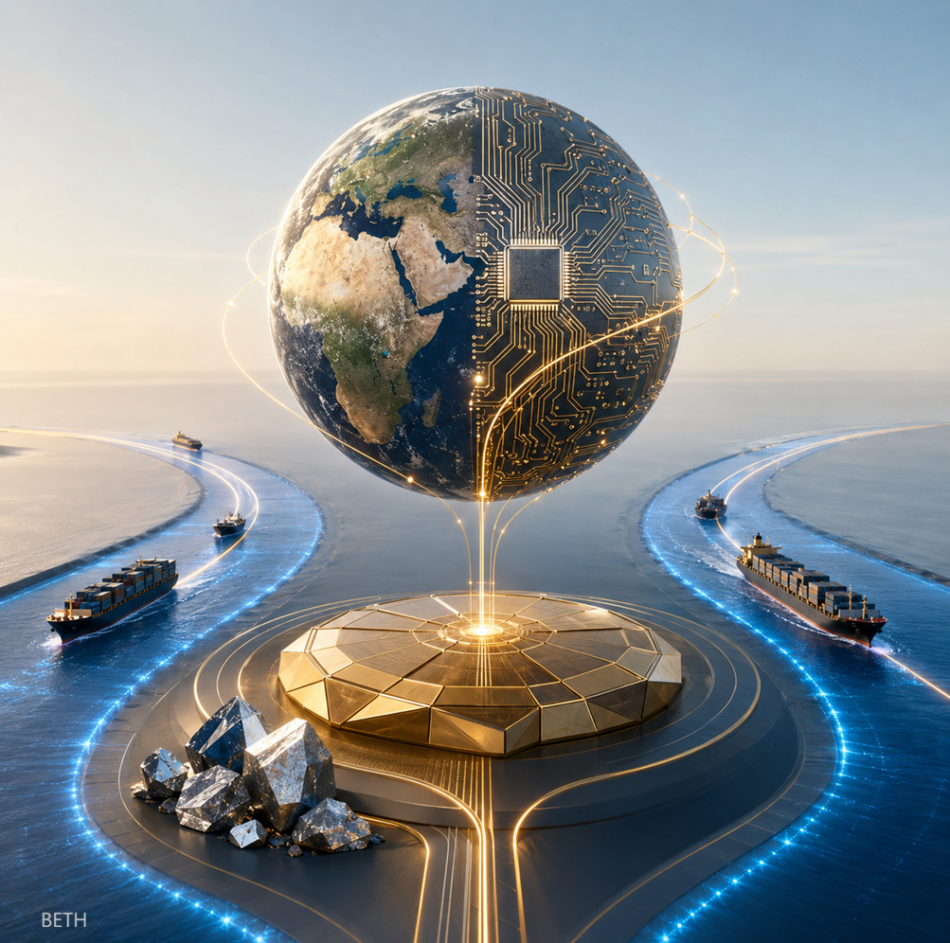
Who Holds the Keys to the Economy?
China’s minerals disrupt the US defense industry, oil shapes interest-rate decisions in London, Tokyo, and New Delhi, while the global press places Saudi Arabia between energy security and the risks threatening maritime routes
Issue Four | July 27, 2026
The Capitals | BETH
A state’s power is no longer measured solely by what it produces, but by what it can obtain when routes are disrupted, sanctions are imposed, and raw materials become instruments of influence.
The United States has the world’s largest defense budget, yet it still needs minerals produced or processed in China.
Britain, Japan, and India have independent central banks, but interest-rate decisions in each of them change as the price of a barrel of oil rises or falls.
Saudi Arabia possesses the resource and the capacity to produce it, but the global press is now watching another question:
Can it deliver energy to markets when the Strait of Hormuz and Bab el-Mandeb are disrupted simultaneously?
Washington | Weapons Need China
The United States is approaching the implementation date for restrictions preventing the defense and industrial sectors from purchasing strategic minerals from China, Russia, Iran, and North Korea, beginning in January 2027.
However, US industry has not yet reached the capacity that would allow it to implement the decision fully.
Despite investing tens of billions of dollars in nearly 150 mining and processing projects, the United States produced only about 300 tonnes of rare-earth magnets in 2025, out of total demand of approximately 48,000 tonnes.
US production may reach about 5,000 tonnes by the end of 2026, but it will remain far from covering domestic demand.
Some minerals used in aircraft, missiles, and electronics, such as tungsten and tantalum, also continue to face major gaps in mining and processing within the United States.
This may force the administration of President Donald Trump to extend some exemptions or purchase additional quantities from abroad, even as it launches a $12 billion project to build a strategic stockpile of minerals.
The paradox is clear:
Washington wants to manufacture weapons that do not depend on China, but it needs China to continue manufacturing those weapons until an alternative is ready.
A political decision can ban imports in a single day, but building mines, refineries, factories, and supplier networks requires years.
Moscow | Peace Without a Document
The Kremlin said it had not received a new and concrete proposal to end the war in Ukraine ahead of an anticipated meeting in Washington between Trump and Ukrainian President Volodymyr Zelenskyy.
The statement came in response to reports concerning ideas about halting airstrikes or freezing certain operations in preparation for broader negotiations.
Moscow, however, maintained its official position linked to its conditions concerning the territories it claims, Ukraine’s military status, and its future relationship with the North Atlantic Treaty Organization.
The problem is no longer the absence of talk about peace.
The problem is that each side speaks of a peace that begins with preserving what it has gained or recovering what it has lost.
This is why mediation channels are multiplying, while the document that both parties could sign remains absent.
Diplomacy is not always obstructed by a shortage of mediators, but because the distance between the belligerents’ conditions exceeds the ability of any mediator to bridge it.
London | Oil Attends the Interest-Rate Meeting
The Bank of England is expected to keep its interest rate unchanged at 3.75%, despite the surge that pushed oil prices above $100 during the US-Iranian escalation.
British inflation declined to 2.6% in June, its lowest level in 15 months, but the bank continues to monitor how higher energy costs are transmitted to transportation, food, and service prices.
The suspension of US and Iranian strikes caused a sharp fall in oil prices, with Brent crude declining by about 9%, reducing expectations of a rapid British interest-rate increase.
The central bank is therefore waiting for a decision that will not be made in London:
Will the truce between Washington and Tehran continue?
If energy markets stabilize, the bank will be able to wait.
But if the war resumes and prices rise, it may find itself compelled to increase borrowing costs, even if the British economy needs support for growth.
Tokyo | Shipping Raises Prices
The prices Japanese companies charge one another for services rose by 3.2% in June, driven by a 5.3% increase in transportation costs.
The increase resulted from higher fuel prices and disruptions to maritime and air transport caused by the war in the Middle East.
The Bank of Japan is expected to keep its interest rate unchanged at 1%, but it may signal the possibility of raising it later if inflationary pressures and the weakness of the yen persist.
For Japan, disruption in the Middle East does not remain confined to foreign-policy bulletins.
A country that imports most of its energy needs experiences the effects of war through shipping rates, factory bills, retail prices, and ultimately the central bank’s meeting.
Every additional mile travelled by a tanker becomes a cost.
And every additional cost becomes inflation.
New Delhi | Growth Takes Priority Over Inflation
The Reserve Bank of India is expected to keep its interest rate unchanged at 5.25% at its next meeting, and possibly until the end of the year.
A survey of 72 economists showed that 68 expect the rate to remain unchanged, despite inflation rising to 4.38% in June, exceeding the bank’s 4% target.
The anticipated decision reflects the priority given to protecting growth from the effects of war and higher energy prices. India imports nearly 80% of its oil needs, making it one of the major economies most affected by disruptions to supplies and prices.
India faces a different equation from Japan and Britain.
Raising interest rates may support the rupee and limit inflation, but it would place pressure on investment, growth, and employment.
Keeping them unchanged gives the economy room to move, but leaves it more exposed to another oil shock.
New Delhi is therefore counting on the current wave of price increases being temporary, and on the brief military truce not turning into another round of war.
Markets | One Night Changes the Calculations
The suspension of strikes between the United States and Iran caused oil prices to fall and stocks and bonds to rise across several global markets.
Brent crude fell below $90 during trading after exceeding $100 the previous week. Shares in travel and airline companies rose, while energy stocks declined.
Bond yields also fell as expectations receded that central banks would be forced to raise interest rates to confront oil-driven inflation.
But this relief exposes the market’s fragility more than it confirms its stability.
A few nights of bombing pushed oil above $100, while nights without bombing brought it back below $90.
Factories and consumption volumes did not change that quickly.
What changed was the likelihood of oil reaching them.
Saudi Arabia in the Global Press
Oil Can Get Out, But
The international economic press focused on Saudi Arabia’s ability to continue exporting oil despite threats to maritime routes, facilities, and vessels.
One of the most telling headlines appeared in the Indian press:
“Saudi oil can still get out, but it will not be cheap or easy.”
The report argues that the East-West Pipeline gives the Kingdom the ability to bypass the Strait of Hormuz and transport crude to Yanbu. However, the threat to Bab el-Mandeb places exports before a second chokepoint and increases the need for additional routes extending northward toward the Mediterranean. Indian coverage
Reuters, meanwhile, focused on Aramco offering additional crude cargoes from Egypt’s Mediterranean port of Sidi Kerir after transporting them through the SUMED pipeline, a move that gives exports heading to Europe and North America greater flexibility away from Bab el-Mandeb.
The global press is therefore not only following how much oil Saudi Arabia produces, but also the engineering of the route it takes.
The Kingdom Between Two Maritime Routes
Western coverage presented the Houthi attacks on facilities in Jizan and Yanbu, as well as on Saudi vessels, as a development that could undermine the de-escalation in place since 2022 and open another front in the regional war.
The danger of targeting Yanbu stems from the fact that it is not an ordinary port, but the outlet that allows Saudi oil to bypass the Strait of Hormuz.
The strategy that protects exports from the eastern threat has therefore become exposed to pressure from the west. Financial Times coverage
The question in the international press has shifted from:
Does Saudi Arabia have an alternative to the Strait of Hormuz?
To:
Can the alternative be protected if the threat extends into the Red Sea?
Markets Are Counting on Saudi Capacity
The Saudi index rose modestly as hopes of de-escalation improved, despite the continuing impact of attacks on energy facilities and the interception of missiles near Yanbu.
Gulf markets also benefited from falling oil prices and lower expectations of a US interest-rate increase, given that the currencies of most Gulf states are pegged to the dollar.
This coverage reveals that Saudi Arabia is simultaneously present in global markets in two images:
A state whose facilities and maritime routes are under threat.
And a state that investors are counting on to continue producing, exporting, and absorbing the shock.
What Matters to Saudi Arabia?
Possessing vast reserves or high production capacity is not enough if the routes to consumers become exposed to danger.
The next stage requires broadening the concept of energy security to include:
Increasing the capacity of the East-West Pipeline and storage facilities in Yanbu.
Enhancing the flexibility of connections with Mediterranean pipelines and ports.
Distributing tankers and contracts across multiple routes.
Protecting ports, vessels, navigation systems, and communications.
Building stockpiles closer to major markets in Asia and Europe.
Developing maritime insurance and risk management in cooperation with international partners.
At the same time, the US minerals crisis reveals another opportunity for the Kingdom.
Saudi Arabia’s mineral wealth, industrial investments, and location between three continents could place the Kingdom within the supply chains of minerals, batteries, and semiconductors—not only as an exporter of traditional energy, but as a producer of the inputs required by the economy of the future.
BETH Reading | Power Begins Before the Product
The news in this issue may appear unrelated:
Chinese minerals inside US industry.
Middle Eastern oil inside the Bank of England’s decision.
Shipping costs inside Japanese inflation.
Energy prices inside India’s growth calculations.
And two maritime routes inside Saudi Arabia’s ability to export.
But they all say one thing:
Possessing the product does not necessarily mean possessing the market; real power begins with controlling the inputs and the route.
It is not enough for the United States to manufacture the missile if it does not possess its minerals.
It is not enough for Japan to set its monetary policy if imported fuel rewrites its inflation figures.
And it is not enough for Saudi Arabia to produce oil if war can threaten its route from the east and the west.
The world is not retreating from interconnectedness, but it is discovering the cost of excessive dependence.
The major task facing capitals has therefore become building an economy capable of functioning when a resource is cut off, a strait is closed, or a supplying country becomes an adversary.
In the fourth issue of “BETH Eyes,” the most important question does not appear to be:
Who owns the largest factory?
But rather:
Who owns the material that operates it, the energy that powers it, and the route that connects it to the world?