


BETH Eyes in Decision-Making Capitals
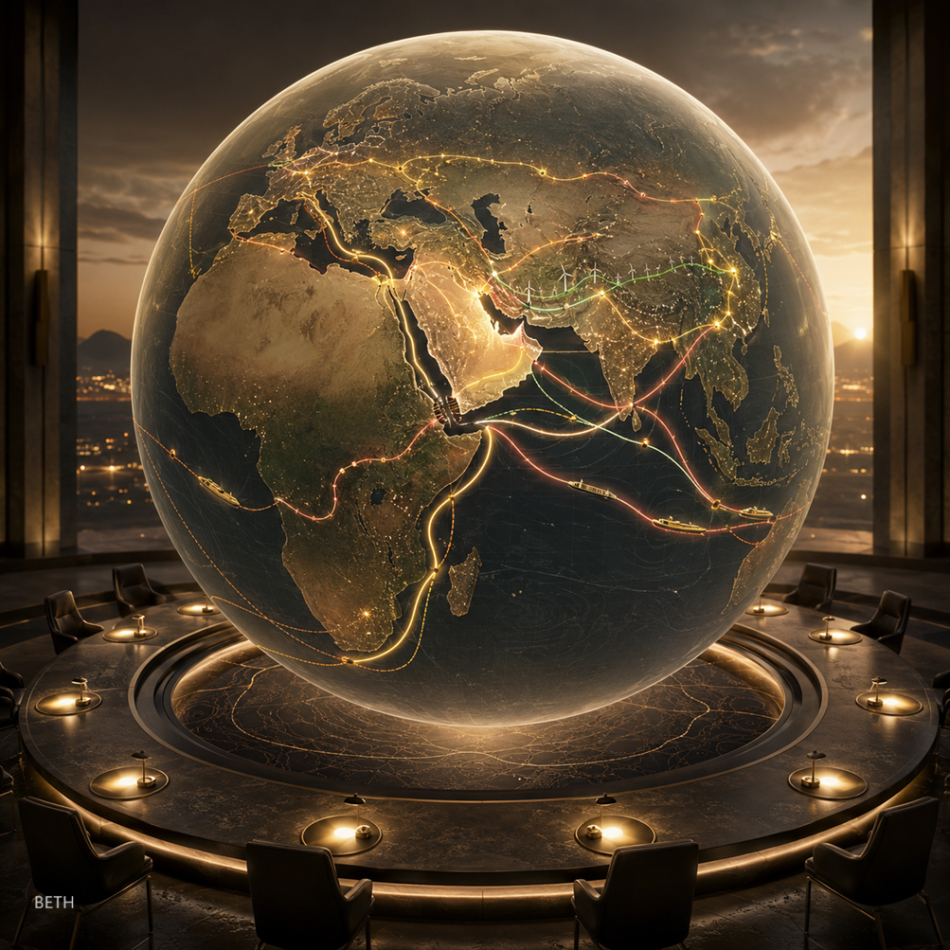
The World Rebuilds Its Routes
From an ally calling on Putin to freeze the war, to China shifting its money toward green energy, and Europe and India raising the banner of domestic production, while Saudi Arabia searches for safer corridors for its exports
Issue Three | July 26, 2026
Capitals | BETH
Major countries do not wait for crises to end before returning to their old plans.
They rebuild the routes of trade, energy, and investment while still inside the crisis.
In Moscow, concern over the continuation of the war in Ukraine has reached a close ally.
In Beijing, the war in the Middle East is accelerating the shift of Chinese financing toward green energy.
In Brussels and New Delhi, protecting domestic industry is becoming a new economic policy.
As for Saudi Arabia, the challenge is no longer possessing energy or having the ability to export it, but ensuring that it reaches the world when corridors in both the east and west are disrupted at the same time.
Moscow | The Ally Calls for a Freeze
Kazakh President Kassym-Jomart Tokayev, while appearing alongside Russian President Vladimir Putin in the city of Omsk, called for freezing the war in Ukraine and returning to negotiations under a new formula based on the Istanbul talks.
The importance of the call lies in the fact that it did not come from a Western country or an adversary of Russia, but from the president of a country connected to Moscow through extensive security, economic, and geographical ties.
Tokayev believes that the continuation of the war is killing more young people, placing pressure on neighboring countries, and disrupting trade and energy exports, without any clear path toward a decisive outcome.
Moscow, however, has shown no willingness to accept a freeze and continues to link an end to the fighting to Ukraine’s withdrawal from the territories it claims and its abandonment of aspirations to join the North Atlantic Treaty Organization.
What happened in Omsk goes beyond a diplomatic proposal.
It is an indication that the cost of the war is no longer concerning Russia’s adversaries alone, but has begun pushing its allies to seek a way out that protects their interests before the prolonged conflict becomes a burden on the economic sphere surrounding Moscow.
Beijing | Money Turns Green
Financing for green energy projects under China’s Belt and Road Initiative reached a record $20.1 billion during the first half of 2026, exceeding the total financing recorded throughout 2025.
The total value of the initiative’s projects reached $126.3 billion, divided between investments and construction activities, with clear expansion in clean energy, technology, mining, and industry.
The share of private companies in the initiative’s projects also rose to 48%, compared with about 13% in 2022, revealing a gradual shift from government financing associated with political influence toward investments seeking greater commercial returns.
The acceleration came at a time when the war in the Middle East has driven oil and gas prices higher and increased demand for energy sources less exposed to disruptions in maritime corridors.
China is not abandoning oil, but it is using the oil crisis to expand its control over the alternative.
Every disruption in Hormuz or Bab al-Mandab does not merely raise conventional energy prices; it also makes Chinese solar technology, batteries, and power grids more attractive to importing countries.
Brussels | Division Serves China
Europe is struggling to build a unified position toward China, despite a widening trade deficit and growing fears that European industry will decline in the face of an influx of Chinese products.
Beijing tries to deal with the European Union as a single bloc when that serves its interests, then turns to individual countries when divisions emerge within the Union.
It expands its relations with countries more willing to cooperate and uses markets, investment, and supply chains to influence governments’ positions, while Paris, Rome, Berlin, and Madrid differ over the required degree of firmness.
China’s trade surplus with the European Union reached approximately €360 billion in 2025 and continued to rise during the first half of 2026.
The dispute is no longer about cheap goods alone.
It is a struggle over the future of electric vehicles, batteries, semiconductors, industrial equipment, and critical materials.
The longer Europe delays unifying its policy, the more China can turn political division within the Union into a commercial gateway.
New Delhi | India Replaces Imports
India has renewed its efforts to reduce dependence on foreign countries and identified imports worth nearly $51 billion that could be replaced with domestically manufactured products.
The plan includes sectors such as textiles, renewable energy, electronics, semiconductors, and mobile phones, as part of a policy aimed at creating jobs, reducing the trade deficit, and protecting supply chains from international disruptions.
New Delhi has allocated approximately $13.3 billion to developing the semiconductor industry, in addition to billions of dollars in incentives for domestic mobile phone manufacturing.
Manufacturing, however, still represents only about 13% of India’s economy, while challenges involving bureaucracy, labor and land laws, and weaknesses in some industrial infrastructure persist.
India does not want to separate from the global economy.
It wants to enter it with greater productive capacity and avoid remaining a vast market for goods manufactured by others.
This means that accessing the Indian market in the future may require establishing factories and partnerships inside India, rather than merely exporting to it.
Seoul | History Becomes an Asset
The Normandy landing beaches associated with the Second World War were added to the World Heritage List, alongside Tunisia’s village of Sidi Bou Said, during meetings of the World Heritage Committee in South Korea.
Recognition of heritage sites is not limited to their historical or aesthetic value. It also reintroduces them as cultural and economic assets capable of attracting visitors and investment and developing their surrounding cities.
A place that is preserved well does not remain merely a witness to the past; it becomes part of the economy of the present and the identity of the future.
These decisions carry a message for countries investing in tourism and culture:
Heritage does not compete with modern development. It can become one of its drivers when it is transformed from a site that is visited into an integrated experience told to the world.
What Matters to Saudi Arabia
These developments may appear distributed among Russia, China, Europe, India, and Korea, but they converge around a single transformation:
Countries are reducing their dependence on one route, one market, or one resource.
Energy | Both Corridors Under Pressure
Saudi pipelines extending from east to west have given the Kingdom the strategic ability to bypass the Strait of Hormuz and transport oil to the port of Yanbu.
But the movement of the threat into the Red Sea and Bab al-Mandab means that bypassing one troubled strait may move tankers toward another strait exposed to danger.
Saudi Arabia is considering adding up to two million barrels per day to the capacity of the East–West Pipeline, strengthening the flexibility of transporting oil away from Hormuz.
The next phase, however, requires more than increasing the pipeline’s capacity:
Expanding port and storage capacity.
Diversifying export directions.
Protecting vessels and maritime corridors.
And building alternative routes that do not depend on a single chokepoint.
The Kingdom possesses a rare geographical advantage through its access to the Gulf and the Red Sea, but the value of this advantage depends on its ability to keep both coasts open at the same time.
Investment | China as Partner and Competitor
China’s expansion in green energy opens opportunities for Saudi Arabia to attract technology, financing, and companies working in solar power, batteries, hydrogen, and mineral supply chains.
But it also means that global competition will intensify.
China does not merely finance projects. It brings with it its companies, equipment, and technical standards, potentially making recipient countries more connected to its industrial system.
For the Kingdom, it is preferable not to remain merely a market for imported green technology, but to become a base for manufacturing, developing, and exporting it to the region and Africa.
Trade | Capital Is Not Enough
Europe and India’s shift toward protecting domestic industry carries a direct message for Saudi investors:
Access to major markets will no longer depend on capital alone.
It will require local content, industrial partnerships, employment, knowledge transfer, and supply chains that comply with the environmental, social, and security standards of each market.
This reinforces the importance of shifting Saudi foreign investments from acquiring assets alone toward building an industrial presence within target markets.
Diplomacy | The Way Out Creates Influence
Kazakhstan’s call to freeze the war in Ukraine reveals the growing need for mediators capable of communicating with opposing parties.
Saudi Arabia has an important space here, thanks to its relations with the United States, Russia, Ukraine, Europe, and China, and its record of hosting talks and facilitating prisoner exchanges.
The longer the conflict continues and the greater its costs to energy, food, and trade, the more valuable becomes the country capable of opening a channel that others cannot.
BETH Analysis | The Power of Alternatives
The world is not moving toward complete self-sufficiency, because that is neither possible nor economical.
But it is moving toward building alternatives that protect it when the primary route is disrupted.
China is building a green alternative to high-cost energy.
India is building a domestic alternative to imports.
Europe is searching for an alternative to Chinese dominance.
And Kazakhstan is searching for an alternative to the continuation of the war.
Saudi Arabia, meanwhile, needs to transform its location between Asia, Africa, and Europe, along with its possession of two coastlines, financial resources, and vast energy resources, into a network of alternatives rather than a single route.
Future resilience will not be measured only by the scale of what a country possesses, but by the number of routes it can use when one is closed.
In a world where corridors are disrupted, tariffs change, and domestic industries are protected, the strongest country will not be the one that possesses the resource alone.
It will be the one capable of producing it, transporting it, financing it, securing it, and delivering it to the market through more than one route.