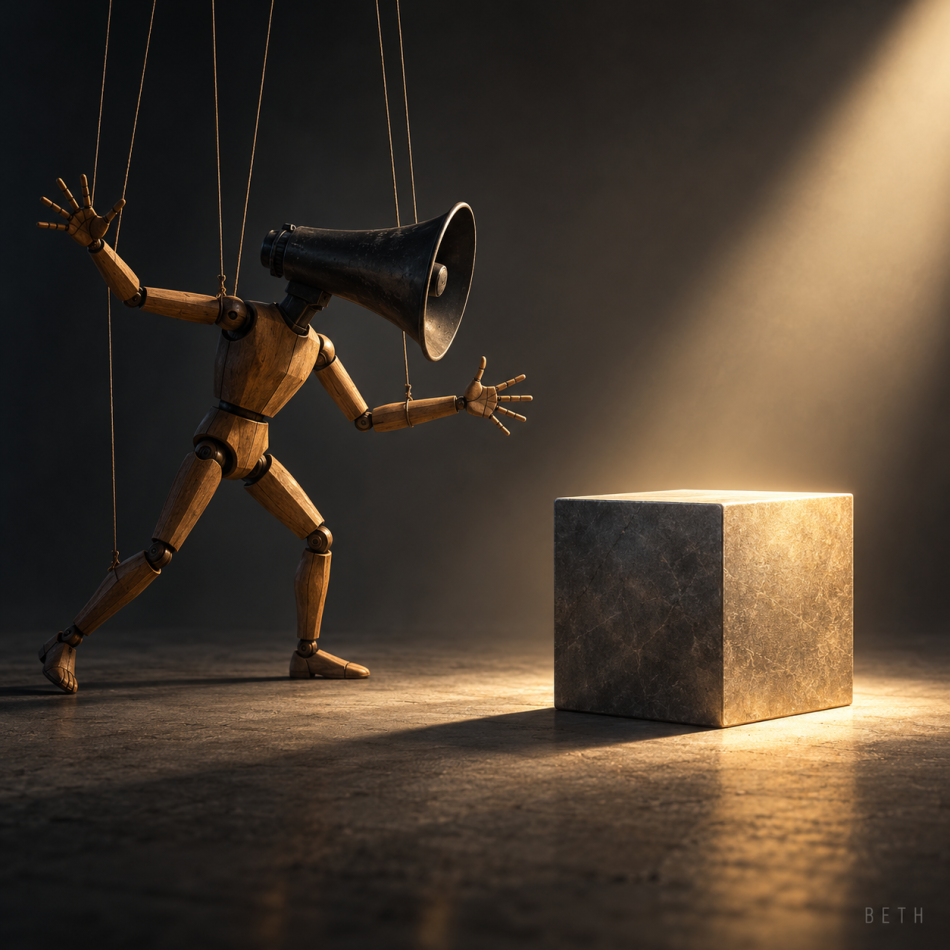



BETH Eyes in the Capitals of Decision

Capitals Under Pressure
From students who brought down a minister in New Delhi to tariffs reshaping trade in Washington and interest rates struggling to contain the impact of war in Moscow
Issue Two | July 25, 2026
Capitals | BETH
Major capitals do not always move according to their own plans.
Sometimes decisions come from the street. Sometimes they are imposed by markets. And sometimes, a war thousands of kilometres away shapes them, with its consequences eventually reaching fuel prices, interest rates, trade, and jobs.
In the second issue of “BETH Eyes in the Capitals of Decision,” pressure is spread across students, traders, factories, central banks, and technology companies.
But the message is the same:
The world is not facing a single crisis, but a network of interconnected pressures moving from one capital to another and pushing governments towards decisions they never intended to make.
New Delhi | Students Bring Down the Minister
Indian Education Minister Dharmendra Pradhan resigned in a political victory for widespread youth protests sparked by leaked national entrance examinations and allegations of irregularities within the testing system.
His resignation followed weeks of sit-ins, marches, and hunger strikes that expanded from an education issue into a broader protest against corruption, weak accountability, unemployment, and the future facing India’s youth.
The resignation represents a rare political concession by Prime Minister Narendra Modi’s government. Protesters did not limit their demands to tougher penalties for those involved. They also called for political accountability and comprehensive reform of the examination system.
What happened in New Delhi goes beyond the departure of a minister.
It signals the emergence of a new political force led not only by parties, but also by younger generations capable of transforming an education issue into a test of the government’s legitimacy.
Washington | Tariffs on the World
The United States imposed new tariffs ranging from 10% to 12.5% on imports from 60 trading partners, including the European Union and China.
The US administration justified the decision by saying these countries had failed to take sufficient action to prevent goods made with forced labour from entering their markets and subsequently reaching the United States.
The new tariffs, however, reveal a broader transformation in American trade policy.
Washington is no longer using tariffs solely to protect domestic products. It is increasingly using them to impose its political and social standards on trading partners.
This means tariffs are gradually shifting from an economic instrument into a form of diplomatic pressure that can be deployed in matters involving labour, the environment, technology, and national security.
As a result, a product is no longer judged solely by its price and quality, but also by the supply chain through which it passed, the laws governing its production, and the country from which it originated.
Brussels | Technology Ignites Trade Tensions
Washington has launched an investigation into the European Union’s trade practices following fines imposed by Brussels on American technology companies, most notably Google.
The United States argues that some European measures unfairly target its companies, while the European Union maintains that its laws are intended to protect competition, consumers, and digital sovereignty.
The dispute is no longer confined to smartphones, search engines, and digital platforms.
It is a struggle over a much larger question:
Who sets the rules of the global digital economy?
The United States possesses the world’s largest technology companies, while Europe commands one of its strongest regulatory authorities. Each side is attempting to transform what it controls into global influence.
The trade war is therefore moving beyond factories and ports into data, algorithms, and digital penalties.
Beijing | Industrial Strength, Market Weakness
China’s fiscal revenue rose by 4.7% during the first half of 2026 to reach 12.1 trillion yuan, supported by higher tax revenue, strong exports, and advanced industries.
At the same time, the figures reveal continuing domestic pressures.
Revenue from government land sales fell by 31.5%, signalling the persistence of the property crisis and weak domestic demand, while the Chinese economy recorded its slowest quarterly growth in more than three years.
Beijing is relying on industry, technology, and foreign trade to compensate for weakness in property and consumption.
This approach, however, presents another challenge. Rising Chinese exports could prompt the United States and Europe to impose further restrictions to protect their domestic industries.
China has the capacity to produce, but its next battle will be gaining access to global markets without provoking a new wave of trade barriers.
Moscow | Interest Rates Between War and Inflation
The Russian central bank lowered its key interest rate by 25 basis points to 14%, despite rising inflation and pressure on oil facilities and supply chains.
The decision came as attacks on refineries and logistics centres disrupted fuel supplies, drove petrol prices higher, and began feeding into the prices of other goods and services.
The central bank also lowered its forecast for Russian economic growth in 2026 to between zero and 1%, while raising its inflation forecast to between 6% and 7%.
Moscow faces a difficult equation:
Keeping interest rates high may restrain inflation, but it also places pressure on investment and growth.
Lowering them may provide the economy with additional liquidity, but it could open the door to another wave of price increases.
Russia’s decision reveals how war reaches citizens’ pockets, even when the fighting takes place far from markets and shops.
Tokyo | Inflation Complicates the Decision
Japan’s headline inflation rose by 1.7% in June, while core inflation, which excludes fresh food, reached 1.6%.
Despite the increase, core inflation remained below the Bank of Japan’s 2% target for the fifth consecutive month.
These figures place the central bank before a delicate decision at its next meeting.
Raising interest rates could help support the yen and limit import costs, but it may also place pressure on consumption and economic growth.
Keeping rates unchanged could give the economy more time to recover, but it would leave Japan exposed to fluctuations in energy and commodity prices, particularly as the war in the Middle East expands.
For Japan, which depends heavily on imported energy, disruption in the Strait of Hormuz is not a distant development.
It quickly becomes a bill that reaches factories, shops, and households.
BETH Perspective | Decision-Making Under Pressure
The developments in these capitals may appear unrelated.
Student protests in India.
American tariffs.
A technology dispute between Washington and Brussels.
Property weakness in China.
Interest rates and inflation in Russia.
And prices being closely watched in Japan.
But they reflect a single transformation:
Governments no longer control the timing of their decisions on their own.
In New Delhi, the street dictated the moment of resignation.
In Washington, trade competition pushed the administration to transform values and standards into tariffs.
In Brussels, protecting the digital market became a political confrontation with the United States.
In Beijing, the property crisis pushed the government towards greater dependence on industry and exports.
In Moscow and Tokyo, central banks are attempting to address the consequences of crises that monetary policy alone did not create.
What Connects the Capitals?
The common factor is that decision-making is no longer entirely domestic.
A protest within one country may spread to another.
A tariff imposed in Washington may alter a production line in Asia.
A European fine on a technology company may become a transatlantic trade dispute.
An attack on a Russian refinery may raise commodity prices.
And the closure of a maritime passage in the Middle East may force the Bank of Japan to reconsider its calculations.
The world is not only becoming more interconnected.
It is also becoming increasingly capable of transmitting crises at speed.
In this world, the strongest capital is not the one with the greatest authority, but the one that understands pressure before it arrives and acts before it becomes a crisis.
A decision not made at the right time may ultimately be made by protests, markets, or wars on behalf of those responsible for it