


Day 29: Escalation Expands
Follow-up & Analysis | BETH
Trump: Cuba is Next
Said U.S. President Donald Trump on Friday evening (Miami time / Saturday morning Middle East time): “Cuba is next,” during a speech at an investment forum.
Trump pointed to what he described as the “successes” of U.S. military operations in both Venezuela and Iran, in the context of broader American movements across multiple international files.
He also confirmed that he informed Iran of the necessity to allow ships to pass through the Strait of Hormuz, adding that Tehran is “negotiating” with the United States and must open the strait.
The Strait of Hormuz is considered one of the most vital corridors for global oil and liquefied natural gas exports, making any restriction on transit there directly impactful on global energy markets.
Houthis Enter the Confrontation
The Houthis have begun participating in the confrontation by launching missiles and drones toward Israel, where a drone heading toward Eilat was intercepted and destroyed.
The Houthis announced the launch of a missile toward Israel.
In an initial Israeli response, an official stated that the Houthis “will pay the price,” indicating that a response is coming, without specifying its timing or nature.
The Houthis announced the launch of a missile toward Israel earlier today.
In the evening, the group launched a second missile toward Israel, which was intercepted, according to an Israeli official.
BETH Analysis
The entry of the Houthis expands the scope of engagement from a direct confrontation
to a network of regional proxies.
The message is twofold:
additional pressure on Israel,
and an attempt to relieve the burden on the Iranian center.
The confrontation is no longer a single front,
but multiple tracks,
managed from one center.
Strikes Deep Inside Iran Continue
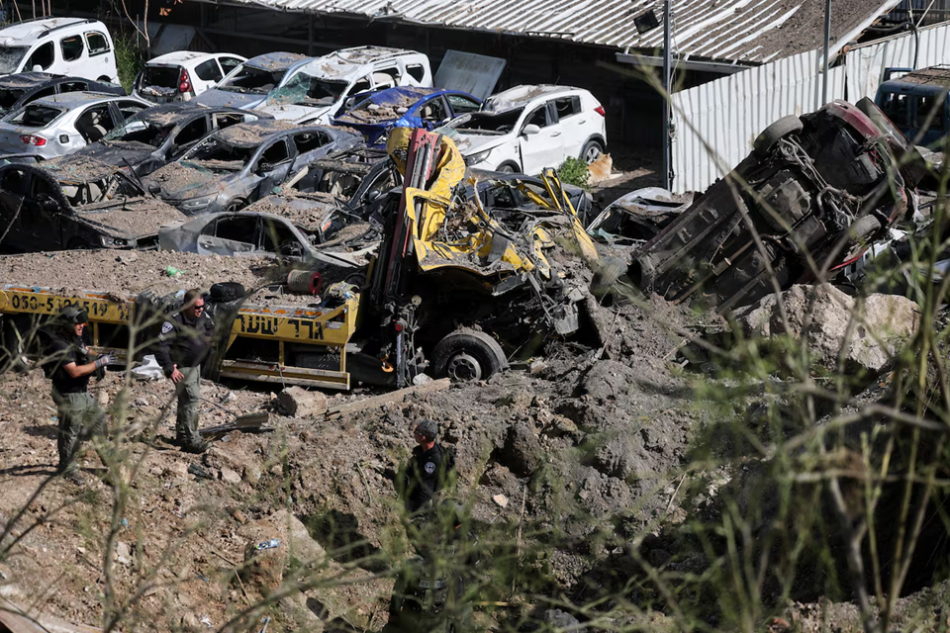
On the 29th day of the war between Iran, Israel, and the United States, Israeli forces intensified their airstrikes on Iranian nuclear facilities. The Israeli army announced that more than 50 aircraft carried out attacks on nuclear program sites across three مناطق.
The strikes included:
- The heavy water facility in Arak
- A site linked to explosive materials for uranium enrichment in Yazd
The attacks also hit industrial locations, including:
- A methanol complex in Bushehr
- Steel facilities in Khuzestan and Isfahan
This led to production lines halting in some factories.
Ongoing Bombardment… and Continued Response
Tehran and Isfahan witnessed consecutive waves of bombardment, targeting:
- Iran University of Science and Technology
- “Sofeh” area in Isfahan
- Sites in Kashan and Parchin
Explosions were also recorded in multiple areas across Tehran and Karaj.
In response, the Israeli army reported detecting missiles launched from Iran toward Israel, marking a continuation of reciprocal strikes.
Regional Expansion
The escalation expanded to include additional الأطراف:
- Bahrain: Interception of waves of Iranian attacks
- UAE: Containment of fires in “KIZAD” following missile interception
- Oman: Port of Salalah targeted by two drones
Meanwhile, Lebanon saw Israeli airstrikes on Beirut’s southern suburbs.
Reading
The indicators do not provide a single decisive answer…
But they point to two possibilities:
- Either a calculated expansion of the battlefield through activating proxies, to increase pressure and reshape engagement rules
- Or a preemptive attempt to offset mounting pressure by bringing new parties into the conflict
In both cases,
the entry of the Houthis does not appear as an isolated event…
But rather a signal of a shift from a single محور… to a broader network.
Island Scenario
Parallel to the escalation, leaks have emerged regarding U.S. options, including:
- A decisive strike
- Or limited incursion and occupation of Iranian islands
Kharg Island stands out as a potential target, given its strategic importance, accounting for nearly 90% of Iran’s oil exports.
Also notable:
- Larak Island (a strategic location in the strait)
- Qeshm Island (the largest island in the Gulf)
In addition to the UAE islands under occupation, which have been turned into fortified military positions.
Iranian Narrative
Tehran, on the other hand, continues to assert its position. A military spokesperson stated that Iran is “victorious on the battlefield” and will impose its conditions for ending the war.
BETH Analysis
The scene is no longer just a direct confrontation…
But a multi-layered escalation network:
- Deep strikes
- Expansion of engagement zones
- Activation of regional proxies
- And the introduction of sensitive geopolitical options
Conclusion
The war is entering a different phase:
Not faster…
but wider.
The wider the fronts expand…
the closer the war moves to a point that becomes difficult to control.