



Day 20 .. Escalation Intensifies
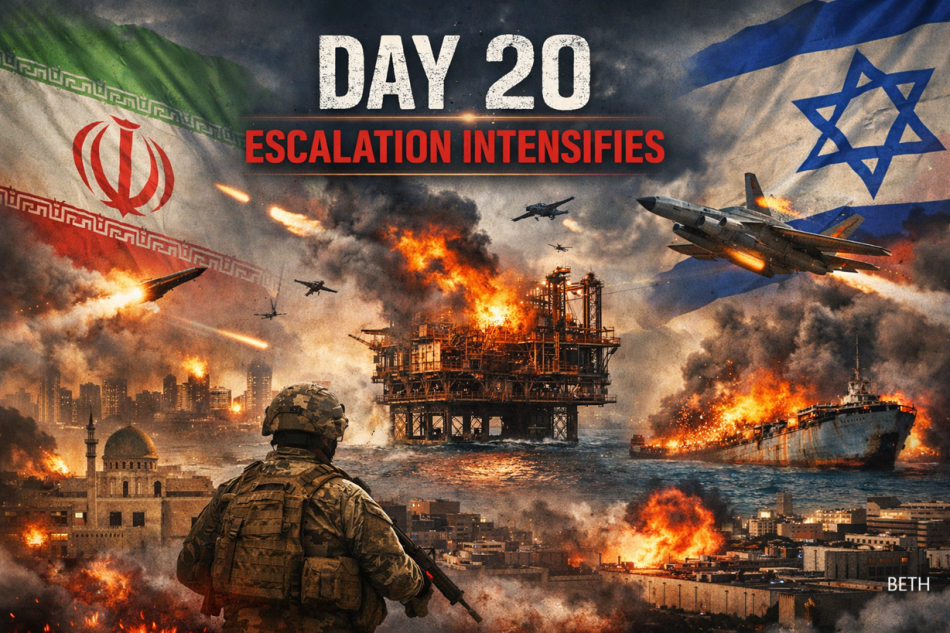
Monitoring & Analysis | BETH
The war in Iran enters its third week, with continued U.S.–Israeli strikes on targets inside Iran and extending to Hezbollah positions in Lebanon. Meanwhile, Tehran maintains its response by launching missiles and drones toward Israel and parts of the Gulf.
Key Developments:
Israel intensifies airstrikes in southern Lebanon and releases footage of targeting Hezbollah operatives
An Iran-aligned Iraqi faction pledges to halt attacks on the U.S. Embassy in Baghdad for five days under conditions
Iranian attacks target U.S. interests and Kurdish opposition groups in northern regions
Israeli official: the war has entered a “new phase” and may last for weeks
Reports indicate Washington is considering deploying thousands of troops to reinforce its presence in the Middle East
Energy Escalation:
U.S. threat to destroy Iran’s South Pars gas field if Qatari LNG facilities are targeted again
Confirmation that Israel struck the field, while Washington stated it had no prior knowledge
Implicit commitment that Israel will not carry out further strikes on the field
Inside Iran:
U.S. strike targeting Bandar Abbas port
An Iranian vessel catches fire amid ongoing developments
BETH Insight:
The conflict is shifting from conventional exchanges to a multi-layered escalation:
Militarily: geographic expansion across Iran, Lebanon, and Iraq
Politically: direct deterrence messaging linked to energy assets
Strategically: a gradual move toward targeting critical economic infrastructure
Despite rising intensity, escalation remains contained within an undeclared ceiling, preventing a full-scale war while sustaining a high-pressure confrontation.
Netanyahu: End of Iran’s Capabilities
Israeli Prime Minister Benjamin Netanyahu stated that Iran no longer possesses the capability to enrich uranium or manufacture ballistic missiles, just 20 days after the start of the U.S.-Israeli air campaign.
Key Statements by Netanyahu
Complete destruction of Iran’s nuclear and missile programs
Targeting Iranian leadership “on land, at sea, and underground”
Orders to strike regime officials even within cities
War continues… with calls for Israelis to remain in shelters
He added that the collapse of the Iranian regime “remains uncertain.”
Caspian Sea Strikes
The Israeli military announced an unprecedented attack on Iranian naval vessels in the Caspian Sea, including:
Destruction of missile-equipped ships
Targeting patrol boats and support vessels
Striking a command center and shipbuilding/maintenance facilities
The army described the operation as one of its most significant strikes since the start of the war.
Intensified Operations
More than 200 targets struck across Iran within 36 hours
BETH Reading:
Israeli statements reflect a dual escalation:
Raising the ceiling of military claims to the level of “decisive outcome”
While maintaining intensive field operations
This raises a critical question:
Is this a declaration of an end… or part of the narrative battle?
Southern Iran Ignites
Southern regions of Iran, particularly Bandar Abbas, Shiraz, and Ahvaz, are witnessing a series of U.S.–Israeli airstrikes that have extended to areas near the Strait of Hormuz, in a notable escalation targeting sensitive strategic points.
After midnight:
Explosions have been recorded in Bandar Lengeh port in southern Iran, coinciding with intensified military movements in the surrounding area of the strait.
Bandar Lengeh is located on the northern coast of the Arabian Gulf in Hormozgan Province, between Bandar Abbas and Bushehr, and is considered one of the historically significant ports with commercial and logistical importance.
Field Analysis
In light of the distribution of the strikes, the targeting does not appear to be limited to the Strait of Hormuz alone,
but rather indicates a broader scope extending along Iran’s southern coastline.
Available indicators also reinforce the possibility that Kharg Island—located off the coast of Bushehr—may be within the strategic calculations, given its vital role in Iranian oil exports.
This suggests a preliminary reading that the operations may be paving the way to exert pressure on this sensitive نقطة,
without confirming it as the direct objective at this stage.
Quick Analysis
The strikes are concentrated on:
Energy hubs (Ahvaz – Hormuz)
Maritime corridors (Bandar Abbas – Lengeh)
Military and logistical infrastructure (Shiraz)
Sensitive sites near the nuclear program (Bushehr)
This indicates a comprehensive pressure strategy aimed at reducing Iran’s ability to exert regional influence, without escalating into a full-scale war.
BETH Reading
The current escalation reflects:
A shift toward deep-target operations
A clear focus on the Strait of Hormuz as a global energy chokepoint
An attempt to reshape the balance through calibrated force
Isfahan Under Fire
In the latest developments on the twentieth day of the strikes,
violent explosions were reported in Isfahan in central Iran, as operations entered the early hours of day twenty-one.
The Israeli military confirmed its continued targeting of missile launch platforms, as part of ongoing operations to reduce military capabilities.
Meanwhile, Germany announced it will participate in securing the Strait of Hormuz after the end of combat operations, signaling early preparations for the post-escalation phase.
Quick Reading
Strikes expanding into the deep interior (Isfahan)
Continued focus on neutralizing missile capabilities
Early international moves to secure vital maritime routes post-conflict
The battle deepens… and the world prepares for the day after.