



Day 15: Continued Strikes on Iran
Follow-up and Analysis | BETH
As the confrontation between Iran on one side and the United States and Israel on the other enters its third week, the scope of military strikes is expanding to include strategic sites inside Iran, at a time when mutual threats are increasing over the security of navigation in the Strait of Hormuz, one of the most important energy arteries in the world.
Strike on Kharg Island
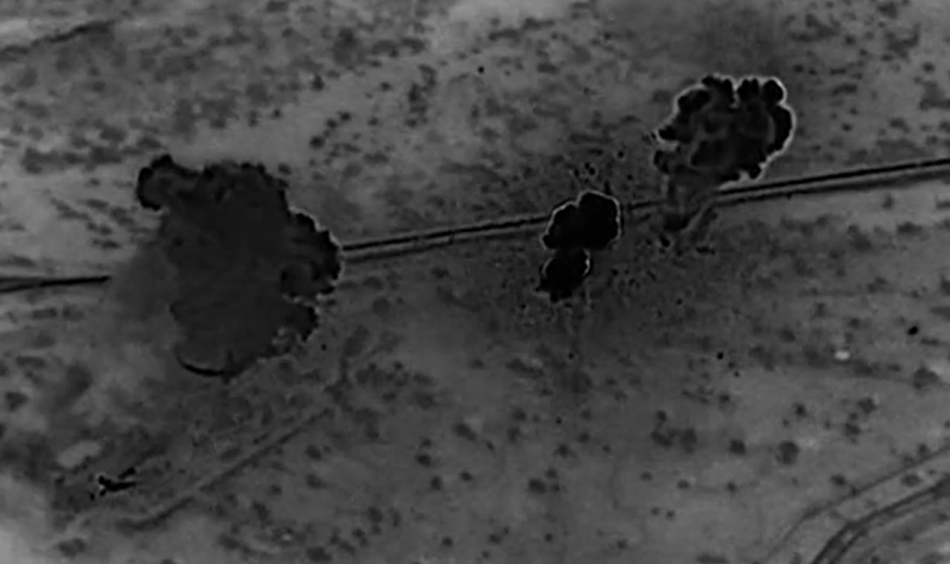
U.S. President Donald Trump announced that the U.S. military had "completely destroyed" military targets on Kharg Island, which is considered the main outlet for Iran’s crude oil exports.
In a post on his platform Truth Social, he said that U.S. forces carried out "one of the most powerful air strikes in the history of the Middle East," confirming that the strikes targeted military sites on the island, which he described as "the jewel of the Iranian crown."
He added that he had chosen not to destroy the oil infrastructure on the island at this stage, but warned that he would immediately reconsider that decision if Iran obstructed freedom of navigation in the Strait of Hormuz.
Trump later published a video of the airstrikes believed to have targeted the island.

Strikes inside Iran
At the same time, several explosions were heard in the city of Tabriz, the capital of East Azerbaijan province in northwestern Iran, where Iranian sources reported that strikes targeted industrial facilities in the area.
Local reports also announced the death of six people in strikes that targeted Ilam Province in western Iran.
Other reports indicated that a strike targeted the Sirjan naval facility in Kerman Province.
In the same context, the Israeli army issued an urgent warning to residents in the Tabriz area before a potential airstrike.
Additional military movements
Reports spoke about the flight of U.S. strategic bombers of the type
B-52 Stratofortress
in the region’s airspace, amid speculation about the expansion of air operations.
On the other hand, the Iranian army announced that it had targeted Israeli units and cyber centers using drones.
The Islamic Revolutionary Guard Corps also announced that U.S. forces had targeted Abu Musa Island.
Regional extension of the confrontation
Outside Iran, Baghdad witnessed a powerful explosion after two strikes targeted elements of Kataib Hezbollah.
Israel also carried out airstrikes on the area of Haret Saida in southern Lebanon, where a strike targeted a residential building, causing it to catch fire.
BETH Reading
The developments of the past hours reveal three important strategic facts:
1. The war moves to strategic infrastructure
Targeting Kharg Island carries a deep significance, as this island represents one of the most important nodes of Iranian oil exports.
The message here is not only military, but also economic:
pressuring Iran’s ability to finance the war and its proxies in the region.
2. A war without a clear front
Satellite imagery analysis conducted by researchers at Oregon State University using data from the Sentinel-1 satellite showed that the damage is distributed across several cities, most notably:
Tehran
Bandar Abbas
Shiraz
Isfahan
According to the researchers, more than 40 facilities were damaged in Bandar Abbas, which hosts a major Iranian naval base on the Strait of Hormuz.
This indicates that the current war is not proceeding along traditional front lines, but through simultaneous strikes across a wide geographic depth.
3. The battle of global energy
With Bandar Abbas and Kharg on the line of targeting, the Strait of Hormuz once again becomes the center of the battle.
About one-fifth of global oil supplies pass through this strait, meaning that any escalation there could immediately affect global energy markets and the world economy.
Trump Rejects Mediation Efforts
Two informed sources said that Oman, which had previously mediated talks with Iran before the outbreak of the war, repeatedly attempted to open communication channels between the concerned parties.
However, the White House informed the mediators that it is not interested in starting a negotiation track at this stage.
A senior White House official confirmed that U.S. President Donald Trump rejected those efforts, noting that the administration is currently focused on continuing military operations aimed at weakening the Iranian regime’s military capabilities.
Washington: Keeping the Strait of Hormuz Open
In a related development, U.S. President Donald Trump announced that several countries will join the United States in sending warships to the Strait of Hormuz.
He explained that the goal of this step is to ensure that the maritime passage remains open and secure for global trade and energy flows, amid concerns over threats to navigation in one of the world's most critical maritime routes.
Iranian Attacks Intercepted in the Region
On the ground, several countries in the region announced the interception of Iranian attacks targeting their territories or airspace.
The interception operations included Saudi Arabia, Kuwait, Jordan, and the United Arab Emirates, where air defense systems successfully dealt with the attacks without major damage being reported.
Conclusion
What is happening now is not merely an exchange of military strikes.
Rather, it is a conflict on three overlapping layers:
destroying military capabilities,
pressuring the Iranian oil economy,
controlling global energy security.
In this context, the war appears to be spreading horizontally inside Iran, while its real center remains in the Strait of Hormuz.