



The World Prices the Climate Shock
Monitoring & Analysis | BETH
News Introduction
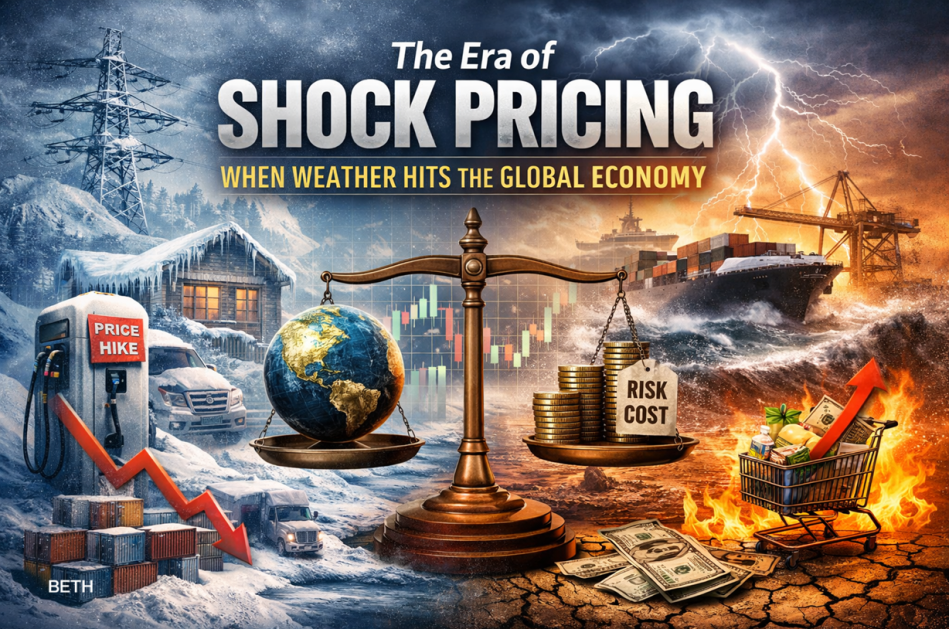
Extreme cold waves sweeping across the United States and violent storms hitting Europe are no longer isolated weather events. What the world is witnessing today is a synchronization of climate disruptions whose impacts now intersect directly with the economy, energy security, and global supply chains—transforming weather from a seasonal headline into a core risk factor for states and markets.
This convergence, previously identified in earlier BETH reports, is no longer exceptional. It is evolving into a recurring pattern that demands a fundamental reassessment of how global risks are managed.
A Disturbed Climate… and an Exposed Global System
The unusual polar air outbreaks in the United States and severe European storms such as Storm Chandra are linked to disruptions in the global atmospheric system, most notably:
Instability in the jet stream
Repeated disturbances of the polar vortex
Increasing intensity of climate events rather than moderation
The result is simultaneous crises instead of sequential ones, significantly raising the economic and political cost of response.
Weather as a Direct Pressure on Energy Security
Weather is no longer a background variable—it has become a central element in energy security calculations:
Sharp increases in demand for heating, electricity, and gas
Growing pressure on transmission and distribution networks
Additional fiscal burdens on governments to ensure readiness and prevent outages
Weather now represents a permanent cost factor in national budget planning.
Supply Chains: The Return of Anxiety—In a New Form
As BETH has previously reported, climate disruptions are reopening the debate over the fragility of global supply chains—but in a different context than the pandemic era:
Port and land transport disruptions
Shipping delays and rising insurance costs
A renewed focus on “operational risk” by logistics and insurance firms
What makes today’s challenge more severe is the frequency of shocks and the shrinking recovery window between them, complicating long-term planning.
Insurance: The Silent Indicator of Shock Pricing
One of the most significant shifts is occurring quietly within the insurance sector, where risks are increasingly priced not on past events—but on anticipated disruption:
Rising premiums in energy and transport coverage
Tighter underwriting conditions
Expanding exclusions related to climate and systemic disruption
When insurance models change, markets are signaling that instability is no longer temporary—it is becoming the new baseline.
Who Pays the Price?
Although the shocks are global, their impact is uneven:
Major economies retain greater shock-absorption capacity
Developing countries face imported inflation and rising food and energy costs
Climate risk evolves from an environmental issue into a social and economic pressure point
BETH Insight
The world is not facing a single crisis—it has entered an era of overlapping shocks.
The key question is no longer what is happening, but rather:
Do states have the capacity to absorb one shock before the next arrives?
What we are witnessing marks the early contours of a new global phase—
one in which risk is priced,
economic decisions are made on the assumption of instability,
and disruption becomes the rule rather than the exception.