



The World at a Point of Convergence: When Crises Collide
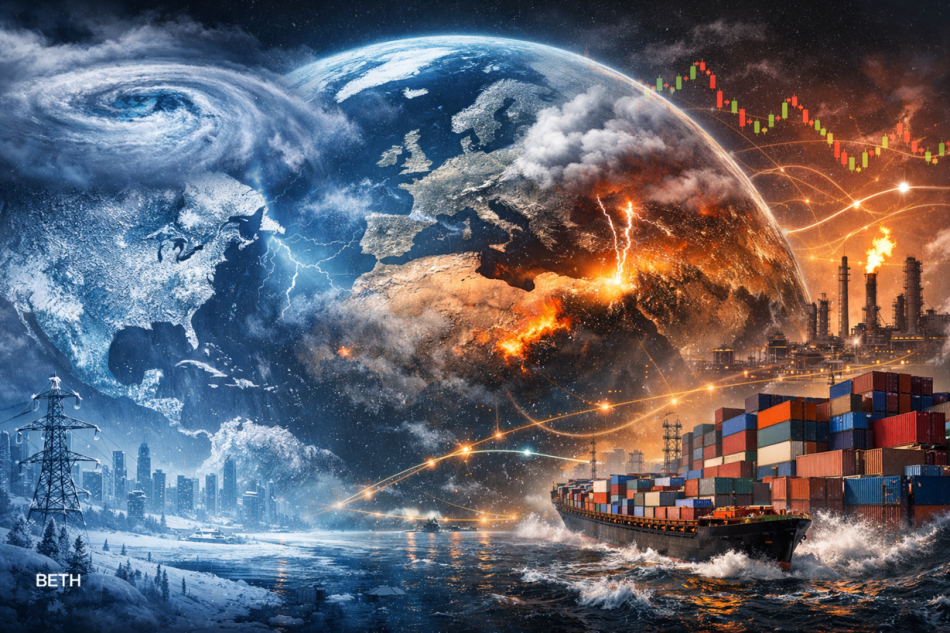
From Weather to Economy: The World Faces a Test of Simultaneous Shocks
Not an Event, but a Moment: Reading the Interconnection of Global Crises
Monitoring & Analysis | BETH
News Introduction | What Is Happening Now?
The world is witnessing a striking convergence of disruptions.
A severe cold wave is sweeping across large parts of the United States, while powerful storms are battering Western Europe, led by Storm “Chandra.” At the same time, concerns are resurfacing over the fragility of global supply chains, alongside rising operational risks in transport, energy, and insurance.
This convergence—where nature, economy, and politics intersect in a single moment—raises a question that goes beyond headlines:
Are these isolated disruptions, or a deeper test of the global system’s ability to manage overlapping crises?
Analysis | When Paths Intersect
1) Weather Is No Longer Background Noise
What the United States and Europe are experiencing is not a typical harsh winter, but a manifestation of instability in the global atmospheric system:
Disruptions in the jet stream,
Recurrent disturbances of the polar vortex,
And the climate paradox, where global warming leads to more extreme—not milder—weather.
Weather has shifted from an environmental factor to a direct economic and political pressure point, impacting energy, transportation, and essential services.
2) Climate Stress Meets Economic Fragility
As freezing temperatures grip the U.S. and storms hit Europe, the effects ripple far beyond borders:
Surging demand for energy strains grids and prices,
Disrupted ports and transport revive supply-chain vulnerabilities,
Shipping and insurance firms reprice risk at an accelerating pace.
Here, weather becomes an economic accelerator, forcing the world to confront its readiness for simultaneous shocks.
3) Politics in the Age of Risk Management
In this environment, politics is no longer about definitive solutions, but about containing spillover effects and preventing cascading failures.
Policy decisions are increasingly shaped by:
Continuity over certainty,
Loss mitigation rather than total resolution,
Managing uncertainty instead of eliminating it.
BETH Reading | What Has Truly Changed?
What has changed is not the weather alone,
nor the economy by itself,
but the logic of the world.
The global system has moved from:
Managing isolated crises
to
Confronting synchronized, interconnected shocks.
In this new reality, risks are more complex, the cost of error is higher, and prediction gives way to resilience and rapid response.
Analytical Conclusion
What the world is facing today is not a single storm,
nor a passing cold wave,
but a genuine global stress test—
a test of whether systems can endure when nature, economy, and politics collide simultaneously.
This is not an event.
It is a moment of convergence.