



Moody’s Confirms Strength of Saudi Economy
Riyadh | B | بث
Dhul Hijjah 06, 1447 AH — May 23, 2026
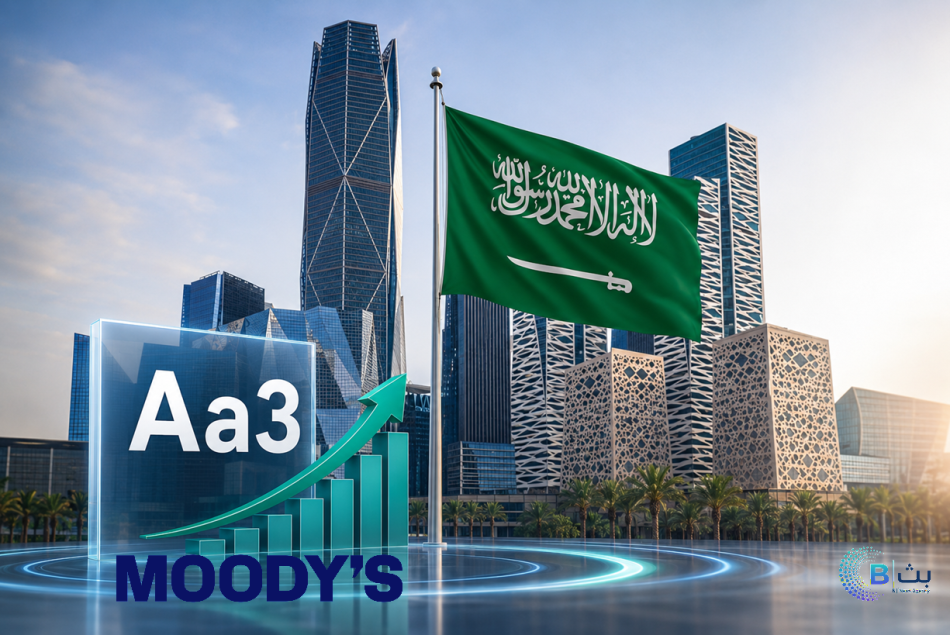
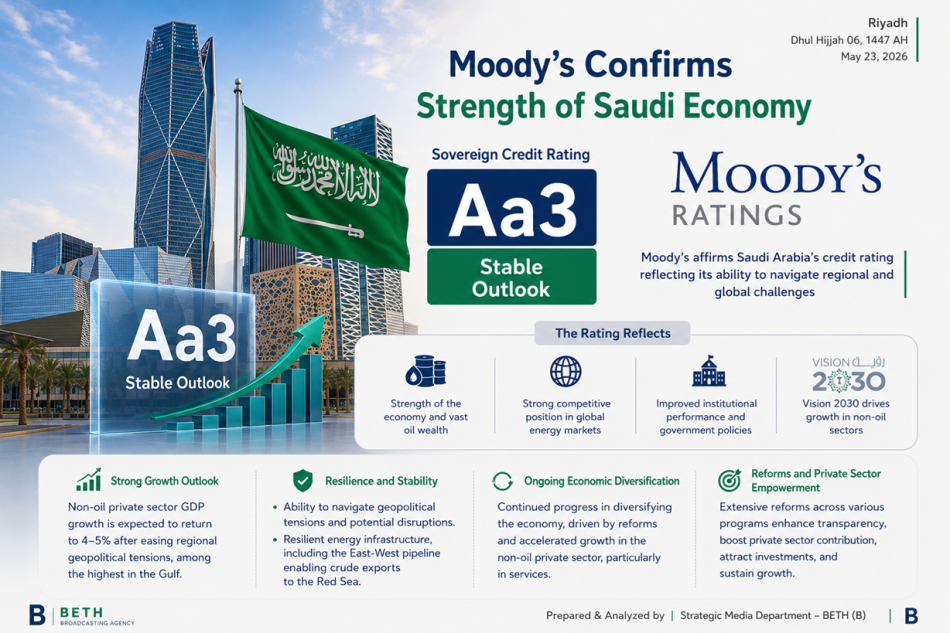
Moody's has reaffirmed Saudi Arabia’s credit rating at “Aa3” with a stable outlook, signaling renewed confidence in the resilience of the Saudi economy and its ability to withstand regional and global fluctuations.
The Brief
The agency stated that the rating reflects:
the strength of the Saudi economy,
its vast oil wealth,
and the Kingdom’s strong competitive position in global energy markets,
in addition to the continuous improvement in institutional performance and government policies.
Moody’s also noted that Saudi Vision 2030 continues to support the growth of non-oil sectors through:
government investments,
structural reforms,
and improved financial and economic transparency.
The agency further emphasized that the stable outlook reflects Saudi Arabia’s ability to navigate:
regional geopolitical tensions,
and potential disruptions.
This resilience is reinforced by the Kingdom’s energy infrastructure flexibility, particularly its ability to transport crude oil exports to the Red Sea through the East-West pipeline.
Moody’s also expects Saudi Arabia to continue advancing economic diversification over the coming years, supported by economic, judicial, and social reforms that have accelerated growth in the services sector and the non-oil economy.
The agency added that non-oil private sector GDP growth could return to levels between 4% and 5% once geopolitical tensions ease, placing Saudi Arabia among the highest growth performers in the Gulf region.
B Analysis
What stands out in Moody’s report is not only the rating itself, but the indirect messages behind it.
The agency is not speaking merely about:
oil,
or revenues.
It is speaking about:
resilience,
reforms,
and the ability to absorb shocks.
In a world witnessing:
wars,
maritime tensions,
and disruptions in global supply chains and energy markets,
international markets have increasingly begun to view:
institutional stability,
and efficient economic governance,
as decisive factors in evaluating the strength of nations.
The reference to the East-West pipeline also carries significant strategic implications, particularly amid tensions surrounding the Strait of Hormuz.
The message here is that Saudi Arabia relies not only on:
production capacity.
But also on:
export flexibility,
and securing global energy flows even during periods of crisis.
The stable outlook also reflects growing confidence among global financial institutions that Saudi Arabia’s economic transformation is no longer merely:
a theoretical vision.
It has become an ongoing execution-driven process supported by:
mega projects,
reforms,
and the expanding role of the private sector.
The key question today is no longer:
Can Saudi Arabia succeed in economic diversification?
But rather:
To what extent can the Saudi economy become one of the world’s most:
resilient,
investment-attractive,
and influential economies over the coming decade?
The answer is:
Saudi Arabia is no longer moving toward economic diversification alone,
but toward redefining its global economic role.