King Fahd Sports City Advances Toward a More Sustainable Future
Riyadh | BETH | B
The redevelopment of King Fahd Sports City continues to make significant progress, combining modern sports infrastructure with advanced sustainability standards in preparation for hosting major international sporting events.
Key Highlights
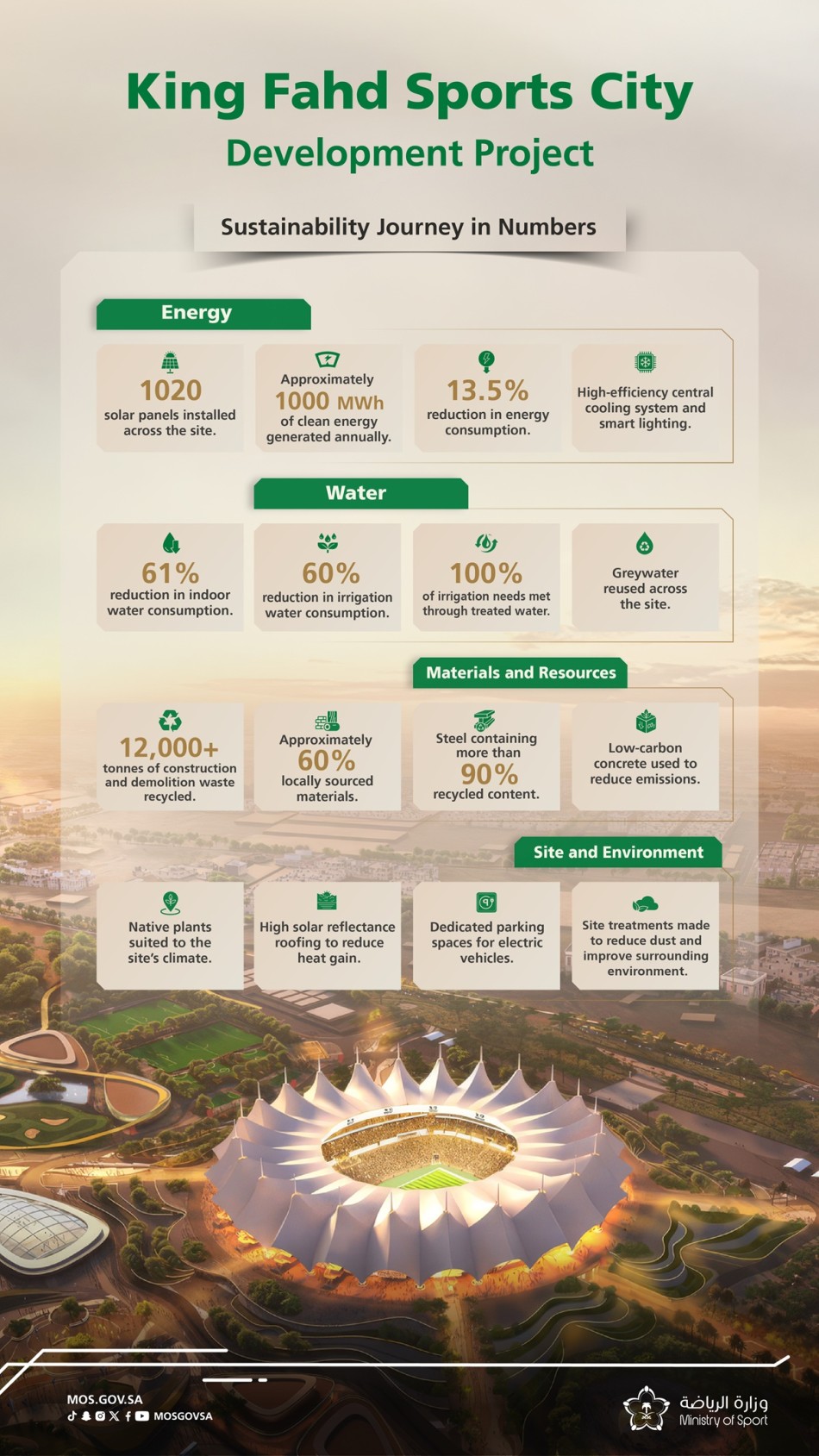
- Installation of 1,020 solar panels, generating approximately 1,000 MWh of clean energy annually.
- 13.5% reduction in energy consumption through high-efficiency cooling and smart lighting systems.
- 61% reduction in indoor water consumption and 60% reduction in irrigation water use.
- 100% of irrigation needs supplied through treated wastewater.
- Recycling of more than 12,000 tons of construction and demolition waste.
- 60% of construction materials sourced locally.
- Use of steel containing more than 90% recycled content, alongside low-carbon concrete.
- Installation of electric vehicle parking spaces, climate-adapted native landscaping, and heat-reflective roofing to enhance environmental performance.
BETH Analysis
Sports venues are no longer measured solely by the size of their stadiums or the quality of their facilities.
They are increasingly evaluated by their ability to reduce resource consumption, lower carbon emissions, and improve operational efficiency.
The figures demonstrate that the King Fahd Sports City redevelopment is more than a renovation project—it represents the transformation of a landmark venue into a smart and sustainable sports complex aligned with global standards.
The question is no longer:
How much does the redevelopment cost?
It is:
How much energy, water, and natural resources will these investments save over the decades ahead?