



Warehouses of the Future
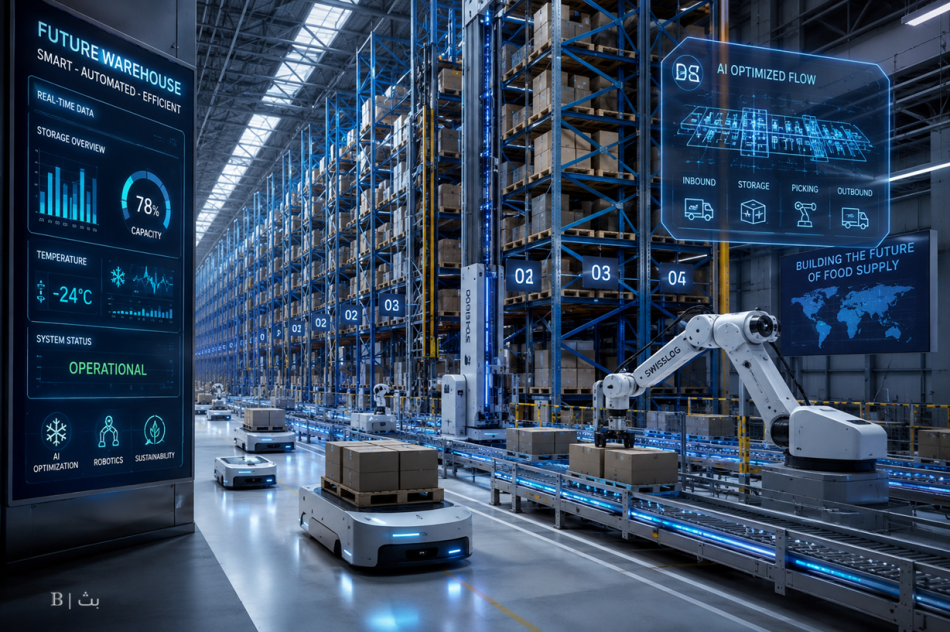
Giant Frozen Food Storage Facilities Reflect a Global Race for Food Security and Supply Chains
London | BETH | B
June 2, 2026
The United Kingdom is expanding its capabilities in smart storage and logistics automation with the announcement of a new large-scale automated frozen food warehouse in Bristol, as part of a broader expansion strategy aimed at building a network of high-tech cold storage facilities across the UK and Europe.
Overview
Swisslog has been awarded a contract to develop a new automated warehouse for Magnavale in Avonmouth, Bristol, following the successful delivery and operation of a similar project in Lincolnshire at the end of 2024.
The project forms part of a long-term framework agreement that envisions the construction of up to eight automated cold storage facilities across the UK and the European Union, supporting Magnavale’s ambition to become one of the leading players in the frozen food storage market.
The facility will be capable of operating at temperatures as low as -28°C within a structure approximately 45 meters high, with storage capacity for around 90,000 pallet positions.
The warehouse will rely on advanced automation systems, including robotic stacker cranes, intelligent transport systems, and warehouse management software, enabling real-time inventory visibility and highly efficient storage and retrieval operations.
Swisslog stated that the facility has been designed to maintain minimum operational throughput levels even in the event of certain system disruptions, enhancing supply chain reliability and reducing the risk of interruption.
BETH Analysis
The significance of this project lies not merely in the size of the warehouse or the number of robots and automated systems involved, but in the broader economic and strategic message it represents.
In a world that has experienced repeated disruptions to global supply chains in recent years, alongside growing concerns over food security, the ability to store, manage, and move inventory intelligently has become a critical component of economic resilience.
Governments and major corporations increasingly recognize that food security is determined not only by agricultural production, but also by the capacity to store, transport, and manage food efficiently during crises and emergencies.
As a result, global investment is increasingly flowing into automated warehouses and large-scale cold storage facilities powered by artificial intelligence and digital technologies, with the aim of reducing waste, improving operational efficiency, and strengthening supply chain continuity.
The next global race may not be about producing food alone, but about the ability to protect it, manage it, and deliver it when it is needed most.
In this context, the “Warehouses of the Future” are evolving from silent logistics facilities into a strategic pillar of global food security infrastructure.
The next global race may not be about food production alone, but about who holds the keys to protecting it.
BETH (بث B) – All rights reserved