


Al Nassr and Ronaldo.. A Global Echo Beyond the League
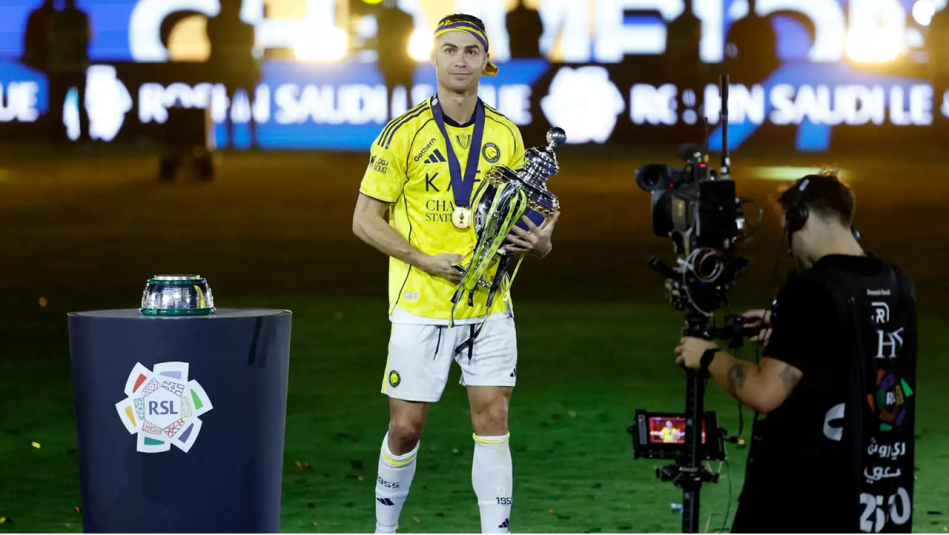
The global media continues celebrating Al Nassr’s Saudi triumph
Monitoring and Analysis | B
Al Nassr’s Saudi League triumph under Cristiano Ronaldo has become a major topic across global media — not merely as a local sporting achievement, but as a new test of Saudi Arabia’s ability to transform its sports project into an internationally marketable event.
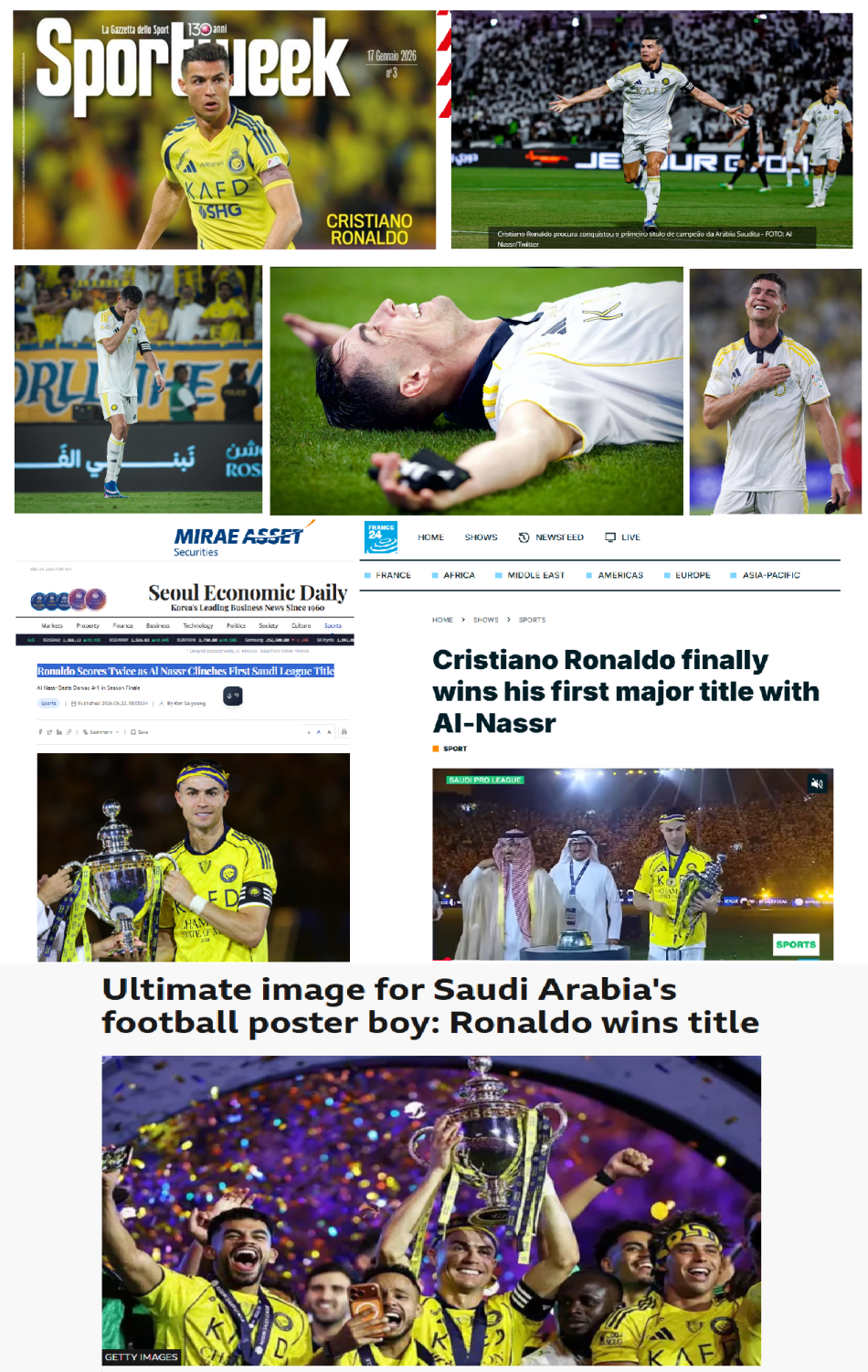
Reuters highlighted that Ronaldo led Al Nassr to the title after a 4-1 victory over Damac, scoring twice in the final round to secure his first league title in Saudi Arabia since joining the club in late 2022. Reuters also noted that Al Nassr finished the season with 86 points, two ahead of Al Hilal.
British outlets such as talkSPORT and The Sun approached the story from a more emotional angle, focusing on Ronaldo’s tears and joy after winning his first title with Al Nassr, emphasizing the personal dimension of his journey after a long wait since arriving in Saudi Arabia.
ESPN described the achievement as Ronaldo’s “first Saudi title” with Al Nassr, while Al Jazeera highlighted that the Portuguese star sealed the championship in the final match before the 2026 World Cup.
The European reaction appeared clear through several different lenses:
Portugal:
Portuguese media treated the event as the return of a national icon to the podium. Headlines from A Bola and O Jogo focused on the end of Ronaldo’s “drought,” his emotional reaction, and his decisive brace, while also highlighting other Portuguese figures linked to Saudi football such as Jorge Jesus and João Félix.
Spain:
Spanish coverage viewed the moment through the lens of Ronaldo’s legacy after Real Madrid, focusing on his first Saudi title, his goals number 972 and 973, and the rivalry with Al Hilal.
Italy:
Italian media gave the story a dramatic tone: “breaking the curse,” “the tears,” and “the first Saudi title,” while indirectly comparing Al Nassr with Al Hilal under Italian coach Simone Inzaghi.
Germany:
German coverage focused more on the technical and statistical side of the achievement: Al Nassr secured the title in the final round, Ronaldo won his first Saudi championship, and the title race remained alive until the last stages against Al Hilal. German coverage was relatively quieter despite Saudi broadcasters’ strong focus on German football and exclusive Bundesliga broadcasting rights. Yet German reports remained among the most precise in documenting the season’s competitive path.
Analytical Conclusion
The European reaction was not only about “Al Nassr” itself, but about Ronaldo as a gateway introducing the Saudi League into European football consciousness.
Portugal celebrated.
Spain compared.
Italy dramatized the story emotionally.
Germany documented it with professional restraint.
And this alone represents a major gain for the Saudi sports project: a domestic league title becoming daily material across European media.
B Analysis
The global reaction revealed that Ronaldo’s name still functions as a massive bridge between the Saudi League and international audiences.
Globally, the story was not read simply as:
“Al Nassr are champions.”
Instead, it was framed as:
Ronaldo finally succeeds in Saudi Arabia.
The Saudi League continues attracting worldwide attention.
The Saudi sports project proves it is no longer a temporary publicity campaign.
And here lies the real value of influence.
Ronaldo’s presence did not merely give the Saudi League temporary fame.
It created an ongoing narrative:
Will he succeed?
Will he win?
Will he make the difference?
Then the title arrived to give that narrative a powerful media conclusion.
But the most important question remains:
If the Saudi League is strong and highly competitive
why did Al Nassr fail to win the title for several years despite its powerful squad since the launch of the project?
Was the issue within the sports project itself?
Within club management?
Or within a media environment that many fans believe does not approach the sports project with a “national mindset,”
but rather with the mentality of “a fan stand wearing a media suit”?
What happened this season suggests that something may finally be changing.
Because the closer competition moves toward fairness
the closer football returns to its true value.
And it now appears that correction has indeed begun
and that the coming phase could become:
stronger
fairer
and more deserving of global respect.
The first impact:
The Saudi League has become far more globally tradable in media value. News about the league is no longer limited to local or Arab coverage, but increasingly present in international agencies, newspapers, and sports platforms.
The second impact:
Strengthening the image of the Saudi sports project.
This victory provides symbolic proof that attracting global stars was not merely for show, but part of building competition, attention, and a viable sports media market.
The third impact:
Transforming the player into a platform of influence.
Ronaldo is no longer just a footballer — he has become a global distribution channel for Saudi sporting events. Every achievement inside Saudi Arabia automatically becomes an international message about the league and the country’s sporting environment.
The fourth impact:
Positioning Saudi Arabia as a rising power in the sports economy.
When a domestic title becomes headline material for Reuters, ESPN, British outlets, and major Arab networks, it means the league is no longer merely a local product — it has become an exportable global media asset.
Therefore, the positive echo of the Saudi sports project will become even more influential globally — whether Ronaldo’s team wins or any other club does — because the true strength of any sports project appears when competition is strong, fair, and the title reaches the team that truly deserves it on the field, as happened this season with the strongest and best-performing side.
Conclusion
Al Nassr’s league triumph under Ronaldo was not merely the end of a football season.
It was a moment of testing the image of the Saudi sports project before the world.
And the result is clear:
the event moved beyond the stadium into global media, transforming from a local championship into a measurable indicator of influence.
And here precisely lies the true power of sport — when it transforms from local competition into a tool of global presence.
BETH (B بث) – All rights reserved