
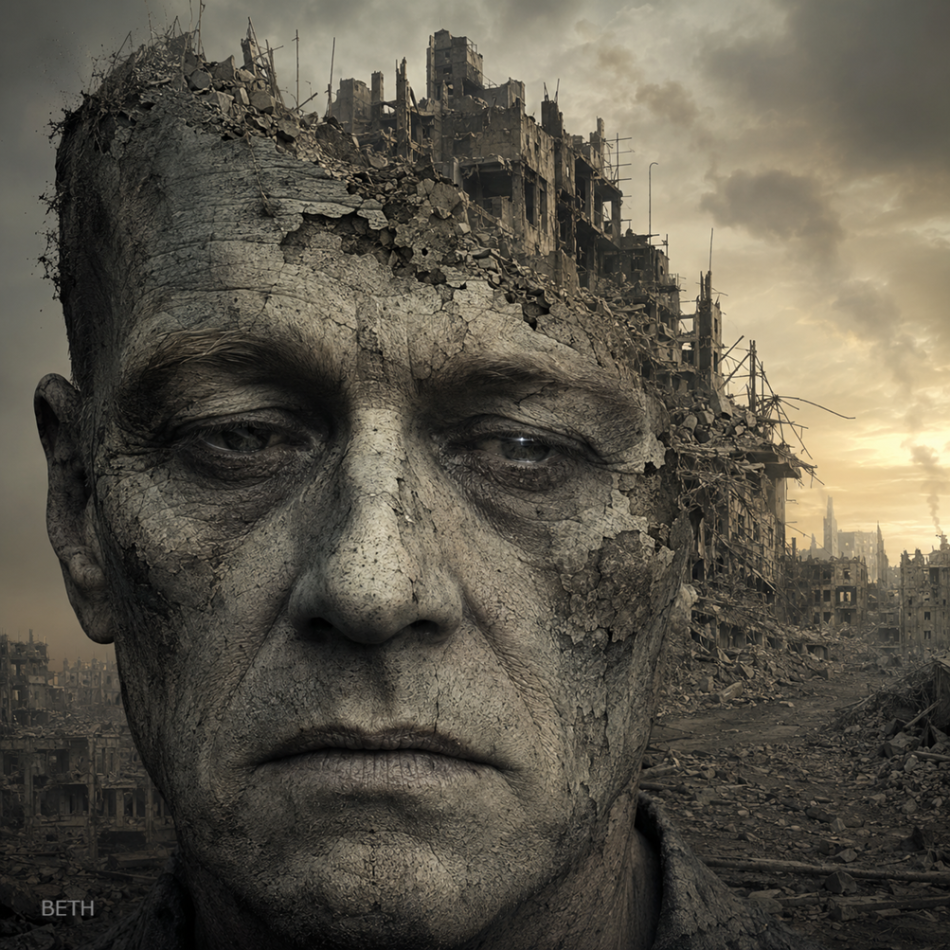


The Measure of Civilization
What is civilizational depth, and how should we measure what nations have left to humanity, away from exaggeration and emotional glorification?
Prepared and analyzed by | Strategic Media Department – BETH News Agency
Supervised by: Abdullah Al-Omairah
Cultural discourse is filled with expressions such as: a nation with an ancient civilization, a people possessing profound civilizational depth, and a civilization that preceded the world.
Yet repeating these expressions does not make their meaning any clearer. Nor does the age of a society alone prove that it contributed more to humanity than others.
Civilization is not an eternal title granted to a nation because it built a palace, ruled an empire, or left behind monumental ruins. Nor is it an emotional contest to prove that our ancestors were greater than the ancestors of others.
The scholarly question is not: Which civilizations are the oldest?
Rather:
What did each civilization produce?
What human problem did it address?
Who benefited from its achievements?
And what remained after its rulers and states disappeared?
A civilization may be ancient and magnificent in its architecture, yet have only a limited influence on contemporary human life. Another may be younger, yet have transformed medicine, education, production, and communication, reaching billions of people.
This is where the need for a fairer and more precise measure begins.
What Is Civilization?
Civilization is the accumulation, over time, of a society’s knowledge, values, institutions, systems, experiences, tools, and ways of life, which it then transmits to later generations or other peoples.
Civilization does not exist in monuments alone. It is found in language, law, education, administration, agriculture, medicine, architecture, and the arts. It is also reflected in a society’s ability to manage its relationship with water, food, land, authority, and knowledge.
The existence of monumental buildings is therefore insufficient to judge a society. Architecture may reveal engineering advancement, but it tells us little on its own about justice, human dignity, the distribution of wealth, or the lives of ordinary people.
Military strength is likewise insufficient to create a civilization. A state may build a vast empire without leaving humanity enduring knowledge or institutions.
Civilization is broader than the state, and society is deeper than the throne that governs it.
What Is Civilizational Depth?
Civilizational depth is the extent of experience accumulated by a society and its ability to preserve, develop, and transmit that experience across time.
It is not measured by centuries alone, but by four elements:
Continuity, accumulation, influence, and the capacity for renewal.
A society may survive for thousands of years yet continue reproducing the same mistakes without converting its experience into knowledge, an institution, or a value. It may be historically ancient without necessarily possessing equivalent civilizational depth.
A society that absorbs the experiences of those who preceded it, examines and corrects them, adds to them, and then transmits them to others creates a depth that transcends the age of the state and the limits of its borders.
Age is history; civilizational depth is accumulated impact.
Human beings themselves do not begin from nothing. They are born into languages, values, knowledge, laws, and patterns of thought they did not create. Yet their civilizational role is not fulfilled by merely repeating what they inherited. It is fulfilled when they preserve what is beneficial, correct what is harmful, and add something upon which the next generation can build.
Civilization Is Not the Product of a “Pure” People
When we speak of Egyptian, Persian, Chinese, or Indian civilization, we are not describing an ethnically pure people who lived in isolation, nor a single state that remained unchanged for thousands of years.
We are referring to a geographic and human sphere through which different peoples, states, religions, and languages passed, creating experiences that retained a degree of continuity.
Egyptian civilization is broader than Pharaonic rule. Civilization in the Iranian sphere is broader than the Achaemenid and Sasanian empires. Chinese civilization is broader than any one ruling dynasty, while European civilization cannot be reduced to Greece, Rome, or modern industrial Europe.
What we call one civilization may, in reality, be the product of many civilizations that interacted within the same place.
Nations do not produce knowledge inside sealed rooms. They learn through trade, migration, translation, war, intermarriage, and travel. They then reshape what they have acquired and add to it.
No major civilization is therefore free from the influence of others.
The Arabian Peninsula Was Never a Void
Before Islam, the Arabian Peninsula was not an empty land without settlement, knowledge, or interaction, waiting for the Islamic message to enter history.
It witnessed numerous kingdoms and societies, including Saba, Ma’in, Qataban, Himyar, Lihyan, Dadan, the Nabataeans, and Kindah, alongside oasis towns, ports, and tribal and commercial communities.
These societies accumulated experience in water management, irrigation, dams, the incense and spice trades, caravans and navigation, inscriptions and writing, architecture adapted to deserts and oases, markets, treaties, and the protection of trade routes.
They also maintained connections with Egypt, the Levant, Mesopotamia, East Africa, and India.
Sites such as Hegra, AlUla, Al-Faw, and the oases of northern Arabia demonstrate that the region was a meeting point for trade routes, cultures, and technologies, not an isolated margin of the world. Archaeological discoveries have also revealed evidence of human presence in the peninsula dating back thousands of years.
Recognizing this depth, however, does not require exaggeration. There is no need to claim that the peninsula invented everything in order to establish its importance. Nor should it be reduced to desert and tribe merely because the remains of many of its regions were only recently discovered or studied.
Islam emerged within a society that possessed language, memory, and experience in trade, treaties, and relations, but that remained politically and tribally divided. Islam rebuilt that society religiously, morally, and politically, united its purpose, and carried it from the boundaries of the peninsula into a global civilizational sphere.
The significance of the Arabian Peninsula is therefore not confined to what it produced before Islam. It extends to the message that emerged from it and reshaped vast regions of the world.
What Do We Mean by Persian Civilization?
When we refer to “Persian civilization,” we usually mean what was produced across the Iranian sphere during different historical periods—not the present-day province of Fars, the Persian ethnicity alone, or any single state.
This sphere witnessed numerous states and peoples, from the Medes and Achaemenids to the Parthians and Sasanians, before becoming an essential part of Islamic civilization.
Ancient Iranian states developed expertise in administering vast territories, governing provinces, operating road and postal networks, organizing bureaucracies and taxation, managing irrigation and agriculture, and advancing architecture, the arts, and court administration.
Yet the ability to administer an empire is not the same as justice. The magnificence of a palace does not reveal the living conditions of the farmer, and military strength does not mean that society was free or prosperous throughout every period.
Nor should every achievement that later emerged in Iran be attributed to the beliefs or political system of the Sasanian state. Society is broader than its ruler, and knowledge may grow at the margins of power—or despite it.
This raises a contemporary question:
What has the Iranian regime added to that civilizational legacy since 1979, and what will it leave to humanity after its slogans and conflicts have disappeared?
Knowledge Is a Shared River
No civilization created its achievements in isolation.
Iranian civilizations benefited from the experience of Mesopotamia and interacted with Greece, India, and Central Asia. Parts of their administrative and cultural expertise later passed into Islamic civilization, where they were redeveloped within a new system.
Numerals of Indian origin reached the Islamic world, where arithmetic and algebra were further developed, before passing into Europe.
Paper traveled from China through Central Asia to the Islamic world, becoming an instrument for expanding authorship, education, and the preservation of knowledge.
Greek knowledge was translated into Arabic, but it was not merely preserved. It was examined, criticized, corrected, and developed before much of it later reached Europe.
Trade routes carried goods, medicines, instruments, ideas, religions, and languages—not silk, incense, and spices alone.
Human civilization is not a collection of separate vaults. It is a river fed by many tributaries, and after an idea has passed through dozens of minds and hands, it may become difficult to determine precisely where it began.
What Did Civilizations Leave Behind?
Mesopotamia contributed to the development of cuneiform writing, record-keeping, codified laws, arithmetic, astronomy, irrigation, and urban administration.
Ancient Egypt developed expertise in managing the Nile and agriculture, as well as engineering, construction, calendars, medicine, and writing.
The Iranian sphere developed systems for administering empires, provinces, roads, postal services, taxation, and irrigation. After Islam, scholars of Iranian origin also made important contributions to medicine, jurisprudence, philosophy, literature, mathematics, and astronomy.
India made decisive contributions to the numeral system, the concept of zero, mathematics, astronomy, medicine, and philosophy.
China developed paper, printing, the compass, and gunpowder, alongside porcelain and silk production, agricultural technologies, and long administrative traditions.
Greece expanded the fields of philosophy, logic, geometry, and inquiry into nature, while Rome left a broad legacy in law, civil engineering, roads, aqueducts, and urban administration.
Islamic civilization did not merely preserve the heritage of earlier nations. It gathered, translated, examined, and developed that knowledge, while its scholars made original contributions to algebra, medicine, optics, astronomy, chemistry, geography, philosophy, and language.
It also created a vast intellectual sphere that brought together scholars of diverse origins, connected the pursuit of knowledge with religious values, and expanded libraries, hospitals, education, authorship, and translation.
Modern Europe produced the scientific and industrial revolutions, developed the modern scientific method and research institutions, and advanced production, transportation, communications, medicine, engineering, and concepts of the state, citizenship, and human rights—even as European colonialism contradicted many of those principles beyond the continent.
Criticism of colonialism must not lead us to deny the immense transformation created by modern science and technology. Equally, admiration for that transformation must not make us ignore the global accumulation of knowledge that preceded it, or the wars and exploitation that accompanied it.
How Should Civilization Be Measured?
Scholarly respect for civilizations does not mean that all their contributions were equal in value or impact.
In terms of saving lives, a poem is not equivalent to an antibiotic. In preserving knowledge, ornamentation is not equivalent to the invention of writing. In the breadth of their beneficiaries, administering an ancient empire is not equivalent to developing electricity, vaccines, or modern communications.
Civilizational impact can be measured through six questions:
What problem did the achievement solve?
Who benefited from it—the ruler and the elite, or society as a whole?
Did it disappear with the state, or was it adopted and developed by other nations?
Did it enhance human dignity and quality of life?
What was its human and environmental cost?
And did the society possess the ability to identify and correct its mistakes?
Fairness does not mean imposing artificial equality. It means giving every experience its true value without exaggeration or denial.
Greater Power Does Not Mean Greater Wisdom
Ancient civilizations established the foundations of agriculture, cities, writing, law, arithmetic, calendars, administration, and trade.
Modern civilization built upon that accumulation and added the scientific method, machinery, modern energy, research institutions, and large-scale production.
It helped extend human life expectancy, reduce infant mortality, treat once-fatal diseases, increase food production, expand education, accelerate travel and communication, and make knowledge accessible to billions of people.
In terms of direct material benefit and the number of people reached, it is difficult to compare any ancient civilization with what modern science and technology have achieved.
Yet modern civilization’s superiority in power does not mean absolute superiority in wisdom or morality.
The tools that extended life also created weapons capable of ending it on a mass scale. The industries that improved living standards damaged the environment. Communication systems that spread knowledge also spread disinformation and hatred, while technologies that made life easier enabled the surveillance and manipulation of human behavior.
Modern civilization has multiplied humanity’s capacity to save and destroy at the same time.
The question of our age is therefore no longer: Can we do it?
It is: Should we do it? Who determines the purpose? And who protects humanity from the power it has created?
What Remains?
No civilization is complete.
A nation may advance in construction while falling behind in freedom. It may progress spiritually while lagging in medicine, excel technologically while weakening in justice, or produce magnificent thought while denying most of its people their rights.
No influential civilization has avoided learning from others.
The error begins when a nation turns its history into a closed doctrine and treats acknowledgment of others’ contributions as a diminution of its own.
Those who are confident in their civilization do not need to falsify history in its favor, nor are they afraid to say:
We took this from others.
We developed this.
We failed here.
And this is what we contributed to humanity.
Civilization is not a crown, a palace, or an army. Nor is it a certificate of moral superiority permanently awarded to one people.
It is humanity’s ability to transform experience into knowledge, knowledge into systems, and systems into better lives—and then transmit them to those who follow.
It is not enough to say that our ancestors were great.
The more important questions are:
What have we understood from their legacy?
What have we corrected?
And what have we added?
True civilizational depth is not measured by how much we extract from the past to glorify ourselves, but by how much we add to the present and leave behind for the benefit of humanity after we are gone.
The true man is he who says, “Here I stand”;
Not he who says, “My father was.”
The verse captures the measure of civilization: nations are valued by what they create today, not only by what their ancestors created.
If we wish to trace the roots of civilizational depth and identify its historical centers, we must examine the history of the prophets and messengers—and contemplate two fundamental questions: Where were they sent, and why?