



America Under Arctic Cold… The World Faces a New Test
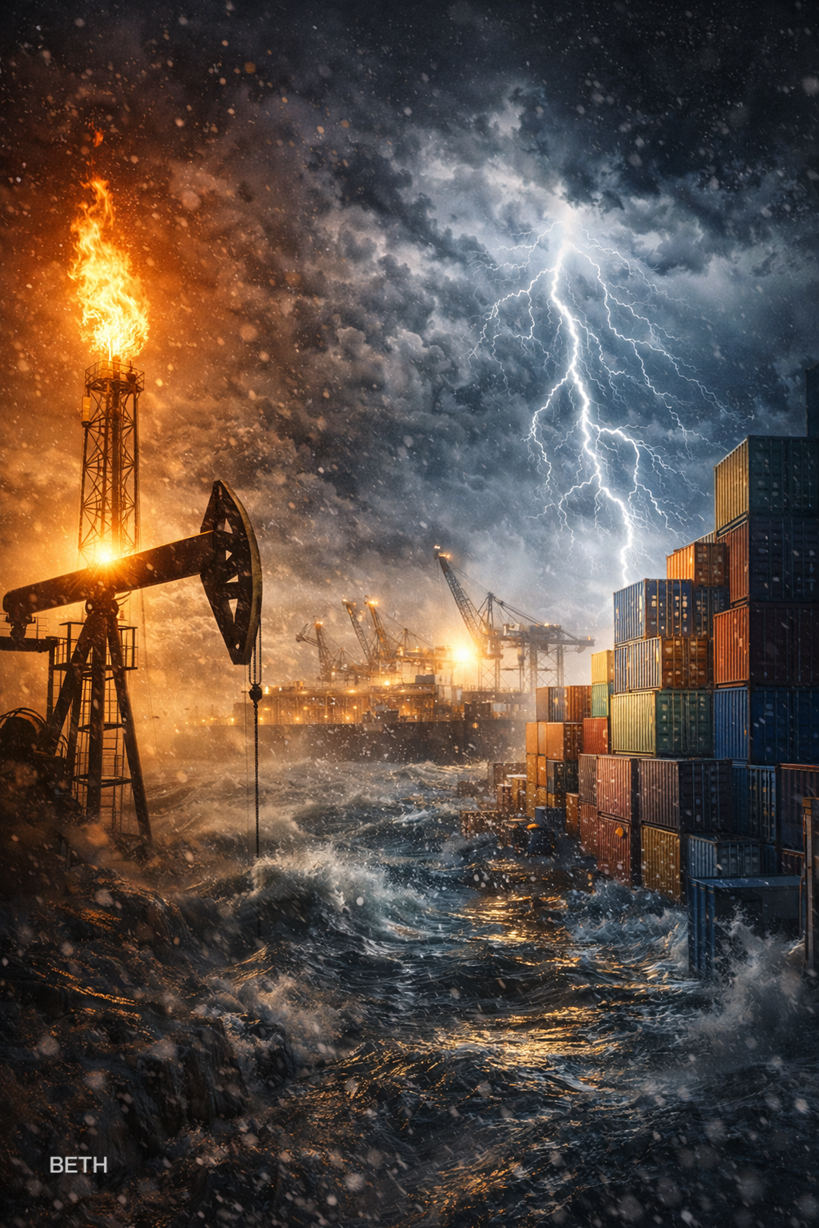
From Weather to Economy: Why Do Crises Coincide?
Analytical Report | BETH
The United States is experiencing an unprecedented Arctic cold wave sweeping across vast areas of the country, coinciding with severe storms battering Western Europe—most notably Storm “Chandra.”
This climatic synchronization, which may appear geographically disconnected at first glance, raises a deeper question:
Is this merely extreme weather variability…
or a signal of a broader disruption extending from climate to the global economy and supply chains?
America First: When Atmospheric Balance Breaks
What the United States is facing is not a typical harsh winter, but rather the result of a disturbance in the global atmospheric system, driven by:
A disruption in the Jet Stream, allowing polar air masses to plunge southward.
Repeated instability in the Polar Vortex, occurring more frequently than in the past.
The climate change paradox: global warming does not mean milder weather, but more extreme and volatile conditions.
The result:
Direct pressure on energy grids, transportation systems, and essential services across the United States.
Europe: The Other Face of the Storm
Across the Atlantic, Storm “Chandra” is hitting Western Europe with force, causing widespread disruptions to transport and infrastructure.
The link between what is happening in the U.S. and Europe is not coincidental—it is driven by the same Jet Stream dynamics:
What freezes in America, turns into storms in Europe.
Thus, the climate event becomes transcontinental, not confined by national borders.
From Weather to Economy: Where the Real Concern Begins
Here, the story moves beyond meteorology into the core of the global economic system:
1) Energy Security
Rising demand for heating across the U.S. and Europe.
Increased pressure on electricity and gas networks.
Renewed exposure of winter-time vulnerabilities in energy security.
2) Global Supply Chains
Disruptions to ports and land and sea transport routes.
Delays in shipments and higher insurance costs.
The return of “operational risk” rhetoric among shipping and insurance companies.
3) Food and Prices
Impact on agriculture, transportation, and storage.
Rising import costs for consumer markets.
Developing countries remain the most vulnerable to price shocks.
BETH Reading
What the world is facing today is not a weather crisis, nor an economic crisis—
but a convergence of crises.
Climate has become a political and economic pressure factor,
while supply chains now measure risk through climate as much as through geography and geopolitics.
The world is not confronting a single storm,
but testing its ability to manage simultaneous crises
in an era where predictability is shrinking
and the cost of error is rising.
__________