


Waldorf Astoria in Diriyah
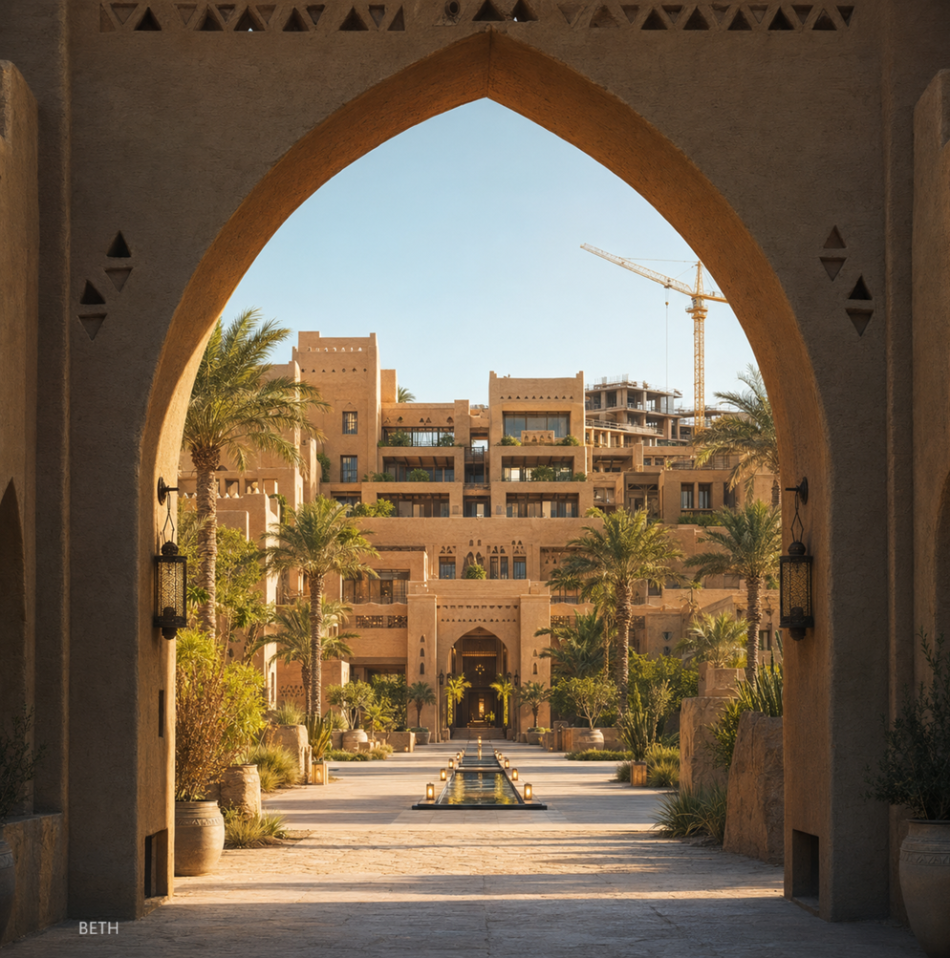
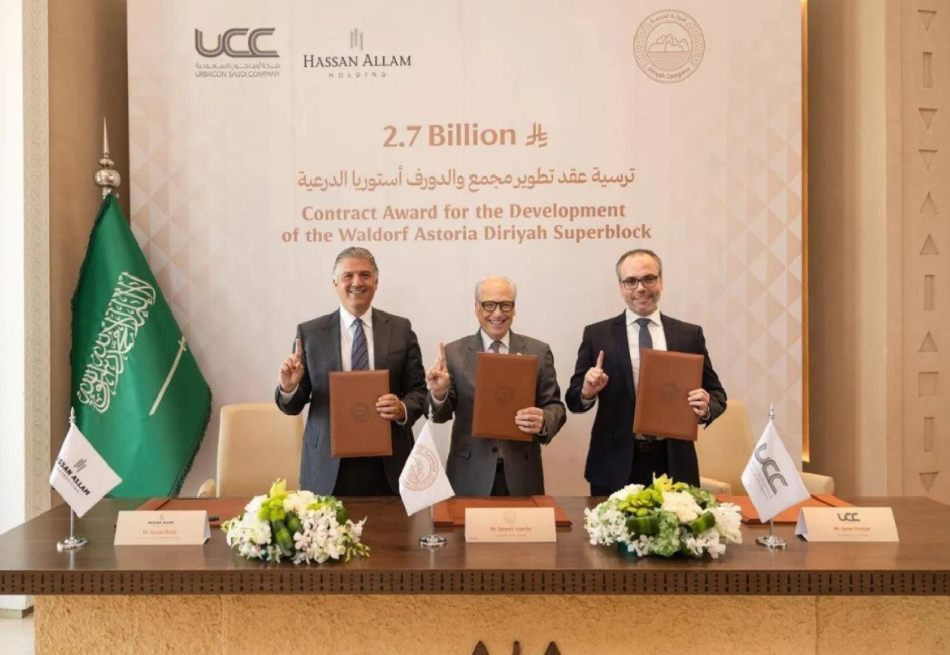
Diriyah Company signs a contract to build a hotel, residential, and commercial complex worth SAR 2.7 billion, with a built-up area of 241,000 square meters
Diriyah | BETH
Diriyah Company has signed a contract to build the Waldorf Astoria hotel and residences, along with the surrounding mixed-use complex, at a value of SAR 2.7 billion, equivalent to approximately $720 million.
The works were awarded to a joint venture comprising Hassan Allam Construction Saudi and UCC Saudi, in the presence of Diriyah Company Group CEO Jerry Inzerillo, Hassan Allam Holding Chairman and CEO Hassan Allam, and UCC Holding CEO Samer Ibrahim.
The project will extend across an estimated built-up area of 241,000 square meters within Diriyah Gate 2. It is not limited to the construction of a hotel, but includes an integrated complex combining hospitality, residences, business, and commerce.
The Project in Numbers
SAR 2.7 billion: value of the construction contract.
241,000 square meters: total built-up area.
200 hotel rooms and suites under the Waldorf Astoria brand.
47 residential units carrying the hotel brand.
2028: expected opening date, according to an earlier announcement by Hilton.
The contract also covers:
Commercial and administrative buildings.
An integrated basement serving the project’s components.
Public spaces and landscaping works.
Infrastructure networks, utilities, and services associated with the complex.
Waldorf Astoria, Hilton’s luxury hospitality brand, will operate the hotel, which will be located amid the upscale restaurants, retail outlets, residences, galleries, and museums planned for development in Diriyah.
More Than a Hotel Contract
The number of rooms may suggest that the contract is expensive if its value is divided by 200 rooms, but such a comparison would be inaccurate because the SAR 2.7 billion does not cover the hotel building alone.
The contract covers a large mixed-use complex comprising the hotel, branded residences, offices, commercial facilities, the basement, public spaces, and infrastructure.
Diriyah Company is therefore not merely acquiring hotel capacity. It is creating a small integrated district combining permanent and temporary accommodation, work, shopping, and services.
Why Waldorf Astoria?
The brand belongs to Hilton’s highest luxury hospitality category, and its presence gives Diriyah greater capacity to attract high-spending visitors, official and executive delegations, conferences, and international events.
The global brand will also place the hotel within an international booking and marketing network, rather than leaving it dependent solely on domestic demand.
But the value does not stop with the operator’s name.
The project will be measured by its ability to combine Waldorf Astoria’s global standards with Diriyah’s Najdi identity, ensuring that the hotel experience cannot be replicated in any other city.
Branded Residences
The 47 residential units represent an economically important component of the project.
Hotel-branded residences are usually sold at a higher value than conventional units in return for their design, services, maintenance, management, access to hotel facilities, and the brand’s reputation.
This model achieves several objectives:
Transforming part of the project into an asset available for sale and investment.
Creating long-term residential demand alongside the hotel.
Providing additional revenue that does not depend solely on room occupancy.
And increasing the property value of the complex and its surrounding area.
Waldorf Astoria will therefore operate here as both a hotel manager and a real estate brand.
Within a City Taking Shape
The complex forms part of the wider Diriyah development, whose budget exceeds SAR 236 billion and which includes more than 566,000 square meters of retail space, over 28 hotels, and 18,000 residential units, according to Diriyah Company data. Master Plan
These figures mean that the hotel will not operate as an isolated destination, but within an integrated ecosystem comprising the historic At-Turaif District, Wadi Hanifah, museums, restaurants, shops, offices, residences, and cultural events.
This integration is economically important because the hotel’s success depends on what visitors do outside their rooms, just as shops, restaurants, and museums depend on their ability to stay longer and spend within the destination.
Economic Impact
A contract of this size creates direct demand for construction materials, engineering services, contractors, suppliers, transportation, and equipment.
After operations begin, the impact will extend to jobs in hospitality, culinary arts, facilities management, marketing, security, transportation, retail, and events.
But the local value will depend on three indicators:
The proportion of contracts and procurement awarded to Saudi companies.
The number of Saudi professionals moving into advanced managerial and operational positions.
And the project’s ability to incorporate local products, designs, food, and services into the hotel experience.
If most materials, expertise, and services are imported, a large portion of the contract’s value will remain outside the domestic economy. But if the works are transformed into knowledge, suppliers, and Saudi jobs, the project will become part of building a hospitality industry, rather than merely a luxury real estate asset.
BETH Analysis | Luxury Serving the Place
The project’s components reveal that Diriyah is not building hotels merely to provide beds.
It is using luxury hospitality to extend visitors’ stays, increase their spending, market residences, stimulate restaurants and retail, and raise the value of the entire area.
The project combines three sources of revenue:
Hotel revenue.
Sales or returns from branded residences.
And income generated by offices and commercial spaces.
This diversity reduces the complex’s dependence on room occupancy alone and makes each component supportive of the others.
But the most difficult test is not merely engineering or financial.
Waldorf Astoria is a global brand, while Diriyah is a place that cannot be replicated.
The project’s success will depend on using the brand to serve Diriyah’s identity rather than allowing it to overshadow it, so that guests enter a hotel built to global standards without forgetting for a moment that they are staying in the heart of Saudi history.
The true value is not that a luxury brand is coming to Diriyah.
It is that Diriyah gives the brand an experience it cannot offer anywhere else.