

How Did the Arabian Gulf Become a Global Necessity?
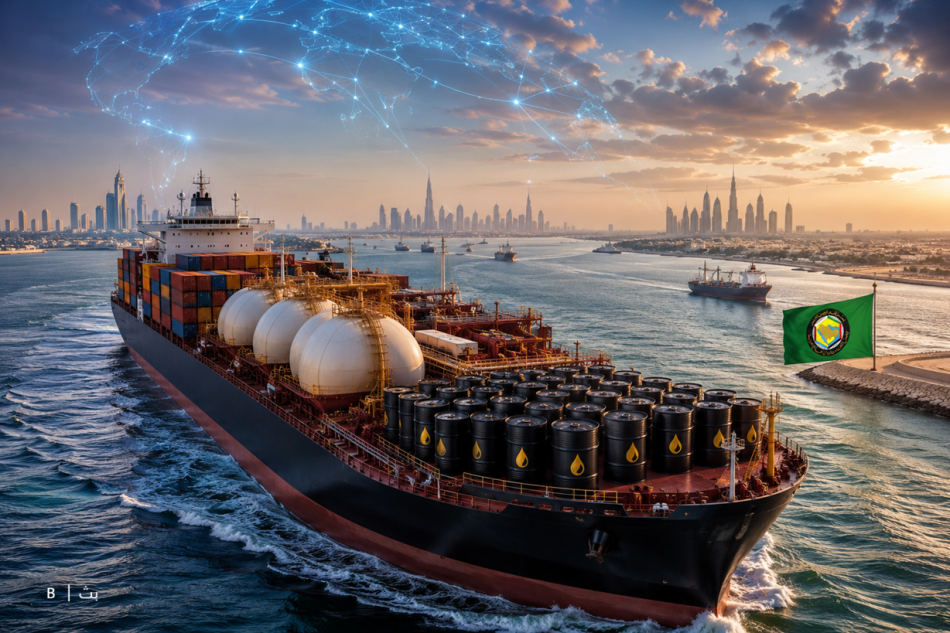
What Did the World Reveal About Itself During the War?
Prepared and Analyzed by | Strategic Media Department – BETH | B
Amid a confused world,
caught between war and non-war,
between threats and de-escalation,
between negotiations and escalation,
a different question emerged:
Are the Gulf states merely oil wells and barrels of fuel?
Or did the world discover too late that they have become part of the balance of life itself?
What Did the War Reveal?
The recent war did not only reveal the power of armies.
It revealed the fragility of the world itself.
Despite all the talk about:
artificial intelligence,
technology,
the digital economy,
and military dominance,
the world still trembles before:
a maritime strait,
a threat to a tanker,
or a disruption in energy flows.
And here, the Gulf appeared in a completely different light.
Not merely as a source of energy,
but as a region that:
holds the rhythm of the global economy,
influences markets,
prevents total explosion,
and tries to keep the world standing amid chaos.
Is the Gulf Just Oil?
This question has echoed for decades,
especially in narratives that reduced the region to:
oil,
wealth,
and consumption.
But recent crises revealed something far deeper.
Today, the Gulf is no longer merely energy reserves.
It has become:
a maritime crossroads,
a center of financial stability,
a political balancing point,
a diplomatic player,
and a space trying to keep the world’s routes open.
The world no longer fears only a shortage of oil.
It fears:
the loss of Gulf stability itself.
The World Is Changing .. Yet It Still Needs the Gulf
Ironically, the world speaks daily about:
green transition,
alternative energy,
and a post-oil future.
Yet in moments of danger,
it quickly returns to the Gulf.
Why?
Because the world discovered that the issue is not merely:
who owns the oil.
But rather:
who possesses the ability to protect stability during crises?
And here, the Gulf’s modern value emerges.
Stability is no longer a local matter.
It has become a global strategic asset.
The Gulf Between Escalation and Balance
At the height of escalation,
the region faced a difficult test:
How can it preserve:
energy flows,
maritime movement,
market calm,
and political balance,
while the world moves along the edge of explosion?
And here appeared one of the Gulf’s greatest strengths:
the calm mind.
The region did not transform into a platform for chaos.
Instead, it attempted to play the role of:
containment,
de-escalation,
and balance management,
despite the intensity of the pressure.
Why Does the World Fear Gulf Instability?
Because the Gulf is no longer merely a regional file.
Any major instability there could mean:
a global surge in energy prices,
supply chain disruption,
market turbulence,
international maritime tension,
and economic pressure extending across the entire world.
That is why protecting Gulf stability has become directly linked to the stability of the global economy itself.
What Changed?
In the past,
many viewed the Gulf simply as a wealthy region.
Today, however,
the world increasingly sees it as a region of:
stability,
liquidity,
energy,
trade routes,
investments,
and balanced relations between East and West.
This transformation was not created by war alone,
but by years of:
reconstruction,
economic development,
expanding international relations,
and building a different image of the region.
Conclusion
What the recent war revealed was not only the importance of oil,
but the importance of stability itself.
The world discovered that the Gulf is not merely a production zone,
but part of the equation of global balance.
And in an age of:
prolonged wars,
disturbed economies,
and shifting alliances,
real power may no longer lie only in possessing weapons,
but in the ability to:
prevent collapse,
protect stability,
and keep the world standing amid chaos.
And here,
perhaps the most important question imposed by the war upon the world is:
Was the Gulf merely oil…
or did the world fail to understand its true value until the ground began shaking around it?