



Day 40: A Ceasefire on the Edge
Coverage & Analysis | BETH
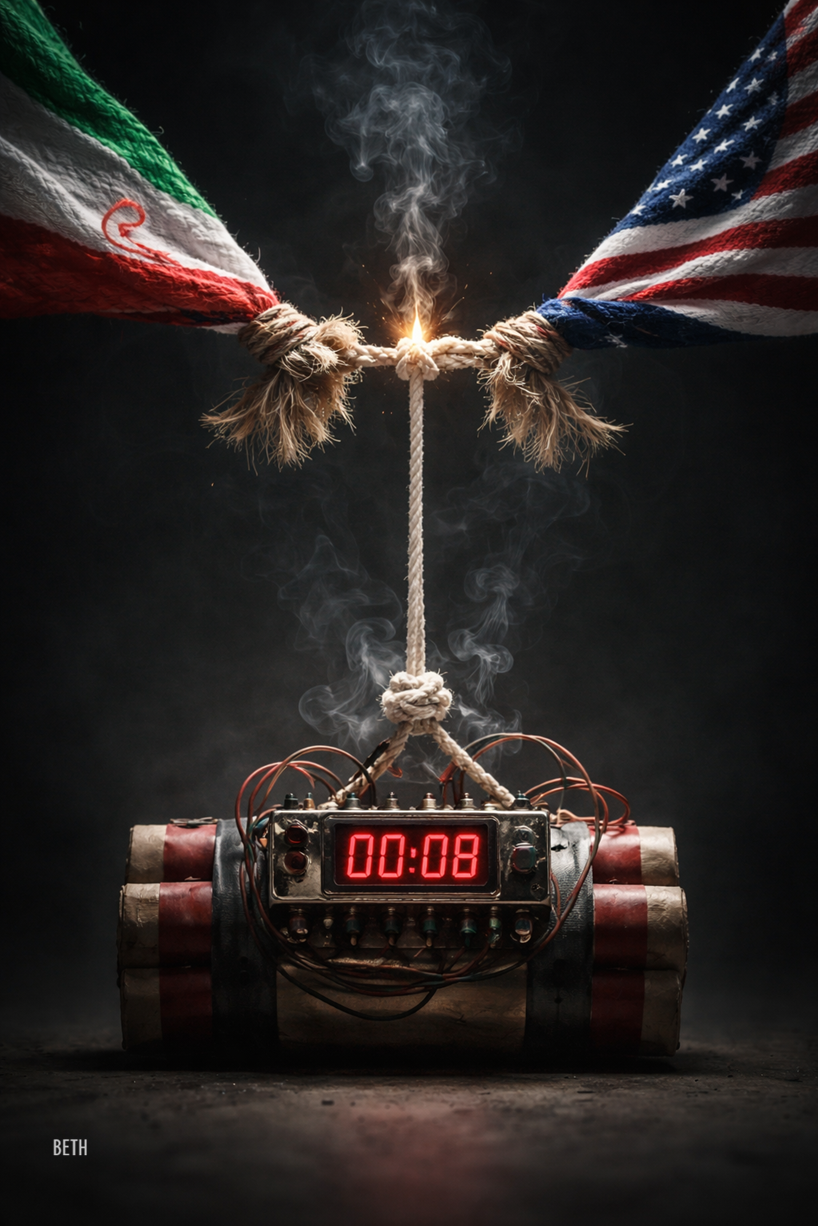
After just one day of announcing a temporary ceasefire between the United States and Iran, escalation has returned to the forefront—not through missiles, but through heavy words.
A truce described from its very first moment as “fragile” now appears closer to a tactical pause, nothing more.
U.S. President Donald Trump renewed his threats toward Tehran, affirming that his country would return to war “bigger and stronger” if the two-week ceasefire agreement—announced through mediation by Pakistan—is not upheld.
He indicated that U.S. forces, across all naval and air formations, will remain in their positions around Iran, sending a clear message that the current calm does not mean withdrawal or reduced pressure, but rather repositioning and preparation.
He also emphasized two main conditions for any agreement:
Preventing Iran from obtaining nuclear weapons, and ensuring that the Strait of Hormuz remains open and secure for international navigation.
On the ground, tensions escalated with Iranian threats to resume operations, particularly following intense Israeli strikes in Lebanon that resulted in more than 250 fatalities, prompting Hezbollah to respond by shelling northern Israel.
In a concerning development, the naval arm of the Revolutionary Guard hinted at the possible presence of mines along the traditional shipping route in the Strait of Hormuz, directing vessels toward alternative paths, amid reports that no oil or gas tankers have passed through the strait since the ceasefire began.
On the political track, Islamabad is preparing to host direct negotiations between the two sides, with the U.S. delegation led by Vice President JD Vance, facing a high-level Iranian delegation, in an attempt to turn the temporary truce into a permanent agreement.
However, a state of “narrative chaos” has intensified following the leak of draft negotiation proposals, which Trump described as “completely fake,” while Vance indicated that some were “written by artificial intelligence,” revealing the depth of the parallel information war.
BETH Analysis
What is happening is not a ceasefire… but a test of intentions under arms.
The United States is not stopping the war, but rearranging it.
Iran does not accept calm, except on terms that expand its scope.
As for Lebanon… it has become a potential breaking point for an agreement that was never fully formed.
Conclusion:
The current truce does not mean peace…
It means that all sides are preparing for a round that may be shorter—and more intense.
Possible Talks with Lebanon
Israeli Prime Minister Benjamin Netanyahu announced that he has instructed the start of direct negotiations with Lebanon, in a move that reflects a parallel political track alongside the ongoing military escalation on the Lebanese front.
Netanyahu stated that the negotiations will begin “as soon as possible,” noting that they will focus on disarming Hezbollah and establishing peaceful relations between Israel and Lebanon.
This move comes following phone calls he held with U.S. President Donald Trump and his envoy Steve Witkoff, amid reports that Washington urged de-escalation in Lebanon and the opening of a negotiation track.
According to initial information, the negotiations are expected to start next week at the US Department of State, with participation from all three sides. The U.S. delegation will be led by its ambassador to Lebanon, Israel will be represented by its ambassador in Washington, and Lebanon will participate through its ambassador to the United States.
Meanwhile, an Israeli official confirmed that there is currently no ceasefire in Lebanon, despite Lebanese calls for a temporary truce to enable negotiations.
BETH Analysis
The Israeli move toward negotiations should not be read as a sudden shift,
but as part of a dual-track strategy: continued military pressure alongside a conditional political path.
Notably, the negotiations are being proposed without a ceasefire, indicating that diplomacy here is not a substitute for escalation, but a parallel tool.
Between escalation and negotiation,
a new path is taking shape—
one that does not seek immediate calm,
but aims to redefine the rules of engagement.
The region is closely watching the anticipated U.S.–Iran talks in Pakistan, which represent a critical test of the parties’ willingness to move from conflict management to conflict containment amid a fragile ceasefire. Pakistan’s selection as the venue reflects its balanced relations with both sides and its potential role as a mediator. The United States aims to curb Iran’s nuclear ambitions, ensure freedom of navigation, and stabilize global energy markets, while Iran seeks relief from political and economic pressures, recognition of its regional role, and security guarantees. Possible outcomes range from temporary de-escalation to a phased agreement or a breakdown of negotiations. Although the talks may help reduce tensions, they are unlikely to mark the end of the conflict, instead serving as a step toward redefining the rules of engagement in the region - Details