



Trump’s Speech: The Tone of Ending .. and Preparing the Strike
Riyadh | BETH
14 Shawwal 1447H | April 2, 2026
Prepared & Analyzed by | Strategic Media Department – BETH News Agency
Supervised by: Abdullah Al-Omairah
Introduction
Today’s speech by U.S. President Donald Trump did not present a radical shift in the course of the war, but rather a calculated development in how it is being delivered.
The overall substance remained within the same framework: pressure, threats, and repeated assertions that the end is approaching, while keeping the door open for further escalation.
What was truly new was not the message itself, but the tone of its delivery, and the subtle signals conveyed through performance, language, and body expression.
Coverage
Trump confirmed that the United States is very close to completing the “mission” in Iran, suggesting that resolution could come within two to three weeks, and stating that “the hardest part of the war” is already over.
He described U.S. operations over the past weeks as a “major victory,” pointing to the extensive destruction of Iran’s military capabilities, including missile launch platforms and drones, as well as a significant weakening of its naval capacity, while affirming that the United States will not allow harm to reach countries in the region.
At the same time, Trump maintained a high level of deterrent rhetoric, signaling the possibility of targeting Iran’s energy and oil sectors if necessary, without committing to a clear or final timeline for ending the war.
While he spoke of an approaching end, the battlefield told a different story:
new Iranian missile launches toward Israel, continued escalation along the Lebanese front, and Iranian threats of “overwhelming” retaliation, alongside regional efforts aimed at de-escalation and facilitating communication.
This parallel between the “approaching end” narrative and the reality of “ongoing fire” remains the key to understanding today’s speech.
BETH Analysis
First: Did the speech bring anything new?
Yes… but not in a fundamental sense.
The speech did not introduce a completely different message, yet it was not a mechanical repetition either.
Trump presented an upgraded version of his previous rhetoric:
the same structure, but with a calmer tone, and a stronger focus on reinforcing the image of resolution rather than merely threatening it.
In more precise terms:
the speech was not entirely surprising… but neither was it a raw repetition.
It was a calculated evolution within the same trajectory.
Second: Apparent contradiction… or deliberate strategy?
On the surface, a clear contradiction appeared:
talk of an approaching end,
alongside threats of escalation,
and the absence of a defined or binding timeline.
Yet this contradiction does not seem like confusion, but rather part of the architecture of the speech itself.
Trump was sending multiple messages simultaneously:
- To the American public: the war is under control
- To Iran: stronger options remain on the table
- To allies: Washington still holds the reins
- To markets: concern is understandable… but the end is not far
This type of messaging does not explain reality as much as it reframes it psychologically.
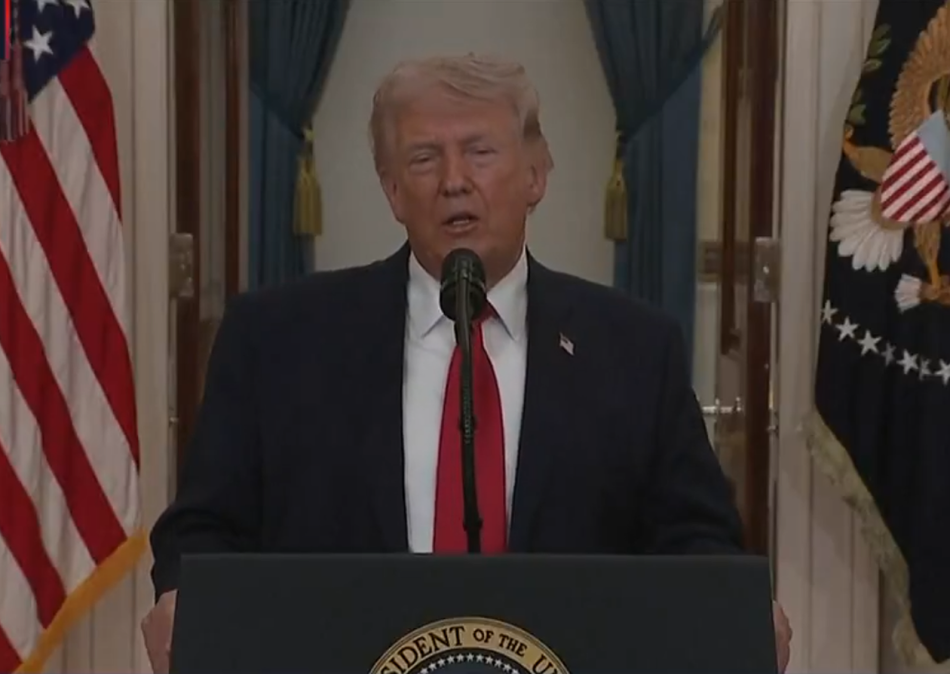
Third: Trump’s psychological presence during the speech
Notably, Trump did not appear as the triumphant, energetic speaker, nor as an emotionally charged leader.
Instead, he appeared calmer, slower in delivery, and less expressive in facial dynamics.
His tone was relatively subdued, his body movement limited, and his facial expression somewhat pale, suggesting that this was not a celebratory speech, but rather one of managing a heavy burden.
While no single explanation can be confirmed, several analytical interpretations emerge:
1. Deliberate emotional control
Trump may have intentionally maintained composure—not out of comfort, but out of awareness that excessive emotion could be interpreted as tension or loss of control.
2. Political and psychological fatigue
Repeating major statements such as “we are close to the end” and “we achieved a major victory,” while the war continues, can place visible internal pressure on the speaker.
3. Controlled emotional suppression
He may have been concealing internal frustration—whether from the complexity of the war, the pace of outcomes, or the contradiction between battlefield reality and political messaging.
4. Preparation for something larger
Another possibility cannot be ignored:
that this restrained performance is part of a strategy to conceal intent.
In this case, reduced emotional expression becomes not emptiness… but a calculated veil.
Fourth: Body language… what was said without words?
The body language reflected three key characteristics:
- Economy of movement: no excess gestures, no visible agitation
- Neutral facial expression: less vivid than usual, more reserved
- Measured delivery: each sentence appeared carefully controlled
This pattern is typically used when indirect messages are being sent, such as:
- I am not acting impulsively
- I am not revealing everything I know
- What comes next may be greater than what is said
- Calmness here is not retreat… but control
Fifth: What impact does this speech have on the war?
In immediate terms, the speech did not end the war, nor did it clearly open the door to peace.
However, it served a critical function:
reinforcing the perception that the end is near—even if its final contours remain undefined.
Such messaging serves three wartime functions:
- Reassuring a concerned domestic audience
- Maintaining psychological pressure on the opponent
- Preserving strategic and political maneuverability
Yet its risk lies in repetition:
if not followed by tangible outcomes, it may gradually lose its persuasive power.
What BETH anticipated—and what was confirmed
In yesterday’s report:
“Trump’s Anticipated Speech: Timing or Message?”
BETH concluded that the speech would not be purely repetitive, yet not entirely surprising either, and that it would come as an upgraded escalation—recycling previous messages with stronger framing to suggest that the end is approaching.
This is precisely what materialized.
Trump did not announce the end of the war, nor introduce a radical shift.
Instead, he re-presented the same core message in a more structured and controlled form:
Pressure continues,
Resolution is near,
And the end will be shaped on American terms.
BETH also anticipated that the speech would leave the door open for negotiation without appearing weak, while reinforcing the image of control—both of which were clearly evident.
This confirms the value of anticipatory analysis:
the speech was not surprising to those who read its trajectory…
but rather a consolidation of what had already been forming.
BETH Conclusion
Trump today was neither a triumphant orator…
nor a retreating leader.
He occupied a more complex middle ground:
a man seeking to project control,
without revealing all intentions,
repeating the language of resolution,
while knowing that resolution is not yet complete.
His calmness was not necessarily comfort,
his slowness not necessarily weakness,
and his subdued expression not necessarily fatigue.
It may all reflect a moment of pressure…
or a deliberate decision to conceal what lies beyond the words.
Today’s speech was not the end of the war…
but an attempt to control the shape of its ending.