



Saudi Cabinet Condemns Iranian Attacks… Declares 2026 the Year of Artificial Intelligence
Jeddah | BETH – March 10, 2026
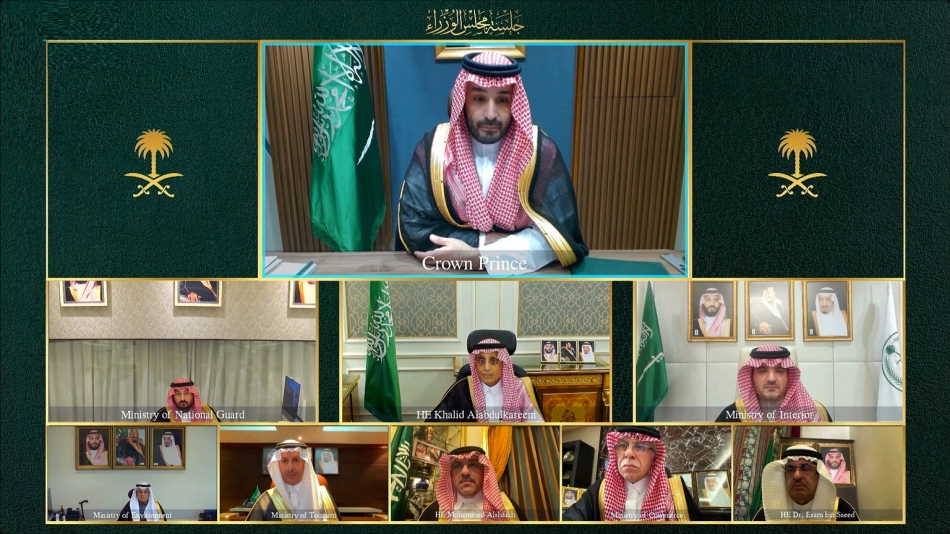
The Saudi Council of Ministers held its session today – via video conference – chaired by His Royal Highness Prince Mohammed bin Salman bin Abdulaziz Al Saud, Crown Prince and Prime Minister.
At the beginning of the session, the Crown Prince briefed the Cabinet on the content of the telephone calls he held in recent days with leaders of a number of brotherly and friendly countries, within the framework of ongoing consultations regarding developments in the region and their implications for regional and international security and stability.
Condemnation of Iranian Attacks
The Council of Ministers strongly condemned the criminal Iranian attacks targeting the Kingdom of Saudi Arabia, the Gulf Cooperation Council states, and a number of Arab, Islamic, and friendly countries.
The Council affirmed that these attacks represent persistence in threatening security and stability and a blatant violation of international charters and international law, through targeting civilian facilities, airports, and oil installations.
The Council stressed that the Kingdom retains its full right to take all necessary measures to protect its security, sovereignty, territorial integrity, and to deter aggression.
The Cabinet also praised the capabilities of Saudi air defenses, which successfully intercepted and destroyed hostile missiles and drones that attempted to target locations and facilities within the Kingdom.
Regional and International Coordination
Minister of Media Salman Al-Dossary, in his statement following the session, explained that the Cabinet reviewed the Kingdom’s continuous role stemming from its approach of supporting solidarity, cooperation, and coordination with its Gulf and Arab surroundings in addressing current regional challenges.
The Council also appreciated what was included in:
the joint ministerial meeting between the Gulf Cooperation Council and the European Union, and
the ministerial meeting of the Arab League Council
which contained statements condemning the Iranian attacks.
Development and Service Reports
The Cabinet reviewed a number of reports related to domestic affairs, praising the recommendations issued by the 33rd annual meeting of the Governors of the Regions, which focused on:
supporting development opportunities
enhancing the capabilities of various sectors
continuing to improve development services
The Council also addressed the state’s continued commitment to strengthening the charitable work system and consolidating the values of giving and solidarity.
The Cabinet commended the success of the sixth National Campaign for Charitable Work, which continues its achievements in recent years.
Saudi Flag Day
The Cabinet noted that the celebration of Saudi Flag Day, which falls tomorrow, Wednesday, March 11, reflects pride in the flag’s symbolism and significance in the history of the Saudi state through foundation, unification, and development, and in what it represents of the Kingdom’s enduring principles and national identity.
Cabinet Decisions
The Cabinet reviewed the items on its agenda, including matters studied with the participation of the Shura Council, as well as the outcomes of:
the Council of Political and Security Affairs
the Council of Economic and Development Affairs
the General Committee of the Council of Ministers
the Experts Authority
The Cabinet concluded the session with several decisions, most notably:
First
Authorizing the Minister of Foreign Affairs – or his deputy – to discuss with the Malaysian side a draft memorandum of understanding on political consultations between the foreign ministries of the two countries and to sign it.
Second
Approving a memorandum of understanding on training between the Ministry of Sport and the Arab Administrative Development Organization.
Third
Approving a memorandum of understanding between the Ministry of Justice and the World Intellectual Property Organization regarding the publication of judicial rulings.
Fourth
Approving two memoranda of understanding for tourism cooperation with:
the Hungarian Tourism Agency
the Ministry of Tourism of the Republic of San Marino
Fifth
Approving a memorandum of understanding between the Saudi Ministry of Economy and Planning and Bahrain’s Ministry of Sustainable Development for cooperation in sustainable development.
Sixth
Approving two agreements to encourage and protect investments between the Kingdom and:
the Syrian Arab Republic
the Oriental Republic of Uruguay
Seventh
Approving a memorandum of understanding between the Saudi Real Estate General Authority and the Real Estate Regulatory Authority in Qatar for cooperation in the real estate sector.
Eighth
Approving the establishment of the Royal Institute for Anthropology and Cultural Studies.
Ninth
Approving the organizational structure of the King Fahd National Library.
Tenth
Approving the Muscat Document on Child Protection Rules during Investigation Procedures in GCC countries, in its binding capacity.
Eleventh
Declaring 2026 the Year of Artificial Intelligence.
Twelfth
Issuing directives regarding several agenda topics, including annual reports of:
Asir Region Development Authority
Human Resources Development Fund
Social Development Bank
Saudi Export-Import Bank
Thirteenth
Approving several promotions within the diplomatic corps and senior government positions, including:
Promotion of Fahd bin Salem Abuthnain to Ambassador
Promotion of Khalil bin Ahmed Admawi to Ambassador
Promotion of several officials to Minister Plenipotentiary
In addition to promotions in the Ministries of Interior, National Guard, Municipalities and Housing, and Finance.
BETH Insight
The Cabinet session reflects three key pillars in Saudi policy at this stage.
First — Security firmness
The clear condemnation of Iranian attacks and the emphasis on the Kingdom’s right to defend itself underline Saudi Arabia’s determination to safeguard its security and regional stability.
Second — Diplomatic engagement
The Crown Prince’s consultations with world leaders and the outcomes of international meetings highlight active Saudi diplomacy aimed at building a unified international stance toward regional escalation.
Third — Future transformation
Declaring 2026 as the Year of Artificial Intelligence reflects the Kingdom’s continued shift toward a knowledge-based and technology-driven economy in line with Vision 2030.
Between security, development, and technological transformation, Saudi Arabia appears to be managing a balance between regional stability and future-oriented transformation.