



Strikes Begin on Iran .. The Gulf Falls Within the Response Zone
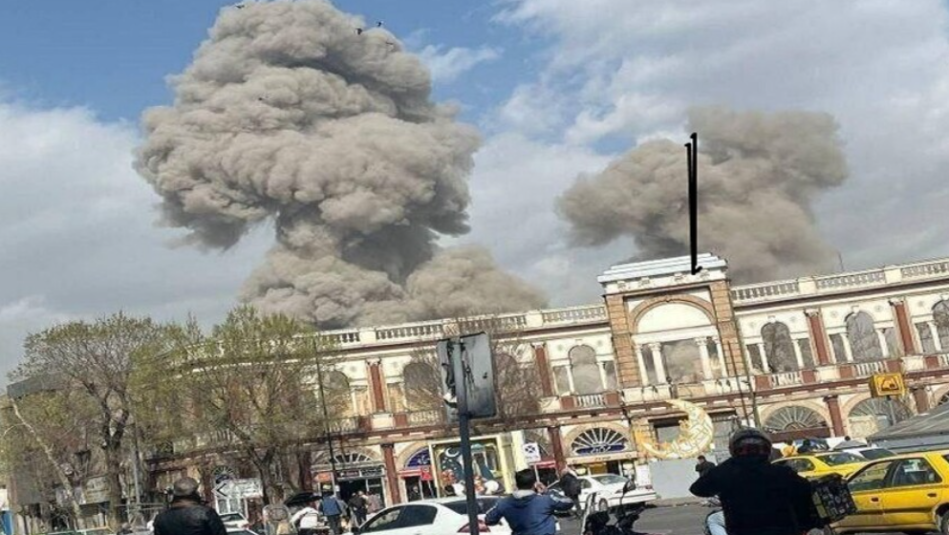
Breaking Analysis | Strategic Media Department – BETH News Agency
Introduction: Escalation Crosses Red Lines
The Middle East is witnessing rapidly accelerating military escalation after confrontation between the United States, Israel, and Iran moved beyond limited strikes into an increasingly regionalized conflict, marked by expanding military operations across multiple fronts within hours.
Following strikes targeting locations inside Iran, Tehran officially announced the start of its military response, confirming via Iranian state television that its forces are targeting U.S. military bases across the region.
Simultaneously, explosions were reported in several Gulf capitals, alongside reports of blasts near sensitive locations inside Tehran, while the Israeli military confirmed that its air force is conducting a series of airstrikes in western Iran.
Iranian Response: Targeting U.S. Interests
In an unprecedented escalation, an Iranian official declared:
“All American interests in the region have become legitimate targets.”
Field reports indicate the launch of missiles and drones toward locations associated with the U.S. military presence, as air defense systems across several Gulf states were activated at high intensity.
This announcement shifts the confrontation from a tactical response into a region-wide targeting doctrine.
The Gulf at the Center of the Equation
Explosions reported in:
Abu Dhabi
Doha
Manama
Kuwait
signal that the conflict has effectively expanded into the Gulf region — one of the world’s most strategically sensitive areas in terms of energy security and international military deployment.
The Gulf is no longer merely observing the crisis; it has become directly embedded within it.
Red Sea Front Enters the Conflict
In a parallel development, the Houthis announced the launch of military operations in the Red Sea, opening a new front threatening:
International shipping lanes,
Global energy supplies,
And commercial maritime security.
This development suggests activation of Iran-aligned regional actors within what analysts describe as a multi-front pressure strategy.
Israel Expands Operations
The Israeli military confirmed ongoing air operations in western Iran aimed at preventing the regrouping of Iranian military capabilities or the launch of additional retaliation waves.
The situation has therefore evolved beyond a strike-and-response cycle into a continuous operational confrontation.
Has a Regional War Begun?
The current landscape reveals three simultaneous realities:
Direct interstate military targeting
U.S. bases entering the operational target list
Opening of maritime and regional fronts
Despite the absence of a formal declaration of war, the region has effectively entered a phase of:
High-Risk Regional Conflict
where even a limited tactical miscalculation could rapidly widen the confrontation.
The Most Dangerous Moment
The primary danger lies not in the initial strikes, but in the convergence of escalation tracks:
Iran striking to establish deterrence,
Israel striking to contain escalation,
The United States preparing to protect its forces,
Regional actors gradually entering the confrontation.
All unfolding simultaneously.
BETH Strategic Reading
What is unfolding represents a transition from crisis management to war management without formal declaration.
All sides appear to be attempting to impose a new deterrence balance while avoiding full-scale war — yet the widening theater of operations significantly reduces control over escalation dynamics.
The Middle East now stands at a critical historical threshold:
Neither peace…
Nor declared war…
But the most dangerous space in between.
Urgent Conclusion
Escalation has moved beyond military signaling.
U.S. bases are now declared targets.
The Gulf has entered the operational sphere.
The Red Sea approaches instability.
The central question is no longer:
Will escalation expand?
But rather:
How many fronts can still be contained before the crisis turns into a full regional war?
Field Developments
▪ Executive Assistant to the Iranian President:
President Masoud Pezeshkian is in good health.
Indication: An internal reassurance message aimed at preventing political instability following the strikes.
▪ Israeli Prime Minister Benjamin Netanyahu:
“The objective is the removal of the Iranian regime.”
Rapid Analysis: A shift in rhetoric from military deterrence toward a long-term strategic political objective.
▪ U.S. Official:
Operations against Iran may continue for several days.
Military Implication: The campaign is no longer a limited strike but an extended operational effort.
▪ Ongoing explosions
reported across Iran, Israel, and several Gulf cities.
Assessment: Simultaneous geographic expansion confirms the transition into a multi-theater confrontation.
▪ Iranian Foreign Minister Abbas Araghchi:
“All U.S. bases in the region are being targeted.”
Analysis: A formal declaration placing the American military presence into an open target framework.
▪ Iranian media outlets:
Violent explosions reported in Tehran and multiple regions following Israeli attacks.
Indication: Continued Israeli air operational reach deep inside Iranian territory.
▪ Israeli Military:
The Air Force is launching a second wave of strikes on Iran.
Operational Reading: Transition from initial strike phase to capability-degradation operations.
▪ Air raid sirens sounding across Israel.
Indicator: Iranian retaliation remains operationally active and not fully contained by defensive systems.
▪ Donald Trump:
“We will wipe out Iran’s naval fleet, its missiles, and its nuclear program.”
Political Analysis: A significant escalation in U.S. objectives toward comprehensive neutralization of Iran’s military capabilities.
Rapid Assessment | BETH
Developments over recent hours reveal three critical realities:
Objectives have become existential rather than tactical.
Military action is evolving into a sustained campaign rather than reciprocal strikes.
The operational geography has expanded from Iran to the Gulf, Israel, and the Red Sea.
Current Classification
This is neither:
a show of force,
nor a limited strike.
Rather, the region is entering:
The early phase of a high-risk, gradually expanding regional conflict.
Immediate Update | Field Situation
▪ Fires reported in Abu Dhabi
Field reports indicate outbreaks of fire at locations inside Abu Dhabi following aerial interception operations.
Analysis: A clear indication that missile engagement effects have reached deep into the Gulf region.
▪ Missile debris falls on Jordanian territory
Jordan announced the interception of two Iranian missiles heading toward its airspace.
Analysis: The widening missile trajectories demonstrate that the confrontation is now crossing the broader regional airspace rather than following limited operational paths.
▪ Bahrain
The National Communication Center confirmed that sites and facilities within the Kingdom’s borders were targeted.
Analysis: Targeting appears to be shifting from military perimeters toward critical infrastructure within states.
▪ Qatar
The Qatari Ministry of Defense announced that air defense systems successfully intercepted several attacks targeting the country’s territory.
Analysis: Regional defense systems are operating at high intensity, confirming sustained waves of attacks rather than a single incident.
▪ Iranian Source
Reports indicate the killing of several Islamic Revolutionary Guard Corps commanders and officials as a result of the strikes.
Analysis: Targeting senior leadership suggests an attempt to disrupt Iran’s operational command structure.
Potential Iranian Leadership Losses
Breaking Update | BETH
Iranian Foreign Minister Abbas Araghchi announced that Iran has lost a number of military commanders following the recent strikes, indicating significant damage affecting senior levels within the country’s military command structure.
Multiple sources reported that:
▪ Iranian Minister of Defense Amir Nasirzadeh
▪ Islamic Revolutionary Guard Corps (IRGC) commander Mohammad Bagheri
are believed to have been killed as a result of Israeli airstrikes targeting locations inside Iran.
Iranian authorities have not yet issued final official confirmation regarding the reported losses, amid ongoing military operations and conflicting field information.
Rapid Analysis | BETH
1. Targeting Command, Not Infrastructure
Reports suggest a shift from striking facilities toward targeting the military decision-making structure itself.
2. Immediate Operational Impact
The loss of senior commanders — if confirmed — could disrupt battlefield decision speed and affect coordination of Iran’s response.
3. Escalation Threshold Rising
Targeting figures of this level represents a qualitative escalation, approaching a strategy aimed at paralyzing leadership rather than merely deterring capabilities.
🔴 BETH Monitoring Continues
Updates will follow as new field developments emerge.