



Saudi Arabia .. A Different Era
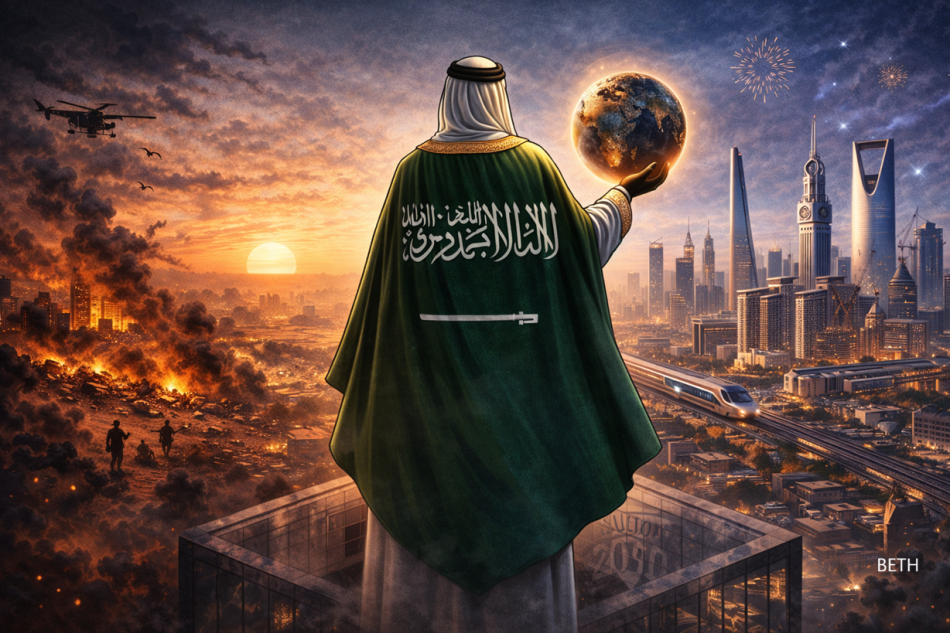
Prepared & Analyzed by | Strategic Media Department – BETH News Agency
Introduction: A Rapidly Changing World… and a Path Taking Shape
As the world enters a phase marked by escalating geopolitical crises, volatile markets, and intensifying power rivalries, many nations appear increasingly preoccupied with managing daily risks rather than shaping the future.
Amid this turbulent landscape, the Kingdom of Saudi Arabia is moving along a different trajectory—
one driven not by reaction, but by the deliberate repositioning of the state within the emerging global order.
What is unfolding in Saudi Arabia is no longer merely an economic reform program, but a gradual transition toward a state model designed for decades ahead, not short political cycles.
Stability… as Strategic Power
In a world where stability itself has become a scarce resource, Saudi stability has evolved from a domestic condition into an element of international strength.
The Kingdom is no longer viewed solely as the world’s largest energy exporter, but as an environment capable of:
absorbing long-term investments,
hosting major global events,
and managing regional balances through calculated restraint.
Here, the traditional concept of power shifts—
power is no longer defined only by military or economic capacity, but by a nation’s ability to maintain direction amid global disorder.
An Energy State… A State of Influence
Saudi transformation extends beyond diversifying income sources to redefining the very concept of energy.
Energy today encompasses:
oil and gas,
renewable energy,
clean hydrogen,
data,
and artificial intelligence.
In this sense, the Kingdom is evolving from a participant in energy markets into an architect of their future, building an interconnected economic, industrial, and technological ecosystem.
Riyadh… A New Decision Hub
In recent years, Riyadh has emerged as a meeting point for complex international files:
political negotiations, economic summits, global investments, and cross-continental cooperation initiatives.
This shift is not diplomatic coincidence, but the outcome of a policy grounded in:
balance rather than alignment,
dialogue rather than escalation,
and shared interests rather than polarization.
As a result, Saudi Arabia is increasingly perceived globally as a trusted mediator rather than a party to conflict.
Growing International Confidence
Major transformations are measured not by statements, but by trust—particularly market and institutional confidence.
International indicators reflect a clear shift in how the world reads Saudi Arabia:
rising foreign investment inflows,
regional headquarters relocating to Riyadh,
expansion of mega-projects,
and accelerating technological and industrial partnerships.
This confidence is not the product of media promotion, but the reflection of policy consistency and strategic continuity.
Transformation as State Policy
What distinguishes the Saudi experience is that transformation is no longer a government initiative—it has become long-term state policy.
Change proceeds at a calibrated pace:
fast enough to keep pace with the future,
yet gradual enough to preserve social and economic balance.
This balance sets the Saudi model apart from reform experiences historically associated with shock or instability.
Analytical Conclusion
At a time when many nations remain focused on crisis management, Saudi Arabia appears engaged in shaping the next phase of the region’s economic and political history.
The central question is no longer:
Where is Saudi Arabia heading?
But rather:
How will Saudi Arabia’s direction reshape the world around it?