



Globalization… the World… and the Worlds When the World Is No Longer One
Analytical Report | BETH
The world is no longer moving within a single economic model, nor according to fixed alliance logic.
What is taking shape today is a comprehensive rewriting of the rules governing trade, industry, supply chains, and even balances of influence.
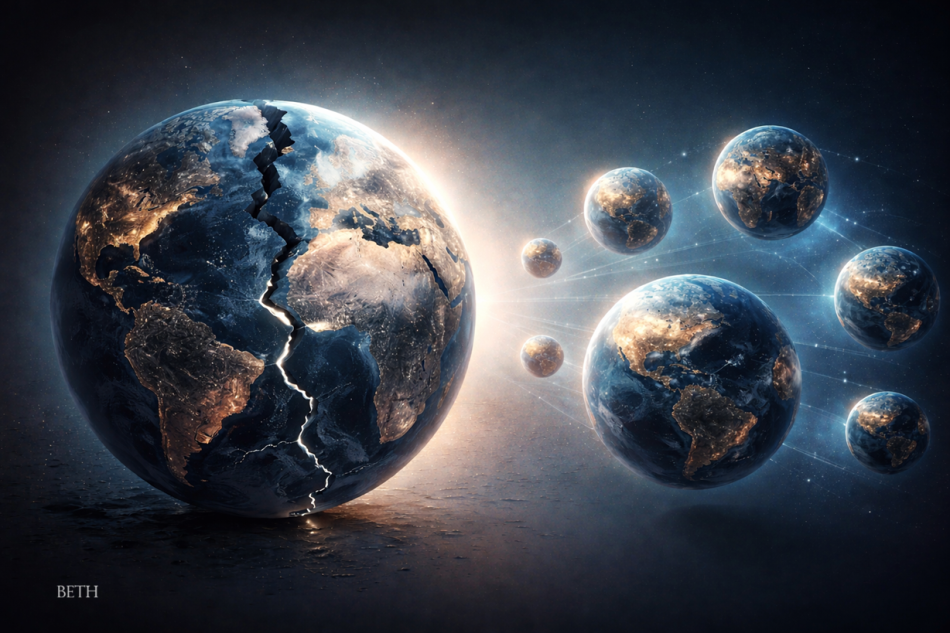
We are not facing a “new globalization,” but rather parallel economic worlds—
worlds governed by sovereignty, risk management, and strategic maneuverability, rather than by market abundance alone.
In this transition, a country’s position is measured not only by what it owns, but by what it understands—and how it manages the moment of change.
Beyond Globalization: Those Who Own Vision, Not Just Capital
The world is entering a “post-globalization” phase without any formal declaration.
Markets are no longer as open as they once were, and trade is no longer governed by neutral rules. Instead, it has become:
a political instrument
an extension of national security
and a testing ground for influence
The countries emerging stronger from this shift are not necessarily the wealthiest, but the clearest in vision—those that know what they want to produce, with whom, for which markets, and under what risks.
In this context, Saudi Arabia stands out as a distinct model:
a diversified economy under construction, not consumption
a geographic position that serves the reengineering of supply chains
an ability to adapt to fragmentation rather than be hostage to it
Today, the world does not reward blind integration—but smart integration.
Artificial Intelligence: From Technology to Sovereignty
The most profound—and most dangerous—shift is no longer purely economic, but one of digital sovereignty.
Artificial intelligence is no longer a question of usage, but of decision ownership:
Who owns the data?
Who controls the chips?
Who develops the models?
And who sets the ethical and operational rules?
Any state that fails to build its digital sovereignty today
will find itself tomorrow consuming influence rather than producing it.
Here, Saudi Arabia faces a historic opportunity—not merely to adopt technology,
but to localize decision-making and build a digital sovereignty ecosystem
that links economy, education, security, and governance within a single trajectory.
Artificial intelligence has become a currency of influence, not just a tool of production.
Peace as Power: Why Mediation Is Advancing Beyond Weapons
In a world exhausted by conflict, the equation of influence has shifted.
Noisy states erode; calm states advance.
Mediation is no longer merely a humanitarian act—it has become a high-impact soft power tool.
Saudi Arabia has quietly built a reservoir of:
political trust
balanced relationships
the ability to bring rivals together without spectacle
At a moment when the cost of war is rising globally,
measured peace becomes influence,
and the trusted mediator becomes an indispensable actor.
Conclusion | Trajectories of the Next Phase
The world is not collapsing—it is being reordered.
And power no longer lies in scale, but in positioning.
Those who possess:
a clear economic vision
coherent digital sovereignty
and a calm, credible political role
will cross this phase with lower cost—and greater influence.
Saudi Arabia is not on the margins of this transformation,
but at its core.
The future will not reward those who merely possess capital,
but those who know how to create meaning, manage change,
and read what is coming—before it is announced.