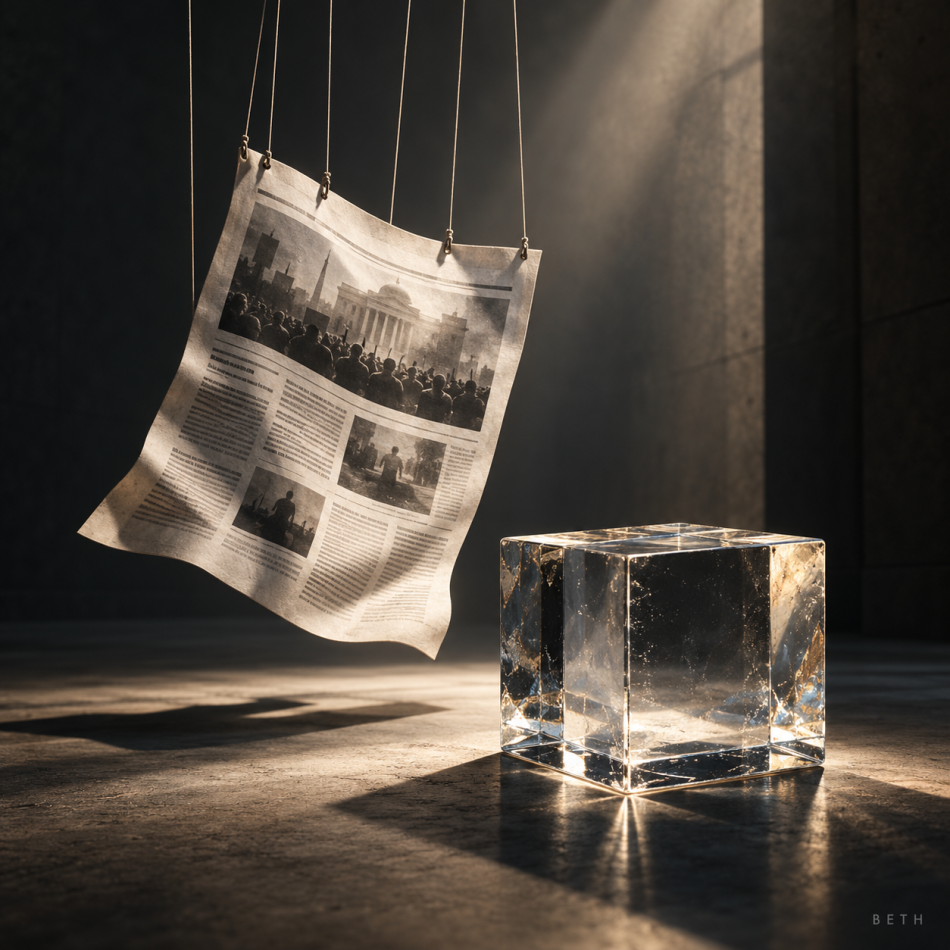



The world is not screaming… it is quietly rearranging itself

Prepared & Analyzed | Strategic Media Department – BETH Agency
Introduction | When nothing seems to happen… everything is happening
In a world accustomed to noise, silence is no longer emptiness—it is a language.
Today, the world does not announce its transformations loudly, nor does it raise alarm banners. Instead, it quietly and deliberately rearranges itself.
Changes pass before us every day without clear names, without breaking headlines, and without ready-made explanations.
And precisely here begins the role of analysis—not in chasing the news, but in reading what lies behind its absence.
This report does not search for what happened, but for what is silently taking shape.
When the world does not scream
(The silent event as a model)
We choose one event that appears ordinary:
A major political or economic development that passes without public outrage, without wide debate, and without sharp polarization.
The question is not: Why didn’t people care?
But rather: What does this indifference mean?
Muted reactions to major news:
Is the audience exhausted by repetition?
Or has it begun to distinguish between what is truly important and what is overused?
The rise of the “stability first” narrative:
Is it a sign of mature awareness after years of turmoil?
Or accumulated fear of the unknown?
Unusual media calm:
Is it deliberate coordination?
Or confusion in reading the scene?
BETH’s perspective:
When the public falls silent, we must not.
We must name what is happening and give it a framework for understanding.
How the world screams… and how it rearranges itself
(Shaping awareness from fleeting phenomena)
The world screams when it wants to apply pressure.
It rearranges itself when it wants to survive.
Political and media noise is not always a sign of strength,
and calm is not always a sign of weakness.
Here, the major questions intersect:
When is silence a tactic?
When is it the prelude to a deeper transformation?
And who has the ability to read the difference?
What we are witnessing is not an absence of events,
but a redistribution of attention, power, and discourse.
Deconstructing silence… not amplifying noise
(Analysis instead of exaggeration)
Instead of asking: What happened?
We ask: Why did it happen now—and why in this way?
Contemporary examples:
A political call or diplomatic move without a long statement
→ What was left unsaid, and why was silence chosen?
Positive economic news without celebration
→ Is it genuine stability that needs no promotion?
Or calm image management without promises?
A decline in escalation in a heated file
→ Is it temporary calm?
Or repositioning in preparation for a different phase?
BETH’s perspective:
The real event is not in the news itself,
but in its timing, its silence, and its boundaries.
Conclusion: Has public awareness truly changed?
The question is no longer: What do people want?
But: How do people think today?
Silent yet decisive axes:
Do people still believe in slogans?
Are elections renewed hope—or a familiar ritual?
Has stability become a value in itself after harsh experiences?
Who leads awareness now: politics, fear, or lived experience?
The most important transformation in 2026 is not only political,
but a shift in how people receive events.
Less emotional…
More cautious…
And more eager to understand than to believe.
Strategic summary
This report does not require breaking news,
is not tied to a specific moment,
and does not chase trends.
Instead, it places BETH in its natural position:
A reference that interprets silence, not a platform that repeats noise.
For in an age of screaming,
those who understand silence
possess awareness.