


Mojtaba Wants to Survive
Is Washington Looking for an Heir to the Regime... or a Way Out of the Crisis?
Prepared and Analyzed by
Strategic Media Department – BETH Agency | B
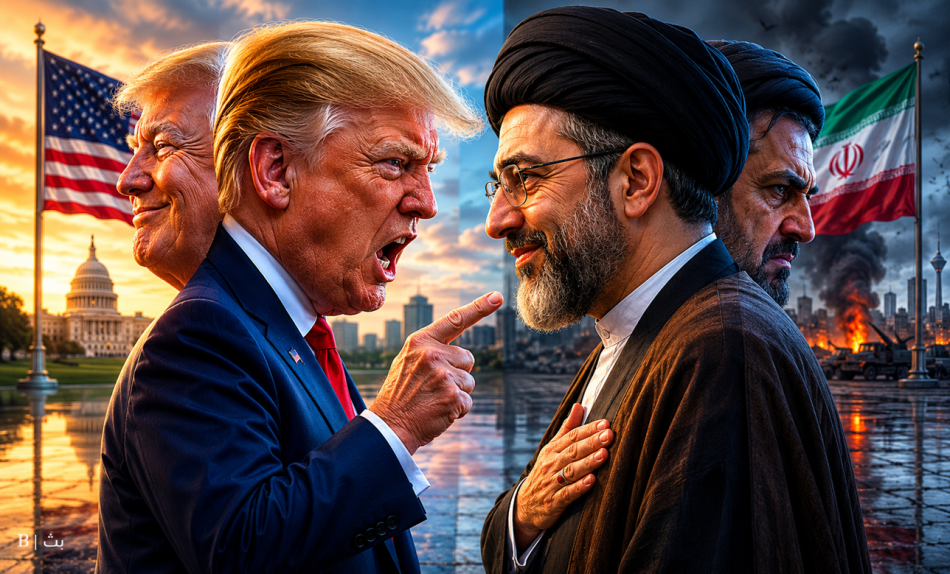
President Donald Trump's remarks about the possibility of meeting Mojtaba Khamenei were not merely a passing comment in the course of negotiations with Iran; they may represent a signal worthy of closer examination.
At a moment shaped by military pressure, economic sanctions, and regional tensions, the discussion surrounding Mojtaba appears to go beyond the individual himself and touch upon a larger question concerning the future of the Iranian regime.
This raises a fundamental question:
Is Washington searching for a new negotiating partner within the regime?
Or is it attempting to anticipate what Iran might look like after the current crisis?
Overview
Trump's statement opens the door to a question larger than the meeting itself:
What does Mojtaba Khamenei actually bring to the table?
He is not an outsider to the regime.
He has not presented a publicly declared reformist project.
Nor does he appear, at least for now, to possess an independent source of popular legitimacy.
His significance stems primarily from his proximity to the ideological and political center of power, and from his position within the environment that has shaped the Iranian system over the past decades.
This creates a clear dilemma:
Can Mojtaba become a figure of compromise?
Or is he merely a new face for an old system seeking survival under different appearances?
Since the Islamic Revolution, Iranian policy has not been built solely around governing a state. It has also been rooted in an ideological project tied to regional influence, networks of allies, and cross-border instruments of power.
Therefore, the real question is not:
Will Trump meet Mojtaba?
But rather:
Can Mojtaba change the very nature of the system from which he emerged?
BETH Analysis
At this stage, Mojtaba Khamenei may appear to be a man seeking political survival before seeking power.
He faces three difficult tests:
First: The domestic challenge, where belonging to the Supreme Leader's family is not enough to establish lasting legitimacy.
Second: The challenge posed by the Islamic Revolutionary Guard Corps (IRGC), which remains one of the most powerful centers of influence within Iran.
Third: The international challenge, where he must convince the outside world that he can offer something beyond a mere continuation of existing policies.
Here lies Iran's deeper dilemma:
Changing faces is not enough if the underlying ideas remain unchanged.
If the revolutionary mindset remains dominant, if regional proxy networks continue to serve as instruments of influence, and if the relationship between ideology, state power, and external confrontation remains intact, then new names alone will not necessarily produce a new direction.
Trump may therefore face two options:
Either to encourage Mojtaba toward a genuine departure from the legacy of prolonged confrontation.
Or to seek a version of the existing system that is simply more willing to negotiate.
Yet the mere emergence of Mojtaba's name at this moment raises another question:
Is Washington seeking an understanding with the current regime?
Or has it begun exploring the shape of a system that may come after it?
Some observers may view Trump's comments as a sign of a significant shift within the Iranian system itself. When attention moves from the Revolutionary Guard and the instruments of hard power toward a figure associated with the regime's ideological legitimacy, it may indicate recognition that the crisis is no longer merely military, but increasingly tied to the future of the regime itself.
In this reading, Mojtaba is not presented as the leader of a new political project, but as a possible face for a phase in which the regime seeks to ease pressure and preserve its continuity, without necessarily abandoning the convictions and tools upon which it has relied for decades.
This raises another recurring question:
Would a future agreement represent a genuine transformation in Iranian behavior?
Or would it merely be a political truce imposed by current circumstances, until conditions change and old policies return through new methods?
History teaches us that regimes do not change simply because they come under pressure.
They change when they reconsider the ideas upon which they were built.
For that reason, any judgment about Iran's future transformation will depend less on what is written in an agreement and more on what happens after it is signed.
Three questions may therefore be more important than the agreement itself:
Will Mojtaba forget what happened to his father?
Will he view an agreement as the end of a conflict, or merely as a pause in a struggle he considers postponed rather than concluded?
And have Western powers truly learned from their previous experiences with Iran, or are they still searching for new solutions within the same framework?
France and America
France hosted Ayatollah Khomeini before his return to Tehran, in one of the defining moments that preceded the birth of a regime that would shape the region for decades.
Yet history has shown that major powers sometimes open doors whose consequences they cannot fully control.
Today, the United States faces a different test.
Does it view Mojtaba as an opportunity to open a new chapter with Iran?
Or is it seeking to reshape the existing system into a form more compatible with Western interests?
The difference is that today's region is no longer the region of 1979.
The balance of power has changed.
Political awareness has grown.
And regional states have become far more capable of defending their interests and refusing to serve as arenas for the conflicts of others.
The Common Thread Between France and America
Many great powers share a common challenge:
They can initiate events.
But they do not always succeed in shaping their final outcomes.
The United States has often entered conflicts with immense capabilities, only to face difficulties managing their long-term consequences.
France has often proven skilled at opening political doors, yet not always at controlling what emerges from them.
In both cases, proxy conflicts have frequently served as instruments of influence.
Today, however, that formula has become increasingly difficult.
Political awareness and the balance of power across the region have changed, and influential states are no longer willing to allow their territories to become testing grounds for the ambitions of others.
This brings us back to a familiar question—one that is now larger and more urgent than ever:
Where do American and Western interests truly lie?
In environments of instability and extremism that generate endless crises?
Or in stability, development, and partnerships that create more sustainable and less costly interests?
Conclusion
Mojtaba Khamenei may seek political survival.
But the more important question is not what Mojtaba wants.
It is what kind of Iran he wants to preserve.
The Iran of the state?
Or the Iran of the revolution?
An Iran that reconciles with its region?
Or one that derives influence from the continuation of crises?
The real challenge facing any future Iranian leadership may not be how to reach power, but how to move beyond the legacy of conflict accumulated over decades.
And if Trump truly intends to meet Mojtaba, the significance of that meeting will not lie in what is said behind closed doors, but in what follows afterward.
The region is no longer waiting for new promises.
It is waiting for a single test:
Can Iran evolve from a state governed by the mindset of revolution into a state governed by the logic of statehood?
Or will the legacy of conflict remain stronger than every attempt at change?
BETH (B Press) – All rights reserved