



When Media Loses Its Voice… and States Gain Meaning
Prepared and Analyzed by the Strategic Media Department | BETH
Supervised by Abdullah Al-Umairah
Introduction: An Unannounced Crisis—Yet Clearly Observed
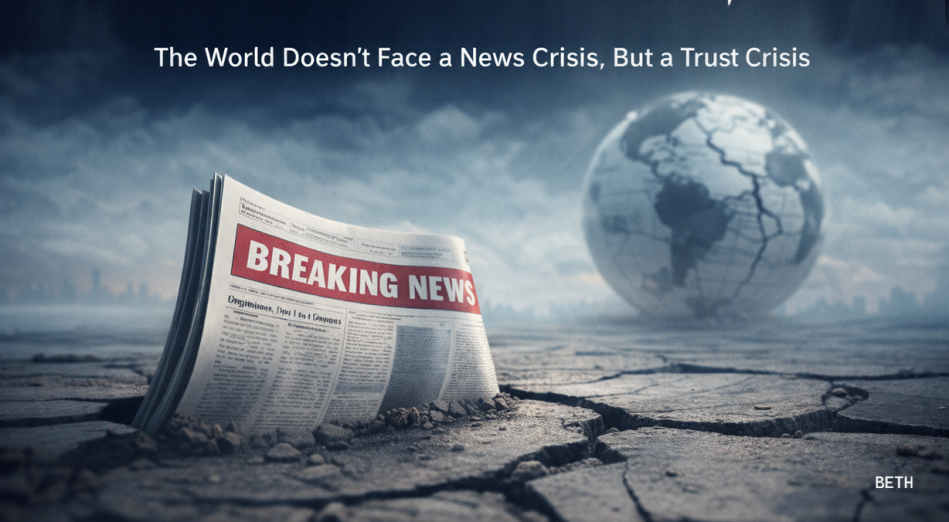
The world is not facing a news crisis,
but a crisis of trust.
The flaw no longer lies in the flow of information,
but in its value, context, and meaning.
At a time when platforms multiply and narratives collide,
audiences have begun—quietly—to withdraw from noisy media,
seeking not a scoop… but understanding.
The Crisis of Trust in Traditional Global Media
Why now?
Because three dynamics converged at a single moment:
Conflicting Narratives
A single event is reported through contradictory headlines and competing angles, stripping news of its explanatory authority.
Audience Fatigue from Sensationalism
Every event is framed as an existential crisis, every development as an impending catastrophe—until the language of media itself lost credibility.
The Rise of Calm, Analytical Content
At the expense of provocative discourse driven by excitement rather than comprehension.
Analytical Reading:
Audiences no longer ask:
What happened?
They now ask:
What does it mean?
Here, traditional media loses its position—
not because it is slow,
but because it is no longer interpretive.
From News to Meaning: A Shift in Global Demand
International audiences—particularly decision-makers, investors, and intellectual elites—are no longer searching for:
The loudest headline
Or the most shocking image
They are looking for:
Coherent context
Unbiased analysis
Meaning they can build upon
This explains the rise of:
In-depth analytical reports
Calm, thoughtful platforms
Media that explains… rather than shouts
The Transformation of Saudi Arabia’s Global Image—Without Promotional Campaigns
At the heart of this media crisis,
a different model has emerged.
What Saudi Arabia did not do:
It did not launch defensive campaigns
It did not flood the space with statements
It did not engage in justification races
What it did do:
Actions accumulated
Numbers persuaded
A clear trajectory required no explanation
Saudi Arabia’s global image was not built through persuasion,
but formed through observation.
Here lies the paradox:
In a world that lost trust in rhetoric,
the state that spoke less—and delivered more—advanced.
The Link Between the Two Crises: When Noise Fades, Meaning Emerges
The crisis of trust in global media opened a rare space:
A space where states are seen as they are,
not as they are presented.
As a result:
Ready-made narratives retreated
Ideological discourse eroded
States that no longer need to defend themselves moved forward
Because defense, in essence,
is a sign of doubt—not strength.
Conclusion | BETH Signature
In a world exhausted by noise,
power no longer lies in raising the voice,
but in the ability to dispense with it.
When a state no longer needs to defend itself,
it has surpassed the phase of persuasion…
and entered the phase of observation.
—
Analysis | BETH
Where news is not retold,
but its meaning is rebuilt.
Image Caption / Visual Explanation
The headline stands on fractured ground—because today’s media crisis lies in trust, not in information.