



Italy Stops: L’Italia si Ferma – Workers Refuse Silence
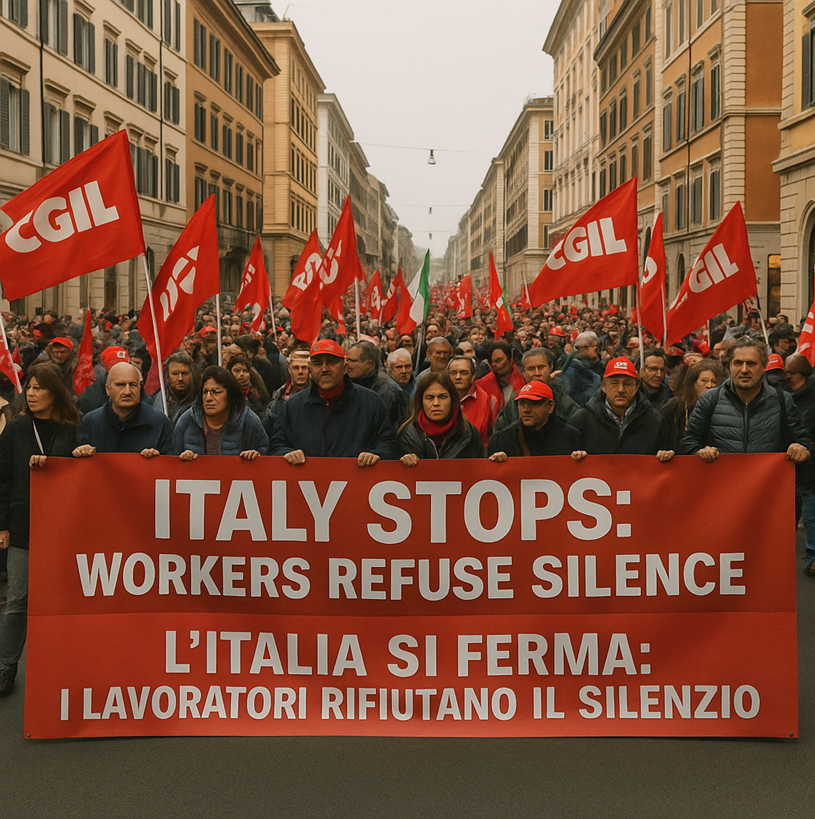
Italy Stops on December 12
When the Working Class Refuses Silence
Special Report – BETH | Rome
On December 12, Italy is preparing for what labor unions call “the day the engines go silent,” as the country’s largest union, CGIL, calls for a nationwide strike against the government’s proposed budget. The strike comes under an unstated but unmistakable message:
“Italy is stopping… because wages have stopped keeping up with life.”
What will happen on December 12?
A general strike covering large sectors of public and private transportation, services, and administration.
Central marches in major cities (Rome, Milan, Turin, Naples…), organized by CGIL and allied unions.
A direct message to the government: the proposed budget
– increases spending on weapons,
– underfunds healthcare and education,
– and ignores the wage crisis facing millions of workers.
CGIL’s Secretary General, Maurizio Landini, summarizes the motives bluntly:
“A worker should not be poor while working… We want higher wages, fair taxation, and investment in health and education—not weapons.”
Beyond wages: a struggle over the model of society
Officially, the dispute is about the “budget law.”
But beneath the headlines lies a deeper question:
What kind of Italy do we want?
Union demands, as outlined in their press statements, can be grouped into four pillars:
• Raising wages and protecting purchasing power
– Linking wages to price increases
– Strengthening collective bargaining
– Fighting “working poverty,” where full-time workers remain below a decent standard of living
• Fair and progressive tax reform
– Reducing the burden on middle- and low-income households
– Strengthening action against tax evasion, which costs the state billions each year
• Prioritizing health and education over military spending
Unions argue the budget favors defense and weapons
at the expense of hospitals, schools, and social protection.
• Defending the European welfare state model
Landini frames the strike as part of a broader fight to protect a social model where citizens are not treated as numbers in a spreadsheet.
Why this strike matters beyond Italy
Italy is a test case for Europe’s right-wing governments
Meloni’s government is being watched across Europe as a model for populist right-wing policymaking.
The strike’s outcome will send a signal about the strength—or limits—of unions in confronting such governments.
A message to Brussels
The budget is not just debated in Rome.
EU fiscal rules on deficit and debt loom in the background.
By striking, CGIL reminds Brussels that:
budget numbers are not everything—there is also a social deficit.
The return of the “working street” after years of quiet
Europe has faced inflation and rising energy prices,
yet major strikes have been scattered.
CGIL’s move may inspire similar actions across the continent.
BETH Analysis – Between Meloni’s Budget and the Ballot Box
The strike comes amid accumulated social tension:
– Protests over labor reforms
– Sharp debates on taxation
– Approaching political deadlines and labor-related referendums
Landini is positioning himself not only as a union leader,
but as a counter-voice to a government narrative that claims “there is no alternative” to cuts in social services and increases in defense spending.
In the background lies a battle for the loyalty of the working class:
Will the populist right continue to speak in the name of “ordinary people”?
Or will unions and the left reclaim this space through wages and tax justice?
BETH Flash
The December 12 strike is not merely the halting of trains and factories.
It is a quiet test of a larger European equation:
Can a government claiming to “defend the people” ignore the voice of the largest organization of working people?
On the day “Italy stops,” many questions will move across Europe and beyond:
about the future of the welfare state,
the limits of austerity,
and who ultimately pays for budgets where the cost of weapons rises… while the cost of living remains unanswered.
🔸
This strike is neither against nor in support of the government; it is part of Italy’s political culture, where the street acts as a parallel voice to Parliament.
It is a reminder that in Italy, dialogue is never complete without the noise of workers — even when the strike is silent.
____________________________________
L’Italia si Ferma il 12 Dicembre
Quando la Classe Lavoratrice rifiuta il Silenzio
Rapporto Speciale – BETH | Roma
Il 12 dicembre l’Italia si prepara a quello che i sindacati definiscono “il giorno in cui i motori si spengono”, mentre il principale sindacato del Paese, la CGIL, indice uno sciopero generale contro la legge di bilancio proposta dal governo Meloni.
Uno sciopero sotto uno slogan non dichiarato ma chiarissimo:
“L’Italia si ferma… perché i salari non riescono più a inseguire la vita.”
Cosa accadrà il 12 dicembre?
– Sciopero generale che coinvolgerà ampi settori dei trasporti, dei servizi, del pubblico e del privato.
– Manifestazioni centrali nelle grandi città (Roma, Milano, Torino, Napoli…) organizzate dalla CGIL e dai sindacati alleati.
– Un messaggio diretto al governo: la manovra
– aumenta la spesa militare,
– riduce i fondi per sanità e istruzione,
– non affronta la crisi salariale.
Il segretario generale della CGIL, Maurizio Landini, riassume così:
“Chi lavora non deve essere povero… Vogliamo salari più alti, una tassazione equa e investimenti in sanità e istruzione, non nelle armi.”
Oltre i salari: una battaglia sul modello di società
Ufficialmente, si discute della “legge di bilancio”.
Ma la vera domanda è più profonda:
Che Italia vogliamo?
Le richieste dei sindacati si raccolgono in quattro assi:
• Aumentare i salari e difendere il potere d’acquisto
– Indicizzare i salari all’inflazione
– Rafforzare i contratti collettivi
– Combattere il “lavoro povero”
• Una riforma fiscale giusta e progressiva
– Alleggerire il carico su ceti medio-bassi
– Contrastare seriamente l’evasione fiscale
• Priorità a sanità e istruzione invece che alle armi
I sindacati denunciano una manovra squilibrata verso la spesa militare.
• Difendere il modello sociale europeo
Per Landini, è una battaglia per difendere uno Stato sociale dove il cittadino non è un numero.
Perché questo sciopero conta anche fuori dall’Italia
L’Italia come laboratorio delle destre europee
Il governo Meloni è osservato in Europa come possibile modello per le destre populiste.
L’esito dello sciopero invierà un segnale sul peso reale dei sindacati.
Un messaggio anche a Bruxelles
La manovra non si discute solo a Roma, ma anche a Bruxelles sotto le regole sul deficit e sul debito.
Lo sciopero ricorda che:
i numeri del bilancio non bastano; esiste anche un deficit sociale.
Il ritorno della “strada del lavoro”
Dopo anni di proteste più contenute, questo sciopero può riaprire la stagione della mobilitazione sindacale in Europa.
Analisi BETH – Tra la manovra Meloni e le urne
Lo sciopero arriva in un clima di tensione sociale:
– precedenti proteste sulle leggi del lavoro,
– discussioni accese sulla fiscalità,
– scadenze politiche e possibili referendum.
Landini appare non solo come un leader sindacale,
ma come la principale voce alternativa a un governo che sostiene che “non ci siano alternative” a tagli e riarmo.
La posta in gioco riguarda la rappresentanza delle classi popolari:
Il populismo di destra continuerà a parlare a nome del “popolo”?
O i sindacati e la sinistra riconquisteranno questo spazio?
Lampo BETH
Lo sciopero del 12 dicembre non è solo il blocco di treni e fabbriche.
È un test silenzioso per una questione europea più ampia:
Può un governo che dice di difendere il popolo ignorare la voce dell’organizzazione più grande del popolo lavoratore?
Nel giorno in cui “l’Italia si ferma”, si muoveranno domande su futuro del welfare, limiti dell’austerità e su chi paga davvero i costi di bilanci dove cresce la spesa militare… mentre il costo della vita resta senza risposta.
🔸
Questo sciopero non è né contro né a favore del governo; è parte della cultura politica italiana, dove la piazza funge da voce parallela al Parlamento.
È un promemoria che in Italia il dialogo non è completo senza il rumore dei lavoratori… anche quando lo sciopero è silenzioso.