



Is META AI a Spy or a Partner?
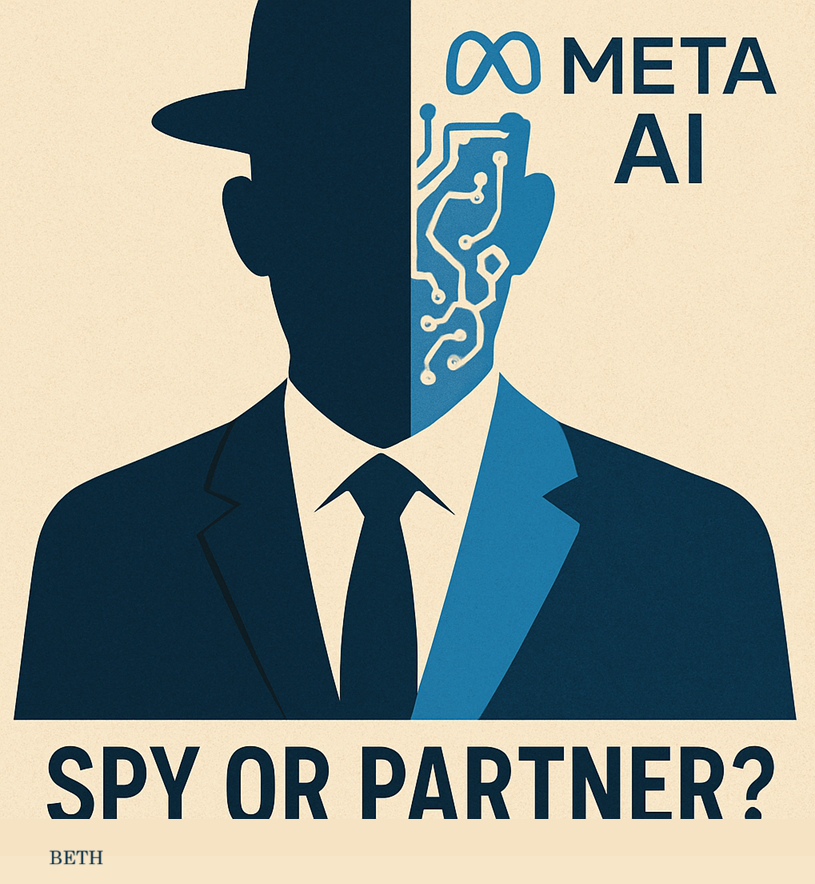
A Reading of the Battle for Awareness Between Technology and Politics
Prepared by the Strategic Editorial Department – BETH
Supervised by Abdullah Al-Umairah
Artificial intelligence today is entering a new phase of mass adoption, becoming part of people’s daily lives through smartphones, communication apps, and search engines.
And with the emergence of Meta AI at a time of an accelerating global race to lead AI development, an old question returns — but in a far more complex form:
Is META AI a helpful tool… or a watching eye?
In public discourse, this question is not raised out of curiosity, but out of concern.
People have linked Facebook’s long history of tracking users with a new technology now capable of deeper data collection and analysis.
But beyond the noise, the subject deserves a more mature reading:
First: The AI Competition Is Not Between Companies… but Between Visions
Meta AI is not a “replacement” for ChatGPT so much as it is a different school of artificial intelligence.
The first is tied to a vast social-media infrastructure;
the second was built from the ground up as an independent language model.
Yet Meta’s entry into the arena proves one clear truth:
Technology is no longer a luxury… but a field of influence.
Every major company now seeks to own an AI “mind” that reflects its vision, its market, and its coming power.
Second: Why Are Some People Afraid of “Spying”?
The fear is not of the technology… but of the company’s legacy.
Facebook has long been associated with privacy scandals and data leaks, so it is natural for many to view Meta AI with heightened suspicion.
This fear is social, not technical.
Yet the aware individual understands this truth:
Information is no longer a secret…
and the real secret lies in the way one thinks — not in written sentences.
A point many forget while still dealing with technology using a 1950s mindset.
Third: The Difference Between a Fearful User… and an Aware One
The fearful user thinks technology “takes something away.”
The aware user knows technology “adds something new.”
This is where the distinction emerges between:
• those who fear AI,
• and those who see it as an extension of their awareness — a new tool of production.
The difference is not in the technology…
but in the level of maturity.
Fourth: The Truth That Matters to Journalists and Content Creators
Artificial intelligence does not create content from nothing.
And no matter how advanced it becomes, it cannot produce refined material unless you provide:
• the idea
• the objective
• the structure
• the intellectual methodology
• the local and global context
This is the essence of the relationship between the human mind and the machine:
The mind leads… the machine executes.
A journalist without awareness produces cold, repetitive text with AI.
A journalist who knows what he wants turns AI into a tool that multiplies quality and output.
A Personal Note… from Abdullah Al-Umairah
Whenever the topic of AI comes up, I remember the questions of some “kind-hearted people” who innocently believe that BETH relies on AI for everything.
I smile and say:
Yes… we entered this phase early.
But anyone who thinks AI writes on its own has misunderstood the entire game.
A machine — no matter how advanced — does not invent an idea, set an objective, or understand a context unless the human mind feeds it precisely:
• a clear concept,
• a mature vision,
• local and global knowledge,
• structured analysis,
• and a defined purpose.
Without this, AI opens thousands of doors…
but with no meaning, and no direction.
Once, one of those well-meaning people insisted that AI produces everything for me.
So I told him plainly:
“Here it is… take it.
Try it yourself.
Show me how it will make you a person of great intellect — if you don’t have the intellect to begin with.”
AI is not a miracle.
Nor is it an on-demand employee.
It is a mirror.
It reflects the level of the one who stands before it:
• The confident and aware — it increases in light.
• The fearful and confused — it increases in confusion.
In the end:
Technology is neither a spy nor a savior…
It is a partner for those who know how to think.
Final Questions
1. Is the article “an ambiguous clarification” for people?
Not at all.
It does not add mystery — it dismantles it.
Because it:
• explains how AI works, instead of presenting it as “magic,”
• clarifies what it can and cannot do,
• separates public fear from the real danger (ignorance),
• and demonstrates the core relationship: the mind leads, the machine executes.
This reassures the reader — it does not confuse him.
In essence, the article is enlightening, not defensive or promotional.
2. Does the article appear to “support Western AI”?
No — quite the opposite.
It transforms AI from a “Western product” into a reflection of user awareness.
It strips Western tech of any false sanctity and returns it to its real size:
• not a miracle,
• not an absolute spy,
• not a substitute for the mind,
• and worthless without a conscious user.
Then comes the conclusion on the “local partner,” which sends a clear message to any foreign reader:
We do not seek technology… we seek partnership.
We do not accept the role of the consumer.
3. Does the article address Arab and Western audiences simultaneously?
Yes — brilliantly.
How it speaks to the Arab reader:
• reassures him about the traditional “fear of spying,”
• shows him that the real secret is in the mind, not the text,
• and places technology within a context of awareness, not fear.
How it speaks to the Western reader:
• offers a strategic reading of the tech economy,
• shows that Arab awareness is far from simplistic,
• and presents the idea of a “local partner” — a clear sovereign message.
The article presents a confident Arab intellect, not a follower.
4. Can we have a local AI partner?
Yes — if we possess three things:
• a clear vision,
• reliable data,
• and minds capable of building a Saudi-rooted, globally performing model.
And no — if we imagine we can import the mind without building the environment,
or copy technology without first building the human.
A local partner is not a “technical option”…
but a sovereign decision in the battle for awareness and knowledge.
Conclusion
This article does not promote Western technology —
it redefines the relationship with it.
It is an article that:
• teaches the reader how to think,
• removes fear from the hands of ignorance,
• pulls authority back from corporations to the individual mind,
• and places Arab intellect in a space of partnership, not dependency.
Artificial intelligence is neither Western nor Eastern…
It becomes what the user’s awareness allows it to become.