


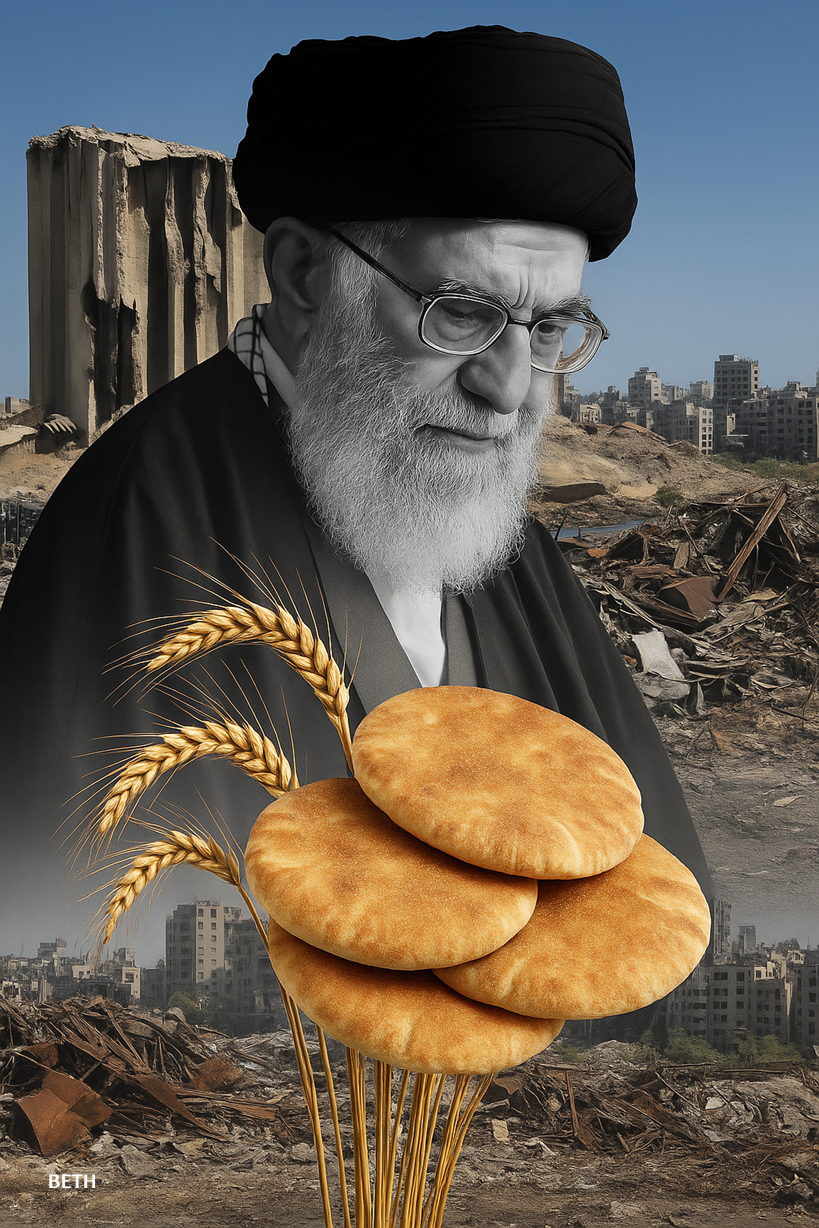
Hezbollah Is More Important Than Bread? A Starving Lebanon… and an Iran Burning from Within
n**
Prepared & Analyzed by: Strategic Media Department – BETH Press
Introduction: A Single Statement Reveals the Whole Project
When Iran’s Supreme Leader declares that “Hezbollah is more important to Lebanon than bread,” he is not delivering a rhetorical flourish. He is openly affirming a hierarchy of priorities: the weapon over the citizen, the militia over the state, and the regional project over the Lebanese people’s right to live with dignity.
This one sentence exposes three fundamental truths:
In the worldview of Iran’s leadership, Lebanon is not a sovereign nation—but a sphere of influence and a bargaining chip.
The suffering of the Lebanese is secondary to the survival of an armed proxy.
The same political mindset that devastated Iran domestically is being replicated in Beirut—as it was in Baghdad, Sana’a, and Gaza.
This statement must be read in light of two parallel realities:
Growing Lebanese and international pressure to restrict Hezbollah’s weapons and challenge its legitimacy.
Escalating internal collapse in Iran driven by corruption, repression, and the systematic destruction of resources—including nature itself.
First: Lebanon Between Bread and the Gun—A State Consumed by Its “Guardian”
Lebanon today faces one of the worst economic collapses in its history: currency implosion, vanishing public services, mass migration, and the disintegration of state institutions.
In this context, the claim that “Hezbollah is more important than bread” sends a shocking message:
Bread is not just food—it represents stability, dignity, and a functioning state.
Hezbollah, empowered by arms and external allegiance, has become a parallel state that overrides institutions, economy, and national interests.
The implicit message is clear:
“Lebanon may starve — as long as the militia survives.”
Meanwhile, a new Lebanese–international momentum is emerging:
Serious debate about the necessity of monopolizing weapons under the state.
Increased foreign pressure to implement UN Resolutions 1559 and 1701 (disarmament of militias).
A new national discourse recognizing that Lebanon’s collapse began when sovereignty was compromised.
This brings Hezbollah’s sponsor into direct confrontation with any political or economic rescue plan.
Second: From Betraying the Iranian People… to Exporting Ruin
To understand the logic of “Hezbollah before bread,” we must return to the roots of the Iranian regime’s domestic structure.
As Prof. Sami Khater explains, the Islamic Republic began with an early betrayal of public trust:
A revolution promised in the name of the people devolved into the Rule of the Jurist—immune to accountability.
The state was transformed into the private estate of a clerical–security elite.
Recent years have seen unprecedented admissions from insiders:
Former MPs and judiciary chiefs admitted that corruption is systemic, not incidental.
IRGC-linked officials exposed parallel financial and security networks operating as internal mafias.
Iran’s Chamber of Commerce leadership acknowledged that IRGC “shadow economy” controls a third of national wealth.
The conclusion shared by many Iranians is blunt:
The regime was not designed for reform, but for silence, plunder, and loyalty.
In this logic, exporting influence—via Hezbollah and others—is not a principled “resistance project,” but an instrument of the same internal corruption:
Funds funneled to external proxies are extracted from Iranian livelihoods.
The IRGC treats these proxies as strategic assets in its geopolitical portfolio.
Third: The Hirkanian Forests Burning—A Natural Metaphor for a Nation Being Consumed
The environmental collapse in Iran mirrors its political decay.
As lawyer Abdulrazzaq Al-Zarzour details, the ancient Hirkanian forests—millions of years old and recognized by UNESCO—are burning year after year.
And it is not an accident.
Government-aligned newspapers admitted that most fires are deliberately ignited to pave the way for land theft.
Investigations revealed illegal construction inside the protected forests under the protection of IRGC-linked networks.
“Development projects” became fronts for clearing forests and selling the land to elites.
These fires symbolize a broader truth:
Nature is a plunder.
Public wealth is a plunder.
The state itself is a plunder.
The exact same mindset that burns Iran’s forests is the one that consumes Lebanon’s sovereignty.
Fourth: What Does the Supreme Leader Really Want From This Statement?
Several messages lie beneath his words:
1. A message of reassurance to Hezbollah’s core
A promise that Iran remains fully committed to preserving the militia’s arsenal—regardless of Lebanon’s collapse.
2. A message of intimidation to Lebanese society
A reminder that any move to separate the state from Hezbollah’s weapons will be met with regional resistance.
3. A message to international actors
An indication that Hezbollah’s fate is not a Lebanese matter alone—but a negotiation card in Iran’s regional strategy.
But reality remains:
No society can live on “symbolic resistance” while starving.
Lebanese people need:
electricity,
a stable currency,
jobs,
and a functioning state.
And Iranians need:
protection of their environment,
preservation of their wealth,
and liberation from a militarized economic model.
Fifth: Where Do the Lebanese and Iranians Stand Today?
Despite oppression, awareness is rising in both countries:
In Lebanon
A growing conviction that the armed militia is at the root of economic collapse.
Efforts—though fragmented—to reclaim sovereignty and reestablish a state monopoly on arms.
In Iran
Repeated protests shattering the regime’s wall of fear.
A rising belief among youth that reform is impossible without structural change.
Recognition that the same system burning the Hirkanian forests is burning Iran’s future.
The central question becomes:
Can a regime built on exporting revolution accept a strong sovereign Lebanese state?
And can a system that burns its own forests refrain from burning neighboring countries?
BETH Summary
The statement “Hezbollah is more important than bread” is not a slip—it is a doctrinal declaration.
A clear definition of priorities:
The militia before the homeland.
The gun before the citizen.
External influence before internal reform.
But history teaches us:
Projects that sacrifice humans for ideology ultimately collapse—while nations survive.
Both Lebanese and Iranians are approaching that moment of realization:
The weapon cannot feed a nation.
Fire cannot build a future.
And no project survives long when it stands against the basic human truth:
The citizen comes before the militia.
The homeland before the proxy.