



Saudi–U.S. Relations: From “Quincy 1945” to “Washington 2025”
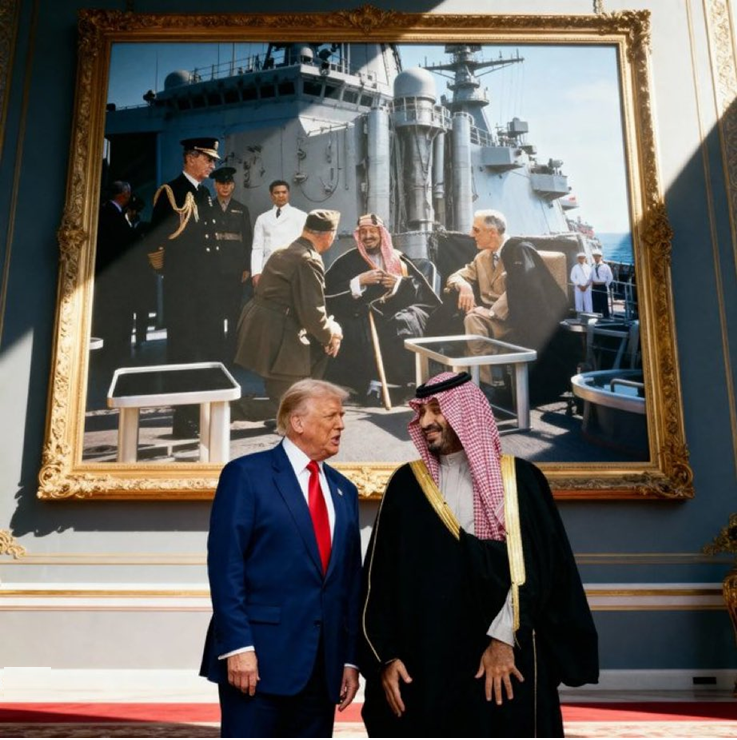
Prepared and Analyzed by the Strategic Media Department – BETH Agency, Riyadh
Supervision: Abdullah Al-Omira
Eighty Years of Alliance — If counted from the historic 1945 meeting.
Ninety-two years — if counted from the 1933 oil concession that began the relationship.
Saudi Arabia: Constancy of identity and stature
Introduction: From a Meeting on the Bitter Lakes… to a Moment of Re-definition
Saudi–American relations were never merely a political understanding since 1945;
they were a long-term project carried by three generations of Saudi leadership — adapting to energy shifts, wars, and changing priorities of successive U.S. presidents.
The story begins on the deck of a naval cruiser…
and, eight decades later, reaches a new phase built on AI, civil nuclear cooperation, and global-scale investment partnerships.
This report offers a strategic reading of the relationship’s trajectory —
from its foundational moment… to its moment of re-shaping in November 2025.
──────────────────────────
I. Foundation: From the Oil Concession to the Quincy Meeting (1933–1945)
1933: The oil concession with American companies — the true beginning of U.S. presence in Saudi Arabia.
1943: Roosevelt declares: “The defense of Saudi Arabia is vital to the defense of the United States.”
1945: The historic meeting between King Abdulaziz and President Roosevelt aboard the USS Quincy — a founding moment of the principle:
Security in exchange for energy stability.
From here began a relationship never written in a single treaty… but strong enough to survive every upheaval of the century.
──────────────────────────
II. The Cold War Alliance (1945–1973)
Saudi Arabia became a central pillar in the American strategy to contain Soviet influence.
Key pillars strengthened:
Oil
Security
Protection of the Gulf
Economic partnership
The relationship was practical, direct, and functional:
Saudi Arabia ensured energy stability… and the U.S. ensured regional stability.
──────────────────────────
III. 1973 – The Oil Shock and the Revelation of Riyadh’s Influence
The October 1973 oil embargo reshaped Washington’s perception:
A nation capable of influencing global markets
An economic actor that cannot be bypassed
A partner that must be treated with complex strategic calculations
Despite the crisis, the two sides quickly rebuilt a deeper relationship — because energy and security interests outweighed the disagreements.
──────────────────────────
IV. The Gulf Between Revolution and War (1979–1991)
A turbulent era:
The Iranian Revolution
The Iraq–Iran War
The Grand Mosque incident
Then Iraq’s invasion of Kuwait
1991 became a decisive moment:
U.S. troops deployed on Saudi soil to repel Saddam’s aggression — establishing a new level of military partnership.
──────────────────────────
V. September 11 — The Toughest Test (2001–2010)
9/11 created an unprecedented image crisis for Saudi Arabia within the U.S.,
but it did not destroy the alliance as adversaries of both countries wished.
Instead:
Intelligence cooperation deepened
Counterterrorism laws expanded
Broad security reforms were enacted
Defense and energy partnerships continued
It was an image crisis, not a crisis of interests.
──────────────────────────
VI. A Decade of Turbulence — The Arab Spring and the Iran Nuclear Deal (2011–2016)
Clear policy differences emerged:
The Arab Spring
The situation in Egypt
The war in Syria
The 2015 Iran nuclear agreement
Yet despite diverging political views, relations continued without allowing disagreements to escalate.
American policies shifted… but strategic interests remained stronger than areas of dispute.
──────────────────────────
VII. The Crown Prince Era — The Intelligent Alliance (2017–2025)
With the rise of Crown Prince Mohammed bin Salman, the partnership entered a new age:
Riyadh Summits (2017)
Integrating Vision 2030 into the Strategic Dialogue
Expanding Saudi investments in the U.S.
Defense modernization
Building a balanced relationship with China and Europe — without severing ties with Washington
Temporary issues created short-lived political and media tension…
but cooperation in security and economics never stopped.
Then came 2025, opening a new chapter.
──────────────────────────
VIII. The 2025 Visit — A Moment of Re-shaping the Alliance
The meeting between Crown Prince Mohammed bin Salman and President Donald Trump showed clearly:
This is not continuity with the past…
but a transition into a new level of partnership.
1) Defense
The pathway to acquiring F-35 fighters
Modernizing air defense systems
Advanced intelligence cooperation
2) Economy
Major Saudi investments inside the U.S.
Infrastructure, industry, and advanced technology
3) Energy
Balancing oil and clean energy
Deep coordination in global energy markets
4) Technology & AI
Cloud-computing partnerships
Semiconductor supply chains
Data-center development
Linking Saudi digital transformation to global digital ecosystems
5) Civil Nuclear
Understandings toward a peaceful Saudi nuclear program
This was not a visit…
It was the announcement of the AI-era strategic alliance.
──────────────────────────
IX. Strategic Reading: How the Balance of Power Has Shifted
1) From “Oil for Security”… to a Multi-Layered Partnership
The relationship now spans:
Security
Defense
Economy
Technology
Energy
Civil Nuclear
2) Riyadh as an Independent Power
Saudi Arabia today is:
An energy powerhouse
An investment powerhouse
A rising technological force
And a partner capable of balancing China and the U.S. without dependence on either
3) Washington Recalculates
The U.S. increasingly recognizes that ignoring Saudi Arabia is impossible.
Riyadh has become a center of regional and global equilibrium.
──────────────────────────
X. From Quincy’s Oil… to the Age of Artificial Intelligence
The 1945 meeting built a security–energy alliance.
The 2025 meeting builds an alliance that is:
Technological
Digital
Investment-driven
Multi-dimensional
A partnership that no longer relies on oil tankers…
but on algorithmic networks, data flows, and future-oriented coalitions.
──────────────────────────
Conclusion: A Symbolic Detail That Resembles History — Not Coincidence
Observers noticed a striking detail between two photos:
King Abdulaziz with Roosevelt (1945)
Crown Prince Mohammed bin Salman with Trump (2025)
The similarity of the thobe and bisht worn by both the founder and his grandson.
It may look like a mere detail…
but it carries a profound symbolism:
Times change.
Issues change.
The architecture of global power changes.
But the constancy of Saudi identity, dignity, and presence in moments of major global transition
remains unchanged.
And so the relationship continues:
From generation to generation…
From one turning point to the next…
In a strategic alliance reshaped each time the world itself changes.