



🌐 The Planet Split Into Three Networks… Has the Era of a Unified Internet Ended?
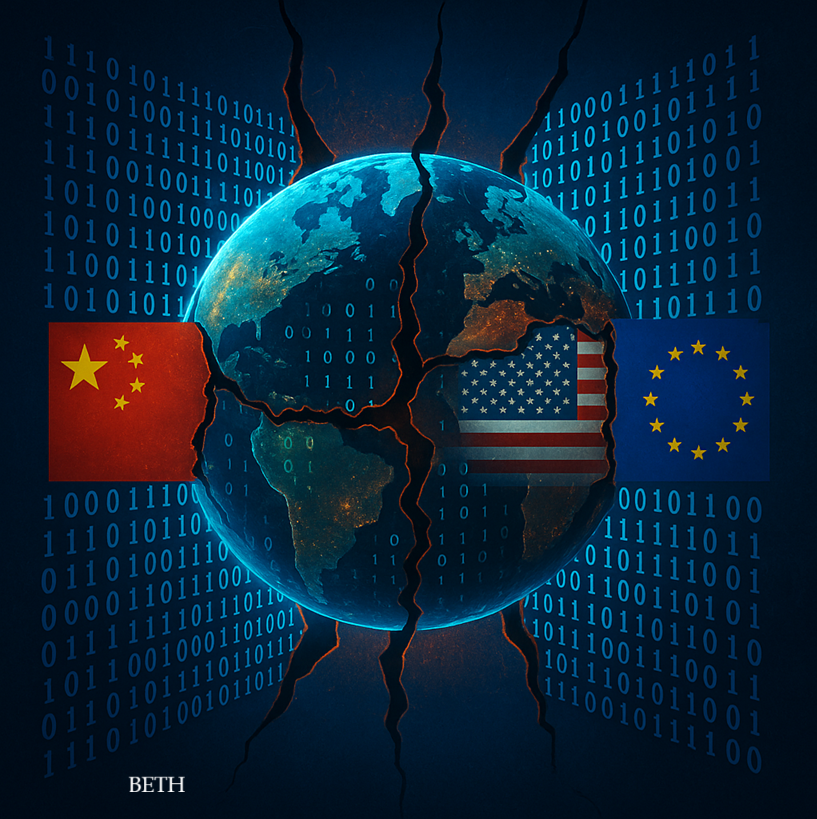
📊 Prepared & Analyzed by: BETH | Riyadh
Without the noise of wars or dramatic confrontations, the world is entering one of the most dangerous turning points in its digital history:
the end of the idea of “one global internet”… and the birth of three competing digital blocs.
What began years ago as an academic debate on “digital sovereignty” and “data protection” has now become an operational reality shaped by laws, policies, and technological alliances led by Washington, Brussels, and Beijing. Its consequences now stretch across every state, every company, and every user — from social platforms to artificial intelligence and cyber-security.
This is not merely a technological story…
It is a story of power, sovereignty, and control over the minds and markets of the world.
🌍 From One Internet… to Three Digital Worlds
1. The American Digital Sphere
Driven by Big Tech: platforms, operating systems, cloud services, digital advertising, and AI.
Its power lies in rapid innovation and dominance over the cognitive infrastructure of global content, commerce, and communication.
2. The European Digital Sphere
Driven by regulation: GDPR, Digital Services Act, Digital Markets Act, and now AI legislation.
Europe does not dominate through giant tech companies…
It dominates through the strongest regulatory frameworks, forcing all players to comply.
3. The Chinese–Asian Digital Sphere
Driven by the concept of complete digital sovereignty:
local platforms, independent chip supply chains, dedicated communication networks, and a semi-separate internet ecosystem — expanding steadily into Asia, Africa, and developing markets.
The result:
The question is no longer: “How do we access the internet?”
but rather:
“Which internet do we access? Under whose rules? And at what cost?”
🔐 Who Controls the Data… Controls the Decision
In this new landscape, data is no longer a “digital fuel.”
It has become a tool of political and economic influence.
Countries capable of storing their data domestically, protecting it, and using it to develop their own AI models…
will be more independent and less vulnerable.
Countries that leave their data scattered across global platforms, without a clear national strategy…
will inevitably become “soft digital colonies” — regardless of their economic strength.
And here lies the most critical question:
Whoever controls a society’s data — education, health, finance, media, and consumer behavior —
controls its decisions, its perception of itself, and its interpretation of the world.
🇸🇦 What Does This Digital Fragmentation Mean for the Arab World… and for Saudi Arabia?
For the Arab region:
Greater fragmentation between Western and Eastern digital systems
A widening dependency gap in cloud and software infrastructure
Absence of strong Arab platforms with negotiating power
For Saudi Arabia:
The Kingdom is moving through a decisive moment:
Vision 2030 is rebuilding the economy on data, technology, and human capital
Smart-city megaprojects (NEOM, The Line, Qiddiya, etc.) require strict data sovereignty
These projects cannot operate without clear policies on where data is stored, how it is used, and in whose interest
In a world divided into three networks, Saudi Arabia faces a strategic choice:
It cannot become a “digital follower” to any bloc —
and it makes no sense to isolate itself from global innovation.
The required equation:
➡️ Multi-directional partnerships… with full digital sovereignty.
🗞 Media at the Eye of the Storm
This division does not affect governments and corporations alone…
It strikes the media sector first:
Platform divergence
We may soon see different dominant platforms in different regions, creating:
Multiple “digital dialects”
Audiences living inside completely different informational bubbles
Analysis over Headlines
In a fragmented world, news is available everywhere…
But understanding why laws change, who is pulling the strings, and what the deeper implications are —
this becomes the true value.
The credibility crisis
Global media outlets will increasingly be accused of aligning with one bloc or another.
This creates space for a news agency that:
Belongs to no propaganda axis
Understands tech, data policy, and digital economics
This is precisely the strategic position BETH can occupy — if pursued early.
🔮 Where Is the Digital World Heading in the Next Five Years?
If the current trajectory continues, expect:
Tighter restrictions on cross-border data flows
Stricter AI governance
Accelerating efforts by each bloc to manufacture its own chips
A growing gap between digital-producing nations and digital-consuming nations
And most importantly:
A new class of digitally influential countries will emerge —
not the strongest militarily, but the strongest in their ability to:
Build platforms
Protect their data
Develop AI models that reflect their own values, not imported ones