



Plastic Treaty: A Planet in Crisis or Leaders in Crisis?
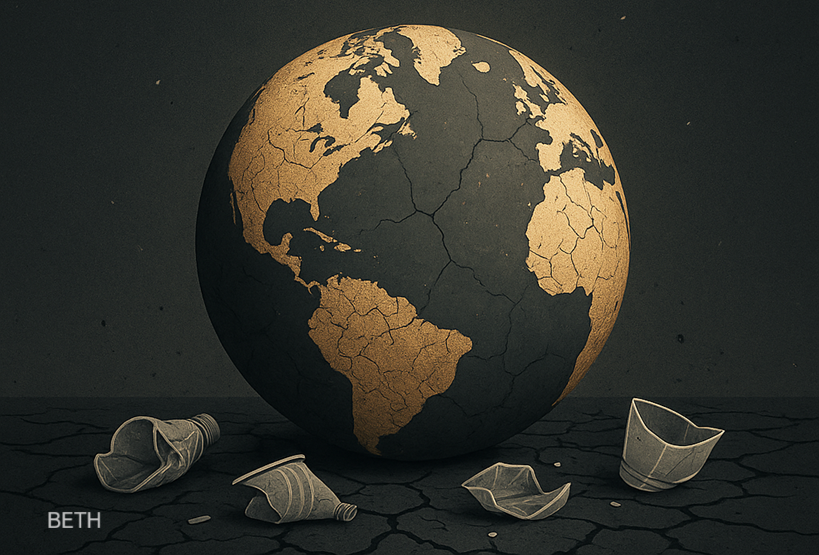
Analysis – BETH Media
The latest round of negotiations to establish a global treaty to curb plastic pollution ended without an agreement, turning what was once described as “the planet’s last hope” into a miniature model of the world’s inability to make real decisions.
Delegates from over 170 countries met in Nairobi, Paris, Nice, and Rio de Janeiro — yet no decisive outcome emerged. They did not disagree on the goal, but on who pays the price and who reaps the political gain.
Plastic or Bureaucracy?
Ironically, the world produces over 400 million tons of plastic each year, with less than 10% being recycled.
The issue is not technical — solutions exist — but rather political and economic.
Industrial nations refuse to sacrifice the profits of their chemical and packaging giants, while developing nations reject taking responsibility for a crisis they didn’t create.
Thus, the treaty remains locked behind closed doors.
Humanity debates who should put out the fire, while the world itself burns.
From Plastic to Politics: The Failure of Global Governance
The “plastic crisis” is not merely an environmental event — it is a mirror reflecting the collapse of global leadership.
The international community has proven incapable of resolving even its simplest technical challenges.
So how can it confront the far greater issues of war and peace, poverty and AI, or global food security?
The problem isn’t the number of summits — it’s the scarcity of collective will.
The world doesn’t suffer from a lack of intelligence — but from the absence of cooperative minds.
Leadership Paralysis: The Disease of Our Era
We may be living in a time when global leaders can no longer keep pace with the speed of planetary interconnection.
Decisions are still made with the mindset of the 20th century, while the world operates at the speed of the internet.
Humanity grows more connected — yet its leaders still think in terms of “borders and sovereignty” rather than “systems and shared destiny.”
This is not only an environmental crisis — it is a crisis of cognitive leadership:
Leaders who possess wealth and information,
but lack courage and collaborative imagination.
🌐 Toward a New Generation of Leaders
Has the time come to change the world’s leadership?
Yes — but not for the sake of change itself.
It’s time to replace administrative leadership with human-centered, perceptive leadership —
leaders capable of collective thinking, rapid decision-making, and transparent action.
Leaders who think with the mind of the planet, not the mind of the continent.
The world doesn’t need more deferred treaties —
it needs a new global leadership system built on the belief that survival cannot be individual.