



Archive of the Future – Document One
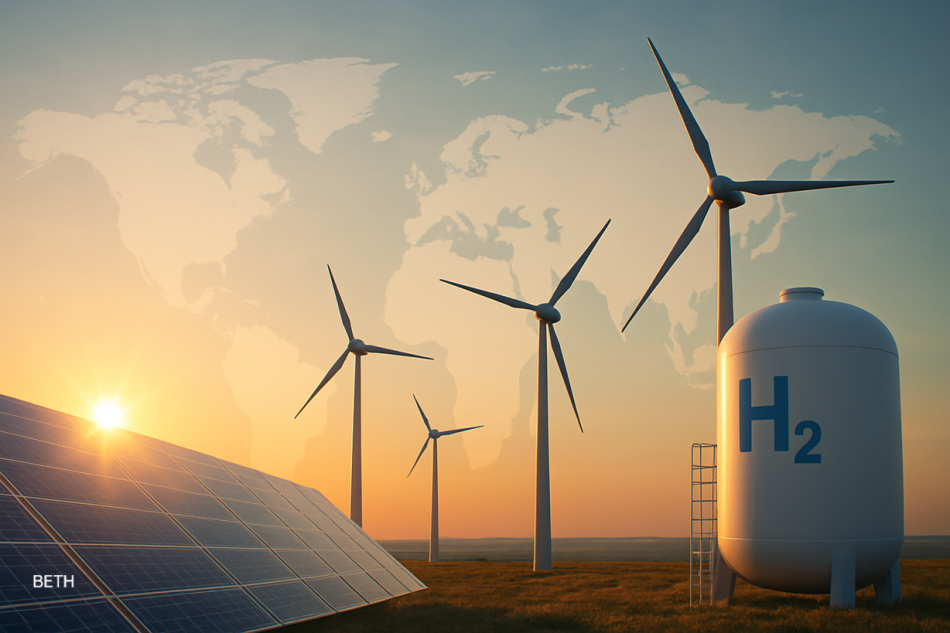
Futuristic Headline (Hypothetical) :
2030… When Energy Turned from a Weapon of War into a Tool of Peace
Prepared and Analyzed by Archive of the Future / BETH News Agency
Introduction: A Voice from Tomorrow
In the archive of the year 2030, energy is no longer a tool of coercion or a bargaining chip among major powers. On the contrary, it has become the “new language of peace.” When nations succeeded in transforming their energy sources from oil, gas, and coal into a hybrid system of green hydrogen, solar, and wind, the capacity for war declined, while the prospects for international cooperation grew stronger.
Axis One: Major Powers and the Balance Reset
The United States abandoned its strategy of “oil hegemony” to become the world’s largest investor in green hydrogen, regaining economic influence without the burden of costly military interventions.
China, having led early in building green energy alliances since 2025, positioned itself as the leader of a new global network — akin to an “OPEC for clean energy” — that included dozens of African and Asian nations.
Saudi Arabia emerged as a global powerhouse in the “clean hydrogen market” after launching mega-projects like NEOM and green economic zones as hubs for exporting sustainable energy.
Axis Summary: Major powers did not relinquish influence; they simply moved it from the battlefield to the sphere of technological and energy investment.
Axis Two: New Alliances – From Oil to Sun
By 2030, alliances once shaped by oil and gas pipelines had transformed into:
Intercontinental electricity transmission networks.
Green hydrogen corridors linking the Gulf with Europe and Asia.
Shared digital platforms for trading “negative emissions.”
Notable Example:
The “Green Mediterranean Alliance” that united Saudi Arabia, Egypt, Greece, and Italy to export solar power from the Arabian desert to Europe — a project that turned the Mediterranean from a sea of conflict into a sea of partnership.
Axis Three: The Digital Economy and Green Energy – A Dual Renaissance
The transformation extended beyond energy, into the rise of a green digital economy:
Artificial intelligence became responsible for managing massive global electricity grids and distributing energy on demand with real-time precision.
Green Coins, digital currencies, linked clean consumption with economic reward, incentivizing individuals and corporations to cut emissions.
Smart cities — such as Riyadh and Shanghai — evolved into civilizational models where every building generated its own power.
Axis Four: Humanity and Nature – A New Reconciliation
The Future Archive of 2030 records that humanity succeeded in:
Restoring millions of hectares of forests.
Recycling 70% of global waste.
Reducing projected global warming by half a degree Celsius compared to 2020 forecasts.
Most importantly, public consciousness shifted: the environment was no longer seen as a luxury, but as a condition for survival.
BETH Conclusion
“Energy is no longer a weapon that kills, but a tool that gives life.”
By 2030 — as the Archive of the Future records — armies were no longer the sole determinant of global destiny. Instead, solar cells, wind currents, and drops of hydrogen emerged as the new forces shaping history.
It marked a second birth of the world: conflict gave way to partnership, rivalry to innovation, and wars to treaties of development.
🔹 The Genius of the Archive of the Future:
It is not science fiction journalism, but a future history written in documentary style, narrated as though events had already taken place — yet rooted in realistic analysis and today’s tangible data.
The Requirements of Power… Saudi Arabia as an Exceptional Model
When rethinking the concept of power in today’s and tomorrow’s world, it is no longer confined to weapons or raw economics. Power has become a composite equation, resting on:
Tools: from technology to energy, from natural resources to human capital.
Innovation: the ability to turn ideas into products, information into awareness, and opportunities into realities.
Resilience: confronting crises, adapting to shocks, and turning challenges into opportunities for growth.
Survival and Sustainability: not just endurance, but maintaining a stable position in a shifting world.
Development: continuous improvement, with investment in the future as a permanent choice, not a temporary luxury.
Stability: internal security, clarity of vision, and the ability to attract the world instead of being consumed by turmoil.
Saudi Arabia: An Exception in the Equation
An objective observer can see these unique requirements clearly embodied in Saudi Arabia today:
Tools: Natural resources + the Public Investment Fund as a global lever + a strategic geographic position.
Innovation: Projects like NEOM, AI in education, and the digital transformation.
Resilience: The COVID-19 experience, energy market stability, and the ability to balance regional crises.
Survival and Sustainability: Vision 2030 placed sustainability at the core of economy, energy, and environment.
Development: Unprecedented investment in infrastructure, tourism, and the green economy.
Stability: Stable political leadership and strategic clarity granting Saudi Arabia increasing weight in the international system.
BETH Final Note
If the world is searching for a new formula of power, Saudi Arabia presents a comprehensive model: soft and hard, immediate and future-oriented, rooted in tangible tools and strategic vision.
It is not merely a nation that succeeded in survival — it is a nation shaping the very standards of power by which the world will be measured in decades to come.
💡 “When power is redefined, Saudi Arabia will be among the standards — not among the spectators.”