



Saudi Arabia and Pakistan… A Joint Statement Cementing Strategic Alliance
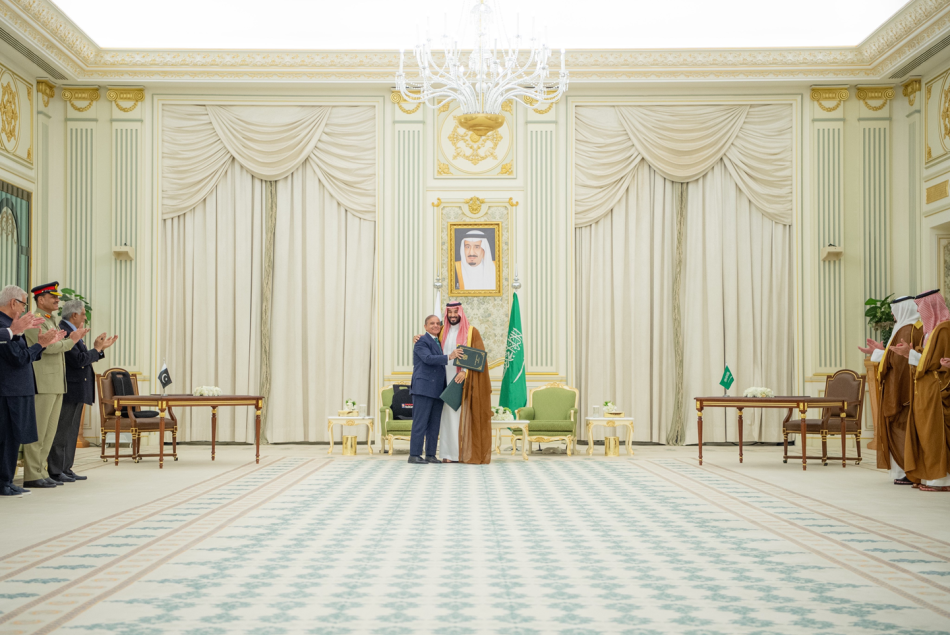
Riyadh – BETH | 25 Rabi’ Al-Awwal 1447 AH, corresponding to September 17, 2025
The Kingdom of Saudi Arabia and the Islamic Republic of Pakistan issued a joint statement following the state visit of Pakistani Prime Minister Muhammad Shehbaz Sharif to Riyadh, which witnessed the signing of the “Joint Strategic Defense Agreement” between the two countries.
The statement reaffirmed the deep-rooted ties spanning nearly eight decades and reflected the determination of both leaderships to enhance defense and security cooperation to achieve peace and stability at both the regional and international levels.
Full Text of the Statement
At the gracious invitation of His Royal Highness Prince Mohammed bin Salman bin Abdulaziz Al Saud, Crown Prince and Prime Minister, the Prime Minister of the Islamic Republic of Pakistan, Mr. Muhammad Shehbaz Sharif, paid a state visit to the Kingdom of Saudi Arabia on 25/3/1447 AH, corresponding to 17/9/2025.
His Royal Highness Crown Prince Mohammed bin Salman bin Abdulaziz Al Saud received the Prime Minister of the Islamic Republic of Pakistan at Al-Yamamah Palace in Riyadh, and a formal session of talks was held in the presence of both delegations. At the outset of the talks, the Pakistani Prime Minister conveyed his greetings and best wishes to the Custodian of the Two Holy Mosques King Salman bin Abdulaziz Al Saud – may Allah protect him. Both sides reviewed the historic and strategic relations between the two countries, as well as several issues of common concern.
Building on the historic partnership extending over nearly eight decades, the bonds of brotherhood and Islamic solidarity, shared strategic interests, and close defense cooperation, His Royal Highness Crown Prince Mohammed bin Salman bin Abdulaziz Al Saud – may Allah protect him – and the Prime Minister of the Islamic Republic of Pakistan, Muhammad Shehbaz Sharif, signed the “Joint Strategic Defense Agreement.”
This agreement comes within the framework of the two countries’ efforts to strengthen their security and achieve peace in the region and the world. It aims to enhance various aspects of defense cooperation, reinforce joint deterrence against any aggression, and stipulates that any attack on either country shall be considered an attack on both.
The Prime Minister of Pakistan, Mr. Muhammad Shehbaz Sharif, expressed his gratitude and appreciation to His Royal Highness Crown Prince Mohammed bin Salman bin Abdulaziz Al Saud, for the warm reception and generous hospitality accorded to him and his delegation. He also extended his best wishes to the Custodian of the Two Holy Mosques King Salman bin Abdulaziz Al Saud, His Royal Highness the Crown Prince – may Allah protect them – and to the brotherly Saudi people for further progress, prosperity, and well-being. Likewise, His Royal Highness extended his best wishes for health and success to the Prime Minister of Pakistan and further advancement and prosperity for the people of Pakistan.

BETH Commentary
🔹 The Saudi–Pakistani defense agreement reflects a qualitative shift in regional security equations: Gulf security is no longer solely reliant on traditional Western partnerships but increasingly built on Islamic–Asian alliances with greater independence.
🔹 The clause stating that “an attack on one is an attack on both” revives the concept of collective security—but this time with a distinctly Islamic dimension, bridging Arab depth with broader Islamic solidarity.
🔹 Pakistan—the only nuclear-armed Muslim nation—adds strategic weight to Saudi Arabia, while cooperation with the Kingdom opens vital political and economic horizons for Islamabad.
🔹 On a broader level, this agreement does not target any specific party but sends a dual message:
Saudi Arabia is capable of constructing independent deterrence partnerships.
Regional security is no longer hostage to external powers—it is now being reshaped from within the region itself.
✒️ BETH Insight
What unfolded in Riyadh was not just ceremonies or signatures, but a strategic step that could mark a pivotal moment in redefining Gulf and Islamic security.