


Reading the Doha Summit through BETH’s International Lens
Prepared and Analyzed by: Strategic Media Department – BETH
First: What Happened?
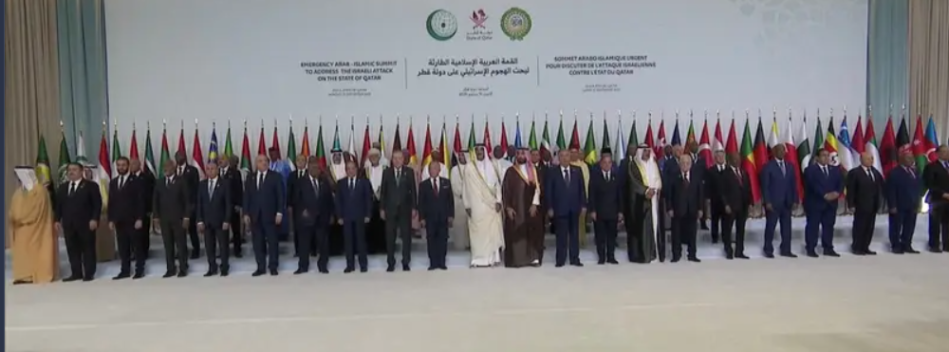
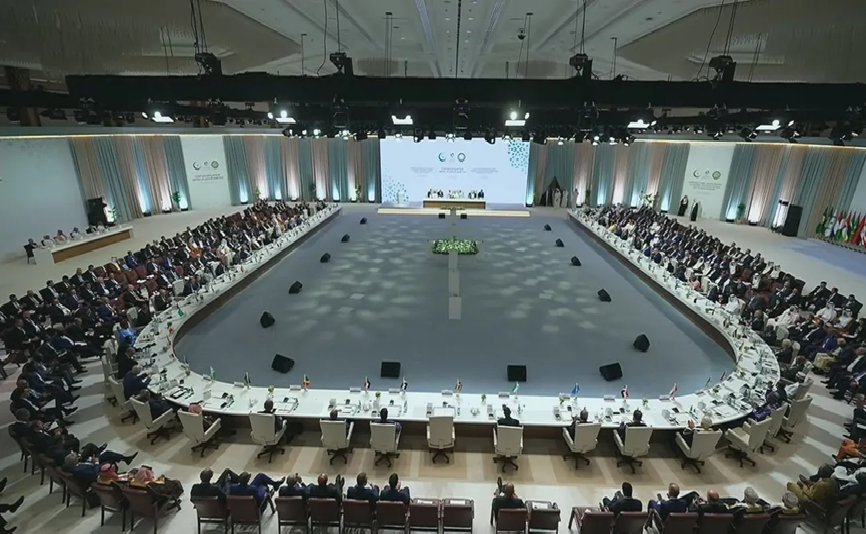
Two extraordinary summits were convened in Doha:
An emergency Gulf summit.
An emergency Arab–Islamic summit.
The event came as a direct response to the Israeli attack on the Qatari capital—an unprecedented step regarded as a blatant violation of Qatar’s sovereignty and a direct threat to the security of the entire Gulf.
This was no ordinary summit; the speed of the call, the scale of participation, the unity of message, and the firmness of language gave it exceptional weight, placing it in a different category from previous Arab or Islamic summits.
Second: What Makes It Different from Past Summits?
Timing: The summit took place just days after the attack, showcasing an unusual capacity for swift mobilization and coordination in a region often known for delayed responses.
Sharp Language: The statements were not couched in soft diplomatic terms, but rather used expressions such as “blatant aggression, cowardly terrorist act, dangerous escalation, direct threat to Gulf security.”
Concrete Steps: What truly set it apart was the directive to the GCC Joint Defense Council to meet urgently, preceded by a meeting of the military committee—a rare move toward the actual activation of the collective defense agreement.
Symbolism of Participation: The wide Arab–Islamic turnout conveyed that the attack on Qatar was not seen as an isolated incident but as a provocation against the entire Ummah.
Third: How Did International Media Read It?
Western Media: European and American outlets described the summit as “a serious test of the Gulf’s ability to rely on itself for security.” Some editorials warned that the attack might accelerate shifts in the regional security equation away from the American umbrella.
Israeli Media: Debate centered on two points: defending the “legitimacy of Israel’s decision” to strike Hamas leaders wherever they may be, and growing concern over diplomatic isolation and the emergence of a more cohesive Arab–Islamic front.
Arab Media: Coverage framed the summit as a rare moment of unity and a strong message that Gulf security is a red line. Some analyses even suggested it could mark the start of a new era for Arab and Islamic collective security.
Fourth: Strategic Implications
Gulf Security Is Indivisible
The summit revived the GCC principle that “an attack on one is an attack on all.” What stood out this time was the seriousness of shifting from slogan to action.
Dual Message of Deterrence
The message was directed first to Israel—that any further escalation would be treated as aggression against all. And second to global powers—that the Gulf has the capacity to move collectively, even symbolically, to defend itself.
Impact on Mediation
Targeting Qatar—the mediator—was not only an assault on sovereignty but also a direct blow to diplomacy itself. The summit thus elevated the defense of mediation legitimacy to a strategic concern.
From Diplomacy to Defense
Unlike most Arab and Islamic summits, which end with political communiqués, Doha’s was distinct in linking political stance with defense capacity, diplomacy with deterrence.
Fifth: What Caught BETH’s Eye?
Speed of Execution: Convening two summits so swiftly highlighted a new level of coordination.
Unity of Message: The phrase “Gulf security is indivisible” became the headline across Arab and Western media alike.
Boldness of Statement: The explicit mention of activating defense mechanisms gave unprecedented credibility to the concept of Gulf deterrence.
Saudi Crown Prince’s Role: Prince Mohammed bin Salman’s praise of the summit’s outcomes and his direct message of thanks to Qatar amplified the weight of the collective stance and confirmed Saudi Arabia’s leading role.
Sixth: Where Could This Lead?
Scenario One: Israel ignores the message, prompting the Gulf to escalate through joint defense moves—possibly via symbolic actions or military exercises.
Scenario Two: International pressure mounts on Israel to avoid further provocations after the summit highlighted regional fragility.
Scenario Three: The moment is leveraged to build a new Arab–Islamic approach to regional security—transforming summits from seasonal condemnations into foundations for long-term strategic action.
✒️ BETH Conclusion
The Doha Summit was not just another meeting; it was an international alarm bell signaling that the Gulf’s and the Middle East’s security equations are shifting.
The attack on Qatar did more than trigger solidarity—it ignited a serious debate on deterrence and joint defense mechanisms.
Through BETH’s international lens, what happened in Doha marks the beginning of a new phase: one where statements are no longer enough, and the region begins to think—and perhaps act—in terms of real collective security and credible deterrence.