



Beyond Sovereignty: Borderless Wars & Weaponized Economics
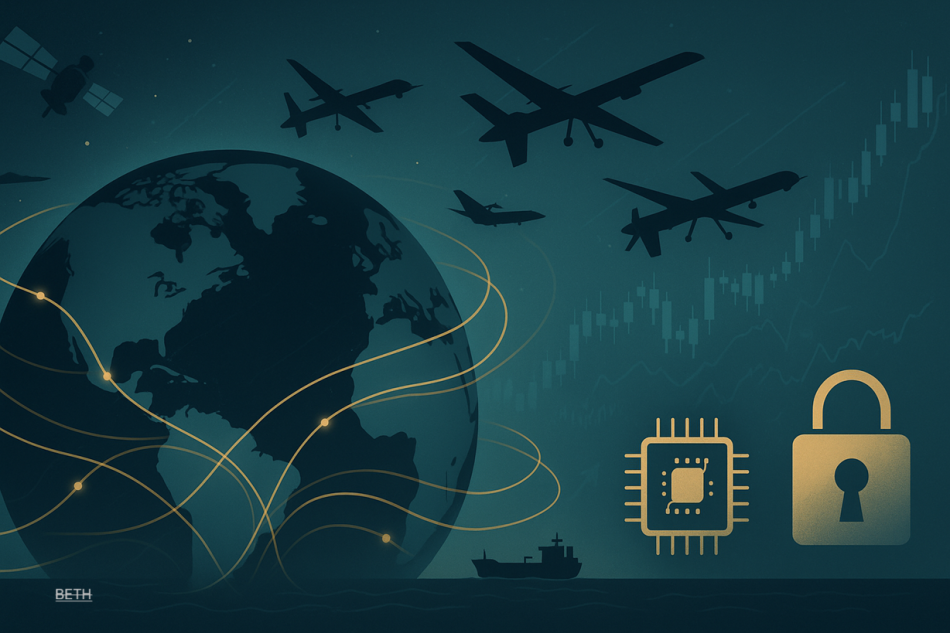
Prepared by: Strategic Media Department – BETH
Preface
Hard borders and foreign bases are no longer sufficient guarantees of state safety. Modern power— from weaponized economics to cyber space and drones—has shifted conflict from conventional fronts to infrastructure, supply chains, financial rails, and narrative warfare. This brief offers an integrated political–economic–social reading of these shifts, outlines scenarios and watch-lists, and closes with a practical Saudi lens.
BETH Take (in two lines)
Power today is built through smart deterrence + economics + technology as much as through arms.
Conflict is migrating to cyberspace, supply chains, financial channels, and drones—with profound political, economic, and social effects.
The Big Questions
How have rules of sovereignty changed in an age of drones and cross-border sanctions?
What is the impact on the real economy (energy, logistics, insurance, investment)?
How do wars reshape society and media (polarization, disinformation, displacement)?
What are the options for middle powers to build durable influence without sliding into war?
Analytical Pillars
1) Politics: The Unraveling of the State’s “Monopoly on Violence”
Gray-zone warfare: cross-border operations, precision strikes, proxy use, and plausible deniability.
Flexible deterrence: raising the political cost for the adversary matters more than outright military destruction.
International law under stress: pre-emptive self-defense, targeted killings abroad, and red lines being quietly redrawn.
Concise examples:
Ancient: Peloponnesian War (alliances/blockade/sea economy); Westphalia 1648 (birth of modern sovereignty).
Modern: Kuwait 1990 (clear breach of sovereignty); Kosovo 1999 (humanitarian intervention vs. state sovereignty); Crimea 2014 then Ukraine 2022 (faits accomplis); cross-border strikes/drones; and conflict spillovers into third-country territories.
2) Economics: Weaponizing Interdependence
Energy & chokepoints: Hormuz/Bab al-Mandab/Suez = prices, marine insurance, freight costs.
Sanctions & financial networks: asset freezes, SWIFT, tech/semiconductor export controls—silent weapons that reroute trade and supply chains.
Firms under fire: risk premia, soaring insurance, port/cable outages, data-center relocation and continuity planning.
3) Society & Media: Deep Impacts
Displacement & migration, brain drain, widening education/health gaps.
Digital polarization: echo chambers, deepfakes, and narrative warfare.
Gendered effects: women bear disproportionate burdens in displacement and informal work—yet soft power rises via women’s sports and culture as counters to wartime stereotyping.
4) Technology as a Battleground
Cheap/smart drones upend the economics of force and expose legacy defenses.
Cyber & critical infrastructure: subsea cables, satellites, data centers—“bloodless” hits with outsized political/economic shock.
AI: from ISR and pattern detection to shaping public opinion and manufacturing narratives.
Lessons from History (Selected)
Westphalia (1648): birth of sovereignty—today we are quietly renegotiating its meaning.
Kuwait 1990: violations can trigger coalition deterrence swiftly.
Kosovo 1999: the sovereignty vs. humanitarian-intervention dilemma.
Energy shocks (1973 and after): oil/gas as bargaining power.
Smart sanctions (Iran to Russia): parallel economies, currency swaps, redirected trade and tech flows.
Three Scenarios to 2030
(A) Managed Deterrence
Clearer rules of engagement + broader mediation channels ⇒ lower risk, better investment climate, steadier supply chains.
(B) Fragmented Sovereignty
Proliferating cross-border strikes & proxies ⇒ higher shipping/energy insurance, price volatility, slower global growth.
(C) Technological Sovereignty
A race over satellites/cables/semiconductors ⇒ control of critical infrastructure becomes leverage exceeding artillery.
Early-Warning Indicators (What to Watch):
Spikes in marine/aviation insurance premia.
Expanding chip/software restrictions and pressure on strategic value chains.
Movements in FX reserves and currency-settlement patterns.
Rising attacks on digital infrastructure (cables, satellites, data centers).
The Saudi Lens (BETH Perspective)
1) Strategic Autonomy
Diversify partnerships, deploy flexible energy diplomacy, and practice constructive neutrality in mediation—preserving a strategic margin of maneuver.
2) Technological Sovereignty
Invest in satellites, subsea cables, data centers, and smart defense industries; owning critical infrastructure = practical sovereignty.
3) Economic Fortification
Deepen the non-oil base, build alternate supply chains, secure food/pharma, and harden logistics—with advanced financial hedging tools.
4) Effective Soft Power
Sports, culture, and high-quality media—craft global public opinion that supports national narratives, diminishing the impact of smear campaigns and shifting the regional image from “theater of conflict” to platform of opportunity.
Executive Recommendations (Actionable)
National Critical-Infra Protocol: protect cables/satellites/data centers + periodic stress tests.
Narrative Monitoring Hub: detect media deviations, deepfakes, and train newsrooms on rapid verification.
Corporate Resilience Rules: multi-site business continuity and mandatory cyber insurance for sensitive sectors.
Logistics Risk Facility: support re-routing during crises to cap cost-inflation spirals.
Closing (Analytical Mantra)
The equation lies beyond bases and closer to the real balance of power:
Sovereignty is secured when a state wields smart deterrence, a resilient economy, and technological control—not by hosting bases or relying on lines drawn on maps.
Expanded Conclusion — BETH
Modern wars transcend traditional borders into economics, technology, and cyberspace. Military bases are no longer a sufficient guarantee of sovereignty; today’s balance of power is built through smart deterrence, protection of critical infrastructure, and weaponized interdependence. This brief maps the political–economic–social landscape and proposes scenarios and early-warning indicators through 2030.
Focused answers to the questions
What about alliances?
Alliances are levers, not crutches. Their value is measured by clear objectives, enforceable commitments, and risk-sharing—not slogans. A successful alliance adds capacity (combined capabilities, intel, logistics) without eroding sovereign decision-making or freezing national deterrence.
Security guarantees and cooperation for stability?
They gain credibility when paired with verifiable conditions (rules of engagement, joint exercises, hotlines, compensation mechanisms) and when breach of a pledge carries a political/economic cost for the defaulting partner.
Where does trust sit?
Trust rests on three pillars:
Declared national capability (what a state tangibly owns).
Mutual dependability (shared supply chains and information security).
Track record of compliance (a history of honoring commitments).
Without this triad, trust remains wishful thinking.
Must every state strengthen itself?
Yes—not instead of partnerships, but as their foundation. The golden rule:
Independent national power + flexible, non-exclusive alliances = respected deterrence and safeguarded sovereignty.
In practice: multi-layered deterrence (military/cyber/economic), technological sovereignty (comms, cables, data), and a shock-resilient economy (diversification, reserves, logistics insurance).
And where is the peace people seek?
Durable peace today is an outcome of management, not intentions:
realistic justice + responsible deterrence + tangible development.
This translates into regional security frameworks, standing mediation channels, defined rules of engagement, and cross-border development projects that lower the cost of returning to war.
Indicators of the path to peace
Falling marine/aviation insurance premia; stabilizing energy and freight prices.
Rising long-term investment and normalized trade/crossings.
Fewer attacks on digital infrastructure; higher media transparency.
Cultural and sports exchanges that rebuild social trust.
Bottom line:
Peace is built by responsible power—not promises; by a capable, cooperative state—not a dependent one.