



Trump: Back to the Theater of War
BETH – Monitoring and Analysis
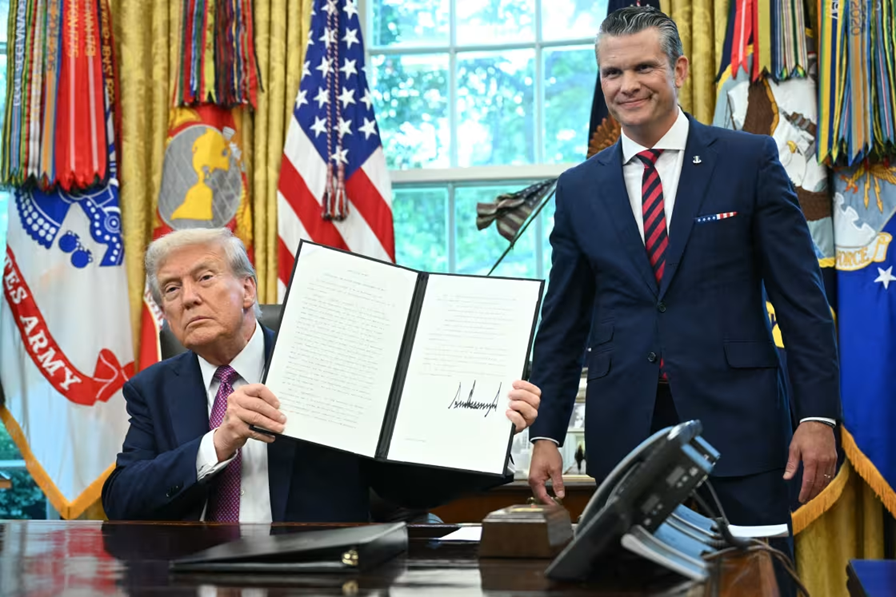
Trump signs executive order changing the Department of Defense’s name to the Department of War
What happened?
On Friday, U.S. President Donald Trump signed an executive order to rename the Department of Defense as the “Department of War” as a secondary name, while the official legal designation still requires Congressional approval. The new name has already appeared in some official correspondence, the official website shifted from defense.gov to war.gov, and certain officials have been given titles such as “Secretary of War.”
What reasons did Trump give?
He described the previous name as “woke” and overly defensive in tone, whereas the new name sends a message of power and victory.
He pointed out that the original name (“Department of War”) was in use during America’s victories in World War I and World War II, giving it symbolic weight.
He insisted that adopting the title “Secretary of War” signals a shift toward an offensive posture rather than purely defensive.
Wars America has lost – and why
Despite Trump’s claims, the United States has not secured decisive victories in several conflicts:
Vietnam War: A chaotic withdrawal after enormous human and financial losses, alongside political backlash at home.
Iraq War (2003–2011): Collapse of post-war planning, state instability, and heavy casualties and costs.
Afghanistan War (2001–2021): After two decades of fighting, the conflict ended unresolved, with the U.S. withdrawal exposing strategic failure.
Key reasons for failure:
Absence of a clear exit strategy or coherent post-war roadmap.
Overlap between military and political objectives, leading to unrealistic expectations.
Strong local resistance, compounded by identity, governance, and political complexities in the host nations.
What does Trump aim to achieve?
Projecting strength and mobilization: The new name aims to instill the image of a nation ready to fight and win.
Reviving the narrative of past victories: Tying back to historical nomenclature seeks to boost national morale and gloss over past setbacks.
Sending polarizing signals domestically and abroad: Through a “peace through strength” posture, the U.S. is reframed as a powerful ally not to be underestimated.
Expanding symbolic authority: Renaming embodies a shift in rhetoric around governance and the military, broadening Trump’s symbolic grip on federal institutions.
BETH Analytical Conclusion
The decision is not just about renaming; it is largely symbolic—an attempt to repackage America’s military image under the banner of “victory.” If war can also be waged through words, then this move amounts to a cultural declaration of war before being an institutional one.