



From Jerusalem to Gaza… and the Myth of “From the Nile to the Euphrates”
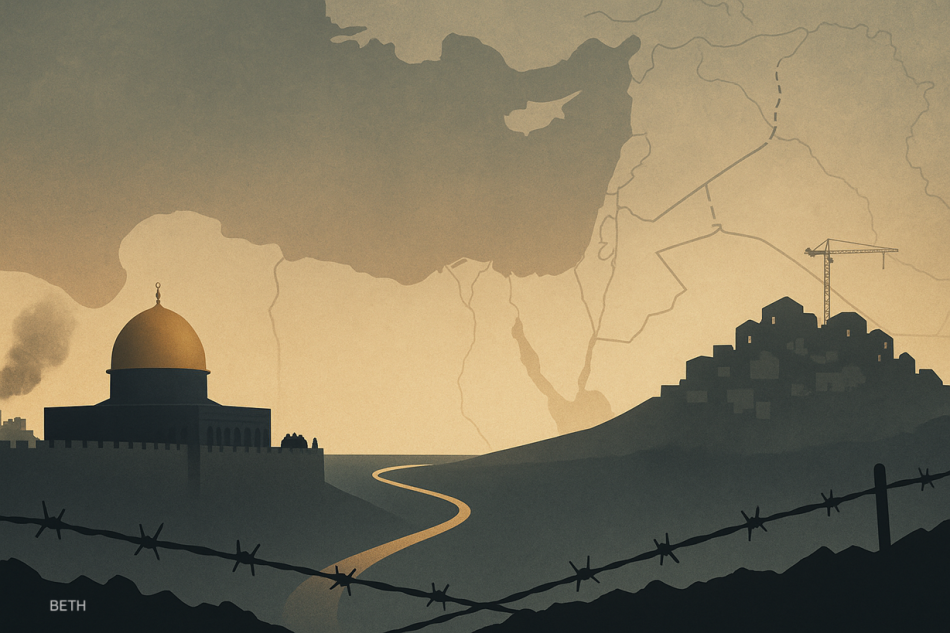
BETH – Prepared & Analyzed | Strategic Media Department
“The Map of Myth and the Limits of the Possible”
Introduction
Historically, the slogan “Israel from the Nile to the Euphrates” draws on a reading of a biblical text (Genesis 15:18) that certain trends within Religious Zionism turned into a political narrative of a “Promised Land.” In the present, the narrative resurfaced via Benjamin Netanyahu’s 2023 UN map that showed the West Bank and Gaza within “Israel,” alongside statements/plans by hard-right figures (e.g., Smotrich) and the acceleration of strategic settlement projects such as E1, in parallel with a broad military campaign in Gaza. These symbolic and practical signals feed the discourse of “Greater Israel.”
From Idea to Policy: How Did It Morph?
The map as a narrative device: Netanyahu displayed maps that erase Palestinian borders (West Bank/Gaza) in his 22 September 2023 address.
A longstanding party program: Since 1977, Likud has entrenched the language of “Judea and Samaria” and “Eretz Israel” within visions of sovereignty and settlement.
The “Decisive Plan” (Smotrich): Options oscillate among annexation, subjugation, and implied forced migration, with expansive rhetoric stretching as far as “Damascus” as an ideological horizon.
E1 today: Approval of the project east of Jerusalem (≈3,500 units) threatens the geographic contiguity of the West Bank (north/south) and is read as a de facto burial of the two-state idea.
Hard Constraints (Why the “Map” ≠ the “Possible”?)
Demography: The global Jewish population is about 15.8 million, ~7.3 million of whom live in Israel—figures that do not enable colonial resettlement across a realm “from the Nile to the Euphrates.”
Law & legitimacy: Any formal expansion beyond the 1967 lines collides with the international recognition system, international courts, and rising political/economic costs (manifest in broad condemnations of projects like E1).
Security burden: Ruling over millions without sustainable political rights risks an apartheid-like model and permanent conflict that drains the army and economy and weakens alliances.
Regional geography: Expansion at the expense of sovereign states with standing armies (Egypt/Jordan/Syria/Iraq/Lebanon…) implies a full-scale war, not a slow “creeping annexation” inside occupied territory alone.
Economy & dependencies: Israel is deeply integrated into Western economies; aggressive expansion would threaten supply chains, partnerships, investment, and technological edge.
Realistic Scenarios (1–3 Years)
A) Conflict Management + Creeping Annexation (most likely):
Entrenching facts on the ground (settlements/road networks/Area C and E1-like projects) with intermittent escalations in Gaza and the West Bank and fragile truces. Likelihood: High (Palestinian division + right-wing cover + Western hesitation).
B) Limited/Wide Regional Flare-up:
Concurrent fronts (Gaza/West Bank/Lebanon/Syria) without major map changes; high costs for all, followed by an “armed calm.” Likelihood: Medium.
C) Interim settlement with international guarantees:
A cold peace in exchange for security/economic packages and regional recognitions (normalization conditioned on a political ceiling for Palestinians, borders, and security guarantees). Likelihood: Low–Medium, rising with US/EU pressure and Arab consensus.
D) Grand endings (collapse/vanishing):
“Northern Israel’s end” or “the Arabs’ disappearance” are propagandistic/apocalyptic notions unsupported by power balances, alliances, demographics, or the global economy. Likelihood: Very low.
Lasting Peace… or Endless War?
Endless war: Possible if the “facts-on-the-ground” track continues without a political horizon, alongside settlement expansion and recurrent escalations.
Lasting peace: Possible only through a settlement that closes files of borders/security/Jerusalem/refugees under international-regional guarantees and a joint development track—a peace of interests, not maps of myth.
What We’re Watching
Practical implementation of E1 (not decisions alone).
US/EU postures: from condemnatory rhetoric to actual levers of pressure.
Terms of any new Arab normalization (linking it to a clear Palestinian track toward a viable state).
Cohesion of the Netanyahu government/right-religious bloc and the rise or retreat of the “Greater Israel” narrative.
Israel’s economic indicators (investment/technology/credit rating) under the stress of war and isolation.
BETH Takeaway
The “biblical map” functions today as a tool of mobilization and legitimation for annexation/settlement policies, not as a geospatial plan that can be executed. Demographic, legal, and economic constraints render “From the Nile to the Euphrates” a mobilizing myth, not an implementable project. The likeliest path is continued conflict management with creeping annexation and chronic tension—unless a deal of interests under international-regional sponsorship turns costs into gains and brings geography back from the fantasy of text to the logic of the possible.
End… or Course Correction?
Initial answer: Netanyahu does not appear to be actively “seeking” Israel’s end; yet his force-centric approach and consolidation of facts elevate structural-erosion risks (political/economic/social), pointing toward “a smaller, more isolated, less democratic Israel,” not “Greater Israel.” E1 is a stark example of turning myth into policy that weakens legitimacy and raises strategic costs.
Concise indicators:
Settlement escalation that harms international legitimacy and diplomatic leverage (E1 effectively bisects the West Bank).
Rising fiscal/sovereign risk (warnings and negative outlooks amid war and governance strains).
Friction with the US—even as support continues (tighter scrutiny and more conditional deals).
Domestic erosion (conscription crisis/coalition rifts) undermining the ability to sustain a long, indecisive war.
Four focused answers:
Is the government steering toward Israel’s end? Not deliberately; but it gambles with identity and function (Jewish/democratic/Western-integrated). Creeping annexation inches toward a high-friction one-state scenario.
Is Netanyahu a passing phase? The odds of “course correction” rise as costs accumulate (coalition cracks/Western pressure/falling confidence and investment).
Does extremism end only if Israel disappears? Extremism is a socio-ideological current that regenerates; it shrinks as costs and isolation rise and utility vanishes.
Pages that bury myths? Yes—if three conditions hold:
Clear political ceiling: a real halt to annexation and a viable Palestinian track.
Balanced incentives & pressures: tie normalization and economic/security cooperation to enforceable rules.
Internal surgery in security/economic priorities (workable conscription law and credit recovery).
Final assessment:
Netanyahu is not Israel’s end—but neither is he its path to prosperity. Continuing “annexation by facts” under open-ended war writes a future smaller politically, weaker economically, and more isolated. A new page is possible only through a realistic interests-based policy that pushes myth to the margins and places borders, security, and rights within an executable international-regional package.
Qur’anic Frame: Specific Address & General Laws
“And We decreed for the Children of Israel in the Scripture: You will surely cause corruption on the earth twice…” (Al-Isra’, 4–7)
First — Textually:
“You will surely cause corruption… twice, and you will surely reach great arrogance”: two cycles of corruption and exaltation.
“We sent against you servants of Ours… who would probe through your homes”: a chastising force as an instrument of decree.
“Then We gave back to you the turn… and reinforced you with wealth and sons”: return of power and prosperity.
“Then when the second promise came… they would enter the mosque as they entered it the first time… and destroy utterly what they had taken over”: a second chastisement reaching the Holy Sanctuary, demolishing what was raised.
“If you do good, you do good for yourselves; and if you do evil, it is against yourselves”: a conditional moral law.
“If you return, We return” (the next verse): a recurrent law with no set timing nor fixed executor.
Second — In exegesis:
Strictly historical reading: first, Babylon/Nebuchadnezzar; second, Rome/Titus (the Second Temple’s destruction).
Historical-Islamic reading: first, Babylon; second, ‘Umar’s entry to Jerusalem.
Law-of-history reading: a recurring law that re-appears whenever the conditions of corruption and arrogance are fulfilled.
Third — Reading it today:
The focus is type of action, not identity: any system combining “corruption + overbearing arrogance” calls down chastisement.
“Servants of Ours” may be believers or not; the point is their function in executing decree.
The verses are not a ready-made political prophecy nor a license for ethnic/religious hostility.
Fourth — A foresight algorithm:
Corruption/arrogance indicators: dehumanizing the other; weaponizing scripture to justify replacement; land/right seizure; impunity; sanctifying force.
Beneficence indicators: declared justice; curbing zealotry; self-correction; honoring holy sites; fair settlement of rights.
The more the first set rises, the closer the “promise” (internal fracture/isolation/strategic cost). The more the second rises, the more the chastisement track is disrupted and doors of reconciliation open.
Summary:
The verses address the Children of Israel textually and point to two cycles of corruption and arrogance followed by chastisement, with a clear moral rule: If you do good, it is for yourselves; if you do evil, it is against yourselves. Today they read as a conditional law: any project built on injustice and replacement—whoever undertakes it—invites its own erosion through internal and external dynamics; those who trade arrogance for justice open a path to reconciliation and suspend chastisement. Thus is “If you return, We return” understood: a normative warning, not a slogan of enmity.
🕊️ Myths do not achieve the impossible — the good of humankind is to deal with life realistically.