



Israel… The Ally That Confounds Its Partners
BETH – Political Analysis
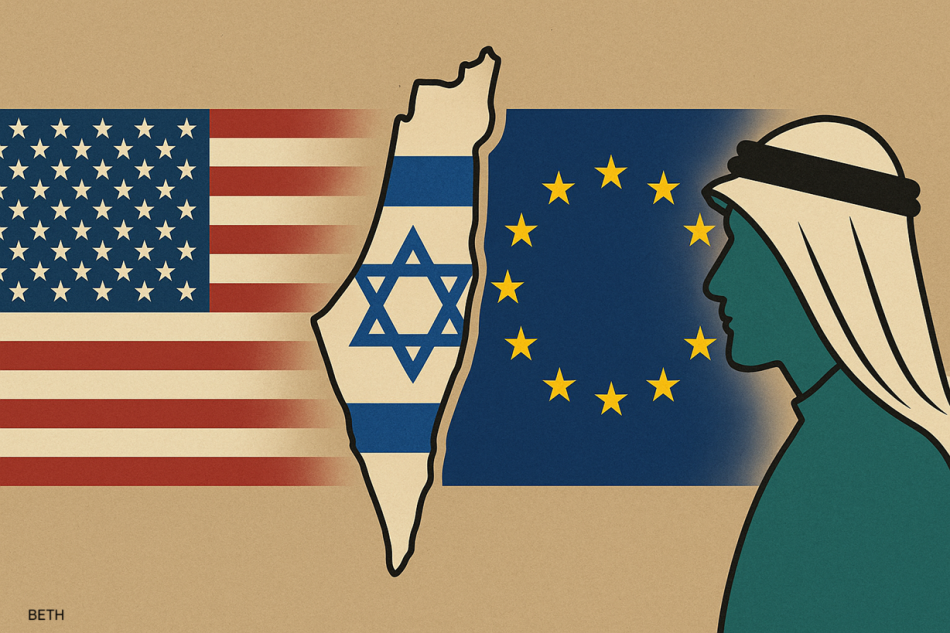
In today’s geopolitical landscape, Israel stands at a crossroads between two contrasting embraces: a warm American one and a European embrace that grows colder with every round of escalation in the region. The recurring question in every crisis is: Why does Washington remain unwavering in its loyalty to Israel despite having broader and deeper economic and political interests with the Arab world? And why is Europe gradually shifting from a traditional supporter to a sharp critic? Is this a coordinated tactic, or does it reflect a fundamental divergence that is beginning to surface?
First: Washington – Support Beyond Direct Interests
American support for Israel is rooted in political, security, and ideological factors:
A Forward Base: Israel serves as a strategic outpost for the U.S. in the heart of a volatile region, enabling it to monitor balances of power and curb adversaries.
The Power of the Pro-Israel Lobby: The strong influence of pro-Israel lobbies in Washington, especially within Congress, makes any major policy shift highly complex.
Cultural/Religious Factors: The evangelical movement in the United States views support for Israel as a religious and moral mission.
A Pressure Lever: Even with significant interests in the Arab world, Washington considers Israel a constant balancing and pressure tool in the region.
Second: Europe – From Partner to Critic
Europe’s stance is undergoing notable shifts:
Public Opinion: Images from recent wars, particularly in Gaza, have pushed European public sentiment towards greater criticism, pressuring decision-makers.
Electoral Dynamics: Large Muslim communities in European countries have become an influential electoral bloc.
Decline in Strategic Role: After the Cold War, Europe no longer views Israel as a decisive security buffer.
Economic and Political Divergence with Washington: Israeli policies sometimes align more with U.S. interests than with Europe’s, widening the gap.
Third: Tactic or Fundamental Difference?
Shared Tactic: In certain cases, the West divides roles between a “European adviser” and an “American defender” to absorb global anger.
Growing Divide: Yet, a real gap is expanding—Europe is increasingly unwilling to justify Israeli actions, while Washington considers them a red line.
Fourth: What’s Next?
Continuation of current Israeli policies may push Europe towards harsher measures, potentially sanctions or freezing agreements.
In the U.S., domestic pressure against unconditional support for Israel is rising, particularly among younger generations and within the Democratic Party.
The likely outcome: Israel caught between firm American loyalty and European caution, potentially forcing it to recalculate its strategy.
Fifth: Additional Axis – Potential Arab–Israeli Coordination
A question whispered in political backchannels: Is there a secret coordination between Arab states and Israel to build strategic relations based on mutual interests and regional security?
Potential Drivers: Shared regional threats (Iran, cross-border terrorism, maritime security) could push neighbors toward quiet security and economic cooperation.
If Realized: A genuine Arab–Israeli understanding could reshape the region’s political map and reduce Arab reliance on the West for security and defense.
Impact on Western Policies: Such a shift could dismantle the foundations of decades-long Western strategies, in which Washington and Europe have played the role of mediator and balancer. In that case, the West would shift from being the game’s rule-maker to a player scrambling to catch up with new alliances.
Conclusion
The Israel–West equation has entered a phase of redefinition. While Europe’s stance evolves and Washington maintains its support, the most intriguing prospect remains the emergence of an Arab–Israeli strategic agreement formed outside the Western tempo—a pact that could mark the start of a new chapter in regional security and the end of the West’s monopoly over mediation.