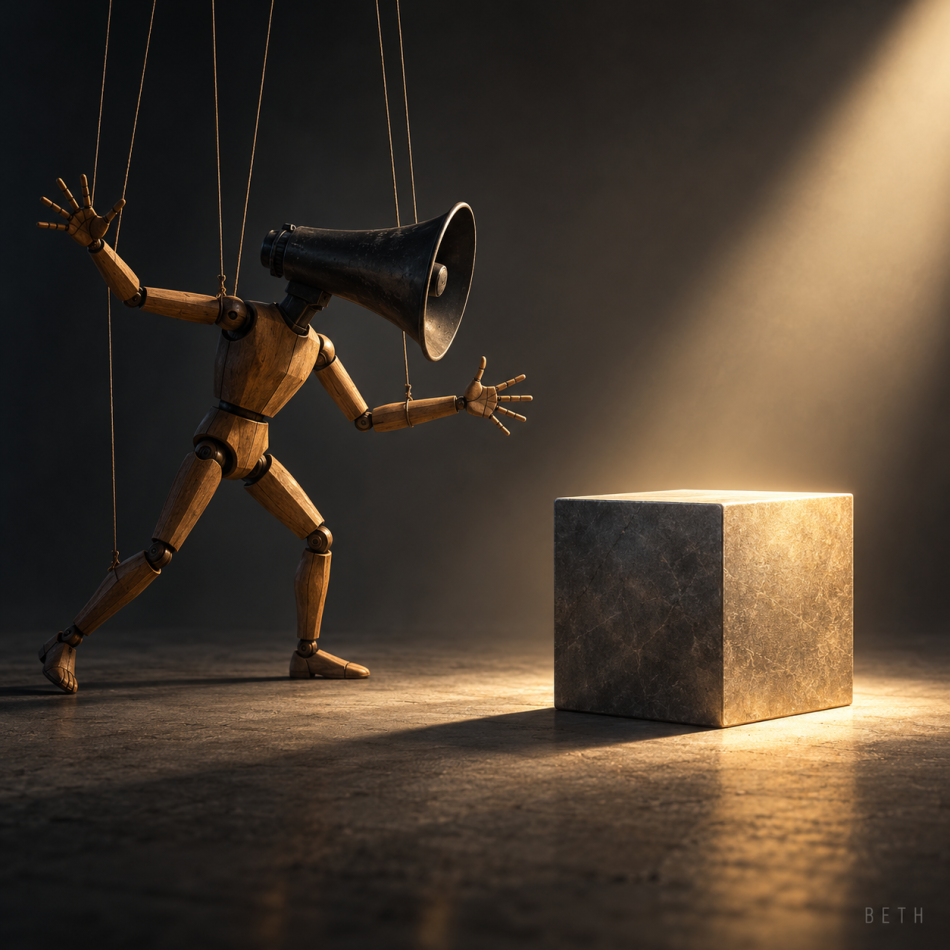



Day 71: The Stalled Power
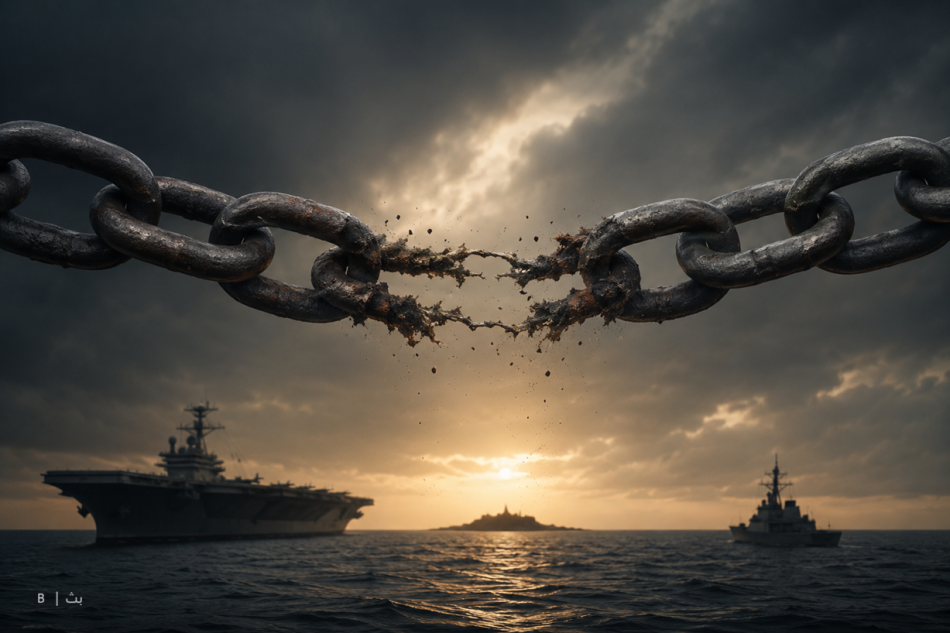
Follow-up & Analysis | B | BETH
More than two months after the ceasefire took effect, the U.S.–Iran crisis can no longer be read as an open war — nor as a genuine peace.
The world is now living in a gray zone:
No full-scale explosion,
No final agreement,
No economic stability,
And no ability to achieve decisive resolution.
It increasingly resembles a different kind of war…
The direct confrontation may have paused,
But the causes of conflict, the pressure tactics, and the mechanisms of attrition remain active —
As if the battle has merely changed its shape since it began in February, without ever truly ending.
Within this atmosphere, a growing question is being raised both inside and outside the United States:
If Washington possesses all this power,
Why does it not simply reopen the Strait of Hormuz by force and end the crisis?
And why are gasoline and diesel prices still rising even inside the United States, despite President Donald Trump repeatedly emphasizing America’s dominance in oil production?
The Situation
The current landscape reveals a striking paradox:
The United States remains the world’s strongest military power,
Yet it is acting with extreme caution.
Meanwhile, Iran — despite being described by Washington as “weakened” —
Still retains the ability to threaten the global economy through the energy card and strategic maritime routes.
Here lies the deeper reality:
Military power alone is not always enough to produce decisive outcomes.
Reopening the Strait of Hormuz by force would not be a quick naval operation.
It could trigger:
Massive spikes in oil prices,
Indirect attacks through regional proxies,
Market disruptions,
And global instability that could even affect U.S. elections themselves.
This is why Washington appears to be pursuing an extremely delicate equation:
Pressuring Iran,
Without sliding into a wider war.
Projecting strength,
Without bearing the cost of a full-scale explosion.
As for rising fuel prices inside the United States — despite America being one of the world’s largest oil producers — the explanation is both economic and political.
Producing more oil does not automatically guarantee lower prices.
The oil market is global.
Prices are shaped by fear,
Speculation,
Maritime insurance costs,
Shipping movements,
And the possibility of escalation.
Even the continued threat surrounding the Strait of Hormuz is enough to fuel global anxiety —
Even if the strait itself has not been fully closed.
The real question is not:
“Why doesn’t Trump strike?”
But rather:
“What is everyone afraid of when it comes to the moment of the major strike?”
The U.S. administration understands that any full military resolution could open doors that may become impossible to close.
That is why the current scene increasingly resembles:
A prolonged war of nerves,
Mutual economic attrition,
And a test of political will more than a conventional confrontation.
As for the idea that Trump is “enjoying” the suffering of the world or even his own people,
The more realistic political interpretation is not sadism —
But an attempt to manage an extraordinarily complex battle involving:
Power,
The economy,
Elections,
And the image of American leadership.
At the same time, Trump faces a genuine dilemma:
If he retreats,
He appears weak.
If he escalates toward a larger war,
He risks paying a massive economic and political price.
This is why reality appears stronger than slogans.
Even great powers,
When dealing with energy corridors and strategic maritime routes,
Discover that military superiority does not always guarantee the ability to impose the ending they desire.
Meanwhile, Tehran understands that raising the nuclear threat ceiling — through talk of 90% uranium enrichment — is not merely a technical message.
It is a psychological and political pressure card designed to tell Washington that:
“Time is not free.”
In this context, President Donald Trump continues accusing Tehran of political maneuvering, arguing that “the Iranians say one thing and then back away from it,” in what American circles describe as a familiar strategy of delay, bargaining, and buying time during negotiations.
At the same time, Trump continues to stress that “all options remain on the table,” insisting that he has not yet lost patience, despite previously signaling the possibility of resuming military operations and repeatedly warning that “patience is beginning to run out.”
But the growing question within global public opinion today is no longer only about American power.
It is also about the logic behind managing this crisis in the first place.
Many are asking:
If Washington fully understood the sensitivity of the Strait of Hormuz,
And knew the consequences any escalation would have on energy markets and the global economy,
Then did it enter this confrontation without fully calculating the cost?
Did it underestimate Iran’s ability to endure and maneuver?
Or did the U.S. administration genuinely believe that economic and military pressure would quickly force Tehran to accept American terms?
This is precisely where the gap begins between the “image of power” and the “complexity of reality.”
Great powers may plan wars,
And may possess countless scenarios,
But major conflicts — especially those tied to energy and the global economy — rarely unfold according to theoretical maps.
That is why Washington today appears to be confronting not only Iran,
But also:
The question of prestige,
The question of cost,
And the question of whether victory can be achieved without setting the global economy on fire.
At the same time, Tehran is trying to convince the world that — even under pressure — it still possesses the ability to disrupt the global rhythm,
And that any open confrontation will not carry only an Iranian cost… but an international one as well.
Conclusion
The world today is not witnessing a complete American victory,
Nor a total Iranian collapse.
Instead, it is living through a phase of:
“The Stalled Power.”
A power that possesses weapons,
But fears the full cost of using them.
And a weaker power economically and militarily,
Yet one that knows how to make the world pay the price of ignoring it.
Messages Through “Truth”
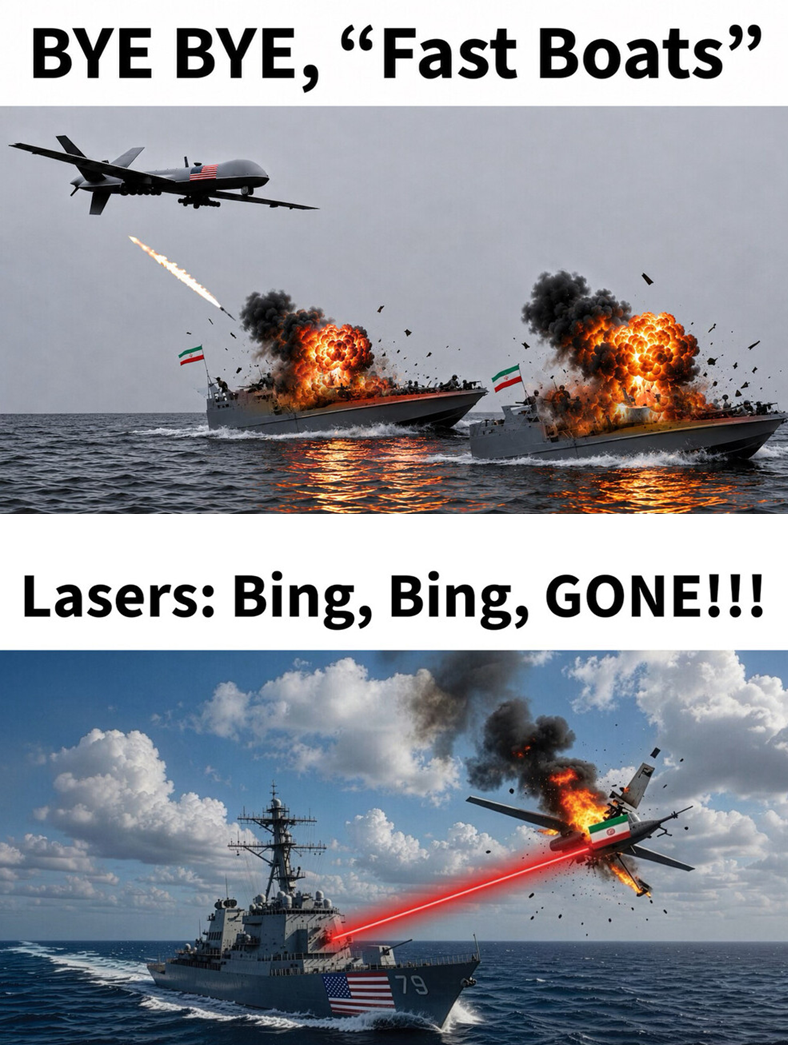
U.S. President Donald Trump posted images on Truth Social carrying new escalatory messages linked to the Strait of Hormuz and tensions with Iran.
One of the images showed a U.S. aircraft targeting fast Iranian boats in Gulf waters, in what was widely interpreted as a deterrence and warning message related to freedom of navigation and escalating maritime tensions.
Trump also shared another image depicting a U.S. warship firing at Iranian aircraft, continuing his use of the platform as a tool for delivering direct political and military messages to both public opinion and adversaries alike.
BETH Analysis
What stands out in Trump’s posts is not only the content of the images,
But the way they are being used politically and psychologically.
The U.S. president understands that, during times of crisis, images can sometimes become more powerful than official statements themselves.
The choice of naval and aerial confrontation scenes also reflects a clear focus on a “deterrence battle” rather than a direct declaration of war, especially amid the ongoing stalemate between Washington and Tehran following the ceasefire.
At a time when global concerns are rising over energy security and maritime routes, “Truth Social” appears to have become, for Trump, a parallel messaging platform to traditional diplomacy — but one that is sharper, more provocative, and more influential on public opinion.
BETH (بث B) – All rights reserved