



Day 70: Between Rejection .. and the Delayed Decision
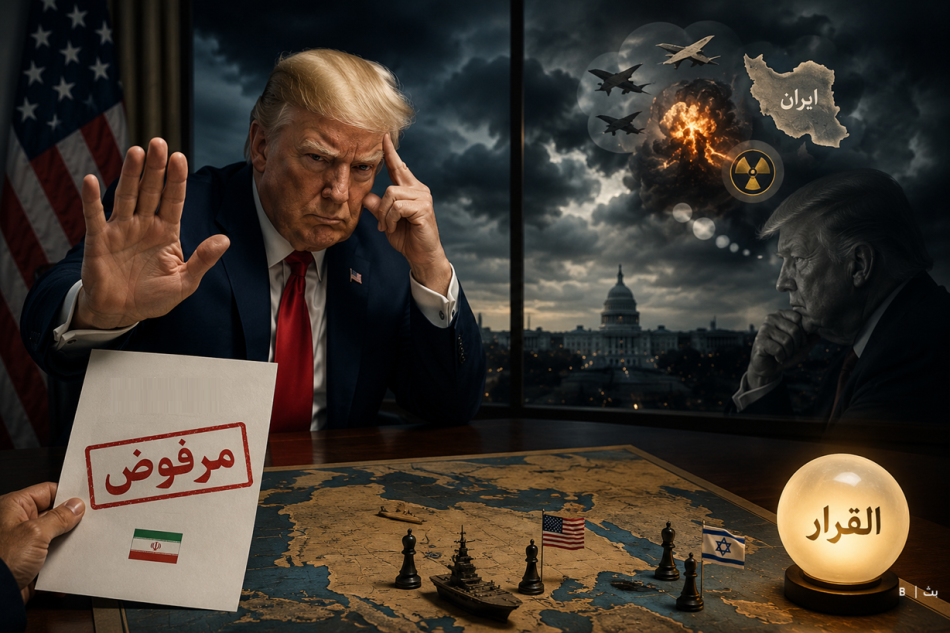
Follow-up & Analysis | B | بث
The American–Israeli war with Iran has entered a more sensitive phase after Washington confirmed receiving Tehran’s response, followed by a direct rejection from U.S. President Donald Trump, who described the Iranian position as “completely unacceptable,” accusing Tehran of “playing games for 47 years.”
At the same time, negotiation channels have not been fully closed. Reports emerging from Pakistan indicate that unofficial contacts are still ongoing, amid deliberate ambiguity surrounding Washington’s true intentions.
The Situation
According to leaks, the Iranian response included a clear equation:
Stopping the war in exchange for political and security guarantees, alongside readiness to reopen the Strait of Hormuz.
However, the American response has so far remained more political and media-driven than military.
Trump appeared to send several parallel messages:
- A public rejection of the Iranian proposal.
- Holding Iran responsible for the escalation.
- A personal assertion that he is “the one responsible for the decision.”
- Preserving ambiguity regarding the next move.
Meanwhile, Israeli Prime Minister Benjamin Netanyahu reportedly stressed during his call with Trump the need for the complete dismantling of Iran’s nuclear facilities, revealing the continuing gap between “ending the war” and “what kind of ending is actually required.”
In the markets, oil prices jumped nearly 3%, surpassing $104 per barrel, signaling that investors are increasingly pricing in the possibility of delayed or failed negotiations.
B | بث Analysis
The current scene does not necessarily indicate the collapse of negotiations.
Rather, it suggests a transition into a stage of “strategic endurance.”
Iran is attempting to:
- Stop the strikes.
- Prevent internal collapse.
- Preserve a minimum level of political prestige.
- Reopen Hormuz under conditions that save face.
Washington, meanwhile, appears to seek:
- A harsher agreement.
- Greater concessions.
- Or additional pressure before any final settlement.
But the most important question remains:
If the United States is capable of decisive military action quickly,
why is it still exercising patience?
The most likely explanation is that Washington understands a full-scale war would not be simple, and that collapsing the Iranian system entirely could unleash massive regional chaos, including:
- Severe global oil disruptions.
- Threats to maritime navigation.
- Expansion of indirect attacks.
- The involvement of international powers.
- Multiple regional fronts erupting simultaneously.
At the same time, Iran recognizes that it is militarily and aerially weaker, yet it is betting on what can be described as:
“the cost of American victory.”
In other words, making any final outcome politically, economically, and internationally expensive for Washington and its allies.
What Comes Next? (Expectations)
The most likely scenarios in the coming days:
Continued Secret Negotiations
Despite the public escalation, both sides still appear to be leaving the door partially open.
Additional Military Pressure
Iran may witness new strikes or limited operational messages designed to increase pressure before any agreement.
No Forced Reopening of Hormuz — Yet
Washington still appears to prefer reopening the Strait through agreement or Iranian retreat, rather than through a large-scale naval confrontation that could ignite the entire region.
Rising Psychological and Media Tension
Contradictory statements are likely to continue as part of a battle of wills more than a battle of clear public positions.
Approaching the “Real Decision Moment”
All indicators suggest that the maneuvering phase is nearing its end, and that the coming days could determine one of two paths:
- A harsh agreement imposed on Iran.
or - A broader escalation that could reshape the region entirely.
Conclusion
What is happening now is not merely a negotiation to stop a war.
It is a negotiation over the shape of the next Middle East.
So far,
Washington does not want to retreat,
and Tehran cannot afford complete surrender.
And because of that,
the world continues to stand atop a burning oil barrel.
BETH (بث B) – All rights reserved