



The World Between Contradictions
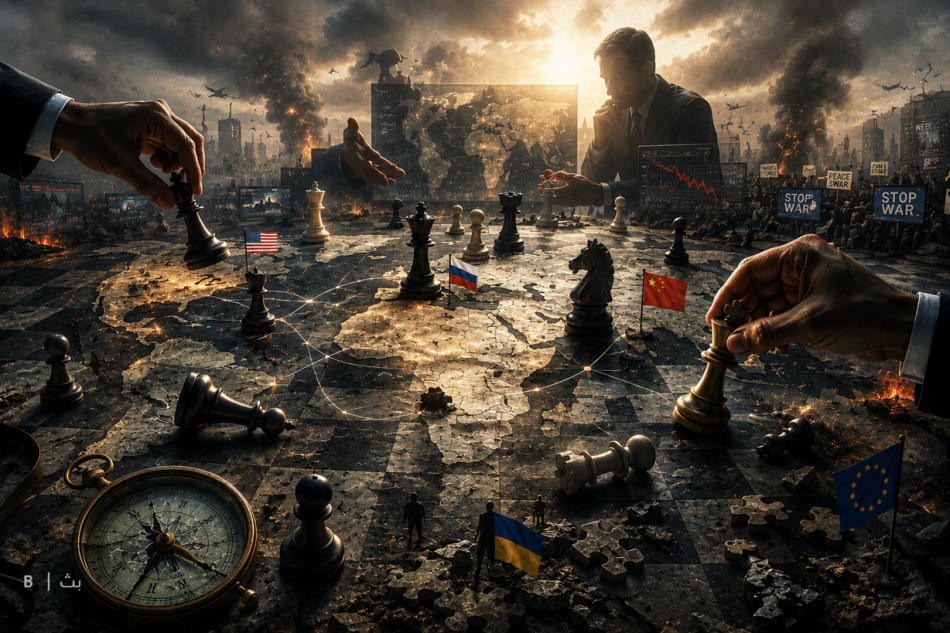
Managing Chaos .. or the Chaos of Management?
Prepared and Analyzed by | Strategic Media Department – BETH Agency | B
The world no longer moves along clear lines: an enemy here, and an ally there.
Instead, international relations are now managed through a more confusing logic: negotiations in public, pressure in secret, rivalry in one file, and temporary understanding in another.
America is economically confronting China, politically negotiating with Russia, and differing with Europe within the same camp. Russia requests a truce in Ukraine during its Victory Day celebrations, while simultaneously moving in the Middle East with rhetoric calling for de-escalation, yet behavior that opens additional doors to tension. Trump announced a three-day Russia–Ukraine ceasefire coinciding with Russia’s Victory Day, amid continuing mutual accusations of violating previous truces.
The dilemma here is not the difference in interests; that is natural in international politics.
The dilemma is that the world hears rhetoric about peace, then sees actions that make wars even more complicated.
Russia, for example, speaks about supporting the diplomatic track regarding Iran, and calls for supporting U.S.–Iran talks, yet at the same time moves within a network of relationships and interests that make its presence in the region appear closer to managing balances than extinguishing fires.
Here, the deeper question emerges:
Do these countries truly know what they are doing?
Or is the world today being managed with the mentality of political maneuvering rather than strategic thinking?
Most likely, what we are witnessing is neither complete chaos nor a perfectly calculated plan.
It is a dangerous mixture of cold calculations, reactions, investment in crises, and attempts by every power to gain time, space, and influence without paying the full price.
America wants to hold the world’s strings without drowning in every war.
Russia wants to return as a power that cannot be bypassed, even if it appears to extinguish a fire with one hand while feeding another with the second hand.
China wants a quiet rise that does not provoke a direct war, yet it benefits from exhausting its rivals.
Europe appears like someone discovering too late that complete dependence on the American umbrella is no longer a comfortable guarantee; European studies themselves point to growing challenges in the transatlantic relationship because of differences over the economy, energy, climate, China, and Washington’s unilateral approaches.
BETH Analysis
What appears as “messiness” in the media may, in essence, be a policy of managing contradictions.
Major powers do not always search for a final solution.
Sometimes they search for a controllable crisis.
They do not want a full-scale war, yet they do not want a peace that ends their ability to apply pressure.
They do not want the enemy to collapse, yet they do not want it to regain its strength.
They do not want major chaos, yet they invest in small chaos.
That is why public opinion lives in a cycle:
A reassuring statement, then a disturbing move.
A call for peace, then weapons in motion.
Talk about international law, then bypassing it at the first test of interests.
The clear message that must reach public opinion is this:
The world is not governed by slogans, but by interests.
Countries should not be read only through their words, but through their repeated behavior, and through identifying who benefits from the continuation of the crisis.
In international politics, contradiction is not always a mistake.
Sometimes it is a tool.
And true awareness begins when we do not believe rhetoric alone, nor become deceived by isolated actions, but instead read the entire trajectory.
Before the Crisis
The transformations and contradictions in global politics can no longer tolerate a traditional media mentality, or advisers who move only after the event has already occurred.
The world is changing at a speed that exceeds improvised reactions, imposing a real need to develop methods of thinking, analysis, and pre-crisis preparedness before explosions occur.
The issue is no longer:
“What do you think about what happened?”
It has become:
What may happen?
Why?
What will the reaction be?
And how can the other side’s move be anticipated before it happens?
This type of thinking requires high precision in selecting advisers, and building teams capable of reading trajectories rather than headlines alone, understanding what lies behind statements, and linking small details to the bigger picture.
Today’s world does not wait for those who are late in understanding.
It rewards those who prepare before the crisis, not after it.
And it seems that the coming phase requires even media institutions — including BETH Agency — to move from merely analyzing the event… to building a proactive mentality capable of reading what comes before the event, and what comes after it, at the same time.
Note
Many analysts — and even some classified as advisers — still speak the language of the self, rather than the language of deep understanding of transformations.
Some media and political discourse still operates with the mentality:
“Listen to what I say… then agree.”
While the new global reality imposes a completely different mentality:
“Think about what I say… before agreeing or rejecting.”
The difference here is fundamental.
The language of the self is a message moving in one direction, with a weak traditional style that relies more on indoctrination than understanding, and more on reaction than the creation of awareness.
Today’s world, however, moves through minds searching for analysis, connecting data, and anticipating outcomes — not merely repeating ready-made positions.
That is why the problem is no longer a lack of information,
but rather the way of thinking about it, and reading what lies behind it.
__________
The image:
The world is neither under the control of complete genius, nor complete chaos... but rather under: confused interests + managed contradictions + shifting calculations + political maneuvering + constant reactions.