



Day 68: The Truce of Attrition
Follow-up & Analysis | BETH | B
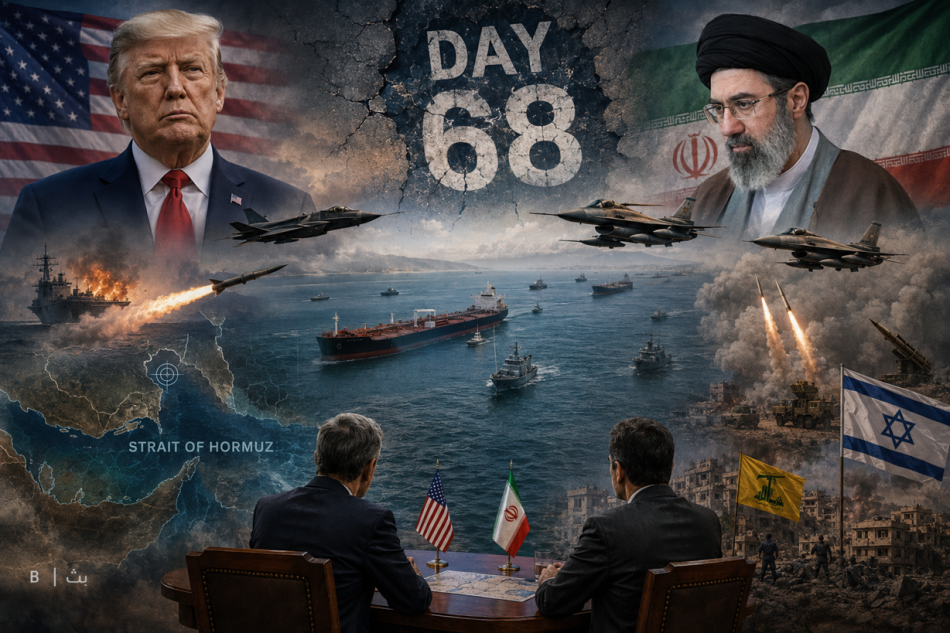
The U.S.–Israeli war with Iran has entered its sixty-eighth day, after months of strikes, pressure, and incomplete negotiations, in a scene that no longer resembles either a conventional war or a genuine peace.
Since the confrontation erupted last February, waves of intense bombardment have paused several times to make room for negotiations. Yet the features of war never truly disappeared.
Threats continue, economic and political pressure keeps escalating, and field-level skirmishes have not fully stopped, while Washington maintains its strategy of “pressure until signature.”
On the other side, Iran’s Revolutionary Guard continues to display resistance and delay tactics, rejecting concessions that could be interpreted domestically as surrender, despite the mounting pressure.
The Situation
The latest indications suggest that U.S.–Iran talks could resume next week, amid conflicting leaks and contradictory statements from both sides, reflecting the widening gap between political rhetoric and what is unfolding behind closed doors.
Among the most notable developments today:
- “Freedom Plus Project” — Trump hinted at an updated plan related to the Strait of Hormuz, signaling continued U.S. focus on securing oil flows and freedom of navigation, with the possibility of expanding maritime and economic pressure tools.
- New U.S. intelligence assessments revealed that the son of Iran’s Supreme Leader, Mojtaba Khamenei, is participating in shaping the war strategy. The move is being interpreted as an attempt to better understand Iran’s internal decision-making circles, and perhaps prepare for a more complex phase in dealing with Tehran.
- On another front of the conflict, Israel continues striking Hezbollah-linked positions in Lebanon, in an effort to prevent the northern front from expanding and to contain any movement that could disrupt the broader pressure campaign against Iran.
Amid all this, Trump continues speaking about the possibility of reaching an agreement, while simultaneously repeating threats and deadline warnings. Tehran, meanwhile, continues issuing dual messages balancing cautious openness with media escalation.
So far, neither side appears to have reached the level of trust necessary for a breakthrough. Instead, both seem trapped in a phase of “managed attrition,” where each side seeks to exhaust the other psychologically, politically, and economically before either a deal — or an explosion.
BETH Analysis
The question echoing today across the global street is no longer:
Are there negotiations?
But rather:
Is this truly negotiation… or simply war through different means?
The United States still appears determined to avoid sliding into a prolonged and costly full-scale war, despite its overwhelming military superiority. Iran, meanwhile, understands that endurance does not necessarily equal victory.
The scene therefore resembles two sides moving along the same edge:
Washington pressures without seeking total collapse.
Tehran maneuvers without entering a final confrontation.
As for the contradictory statements, they may not reflect confusion as much as they reflect part of the battle management itself;
statements used to apply pressure, raise ceilings, test reactions, and buy time.
But the longer this pattern continues,
the greater the chances of miscalculation,
and the wider the space for unintended incidents.
An undeclared truce does not mean peace.
Fragmented negotiations do not mean the war is over.
And in the Middle East,
sometimes,
the most dangerous moments are not the moments of explosion —
but the moments when everyone believes the explosion has merely been postponed.