



Day 67: Truce Under Fire
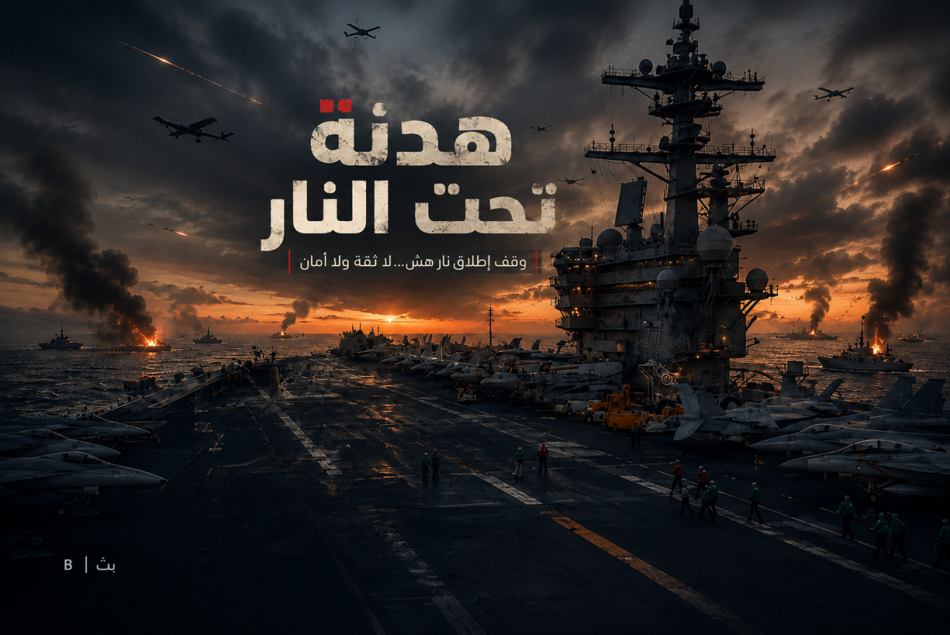
Follow-up and Analysis | BETH | B
The U.S.–Iran confrontation entered its 67th day amid renewed escalation in the Gulf waters and the Strait of Hormuz, after both sides exchanged attacks on Thursday evening, in a scene reflecting the fragility of the ceasefire announced last April.
Overview
U.S. Central Command announced that Iranian forces launched missiles, drones, and fast-boat attacks against three American destroyers, confirming that Washington responded with what it described as “defensive” strikes targeting Iranian military sites in:
- Qeshm Island
- Bandar Abbas
- Kharg Island
in addition to coastal cruise missile sites and air defense radar positions.
According to the American account, Iran was preparing to launch further attacks before the strikes were carried out.
On the other side, Iran’s Revolutionary Guard stated that the United States was the party that violated the ceasefire by targeting an Iranian oil tanker and another vessel near the Strait of Hormuz, as well as conducting airstrikes on the coasts of Khamir, Sirik, and Qeshm Island.
It added that Iranian forces responded by attacking American military vessels east of the Strait of Hormuz and south of the port of Chabahar.
Despite the escalation, Tehran later announced that “the situation has returned to normal,” while Washington stressed that it does not seek to expand the confrontation.
The developments come at a highly sensitive moment as the United States awaits Iran’s response to the American proposal for a preliminary agreement aimed at ending the fighting, while postponing complex issues — most notably Iran’s nuclear program — to later negotiations.
Wall of Steel
U.S. President Donald Trump escalated his rhetoric toward Iran following American strikes on Iranian military targets, while insisting that the ceasefire agreement with Tehran “remains in effect and operational,” despite continued clashes and rising tensions in the Gulf waters and the Strait of Hormuz.
Trump described the American strikes as a “limited retaliatory response,” calling them nothing more than “a light slap,” in a signal that Washington is still trying — at least for now — to avoid sliding into a full-scale confrontation.
Through Truth Social, Trump confirmed that three American destroyers successfully crossed the Strait of Hormuz “under Iranian fire,” stressing that none of them sustained any damage.
He added that the Iranian boats involved in the attack were “completely destroyed,” saying U.S. forces “easily intercepted the missiles,” while the three destroyers would join what he described as:
“A Wall of Steel”
as part of the naval blockade imposed on Iran.
Trump also threatened “much harsher” strikes if Tehran does not sign an agreement “quickly,” while simultaneously confirming that negotiations between the two sides are continuing.
He further revealed that Pakistan had asked the United States not to implement the so-called “Freedom Project” in the Strait of Hormuz while negotiations are ongoing — a statement reflecting the extreme sensitivity of any large-scale military move inside the world’s most critical energy corridor.
BETH Analysis
Trump’s language reveals that Washington is trying to manage an extremely delicate equation:
Showing strength,
without igniting a full war.
He speaks about:
destruction,
blockade,
and harsher strikes,
while at the same time insisting that:
the ceasefire is still active,
and negotiations have not stopped.
This means the current escalation should not yet be read as a final decision for war,
but rather as part of:
“Negotiating through fire.”
The phrase:
“A Wall of Steel”
carries not only military meaning,
but also a psychological and strategic message aimed at:
demonstrating American control over maritime routes,
reassuring global markets,
and deterring Iran from imposing a new reality inside the Strait of Hormuz.
Yet the broader picture also reveals that the region has entered an extremely sensitive phase,
where:
military strikes,
political messaging,
negotiations,
and naval blockade operations
are all unfolding simultaneously.
And here the most dangerous contradiction emerges:
Every side says it does not want war,
yet everyone moves closer to it with every new round of escalation.
What is happening can no longer be described merely as a “ceasefire violation” in the traditional sense.
It has evolved into a new pattern that can be described as:
Truce Under Fire.
Neither side wants a full-scale war,
yet both also refuse to appear weak, retreating, or incapable.
That is why we continue to witness a recurring equation:
limited strikes,
calculated responses,
fiery messages,
followed by a rapid return to the language of de-escalation.
The scene reveals that the current ceasefire is not built on mutual trust,
but rather on:
managing the fear of a major explosion.
The United States seeks to protect maritime navigation and maintain pressure without sliding into open war,
while Iran seeks to prove that it still possesses the ability to threaten maritime routes and impose costs on any American move.
But the more dangerous aspect is that the repetition of these “limited clashes” may gradually create a dangerous state of normalization,
where reciprocal attacks become an almost routine part of daily life in the Gulf.
And here the most important question emerges:
Are we truly witnessing a ceasefire…
or merely a transitional phase between two wars?