



What Is Happening in Mali?
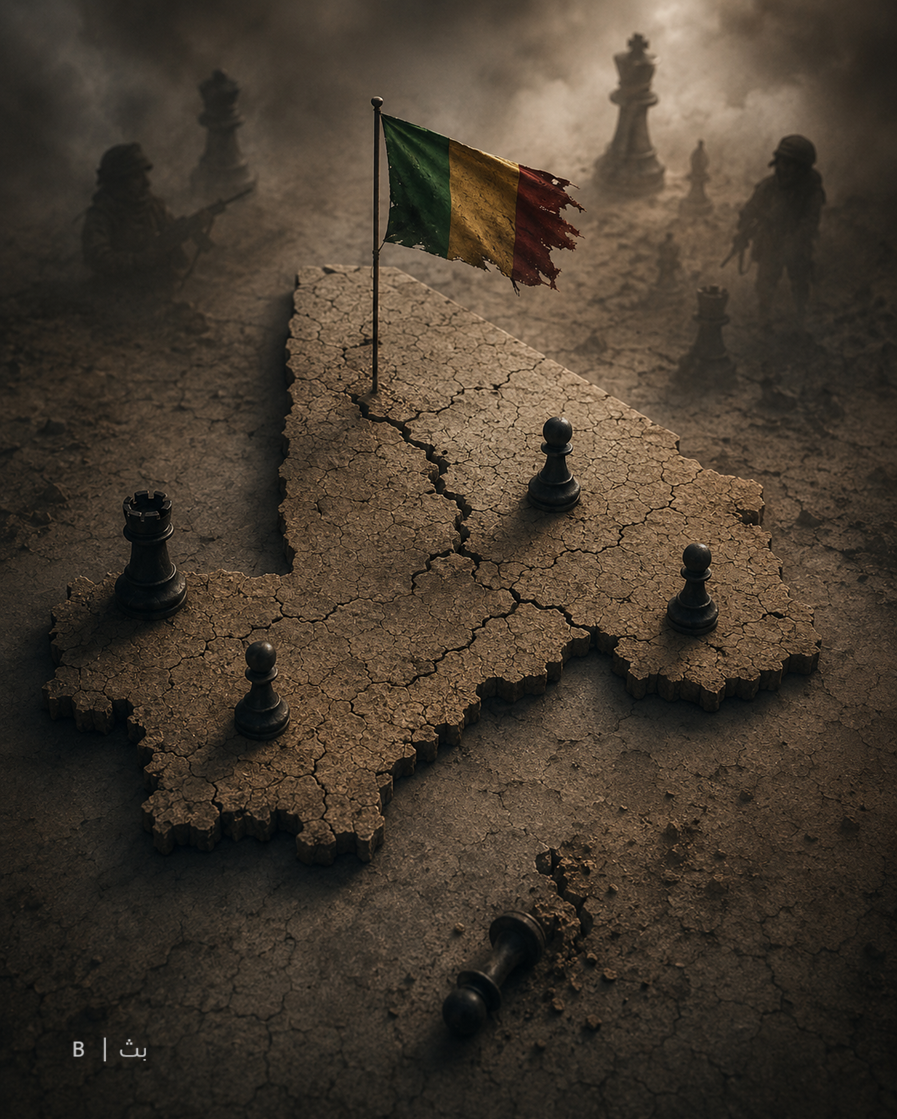
Follow-up and Analysis | BETH | B
What is happening in Mali can no longer be described as mere security unrest or scattered attacks in a distant African country.
The situation today is far bigger than that.
Mali is gradually transforming into a complex model of a fragile state where armed groups, military authority, international influence struggles, proxy conflicts, and the strategy of “attrition instead of decisive victory” intersect on the same ground.
The question is no longer: Is there a war in Mali?
But rather: Where is Mali heading? And why has it become such an open arena?
What Is Happening on the Ground?
Mali is witnessing an escalating wave of violence led by Jama’at Nusrat al-Islam wal-Muslimin (JNIM), the al-Qaeda-linked group, alongside movements by Tuareg separatist factions in the north.
The attacks are no longer confined to distant regions. They have begun placing pressure on the outskirts of the capital, Bamako, through targeting roads, supply lines, and military positions in an attempt to gradually suffocate the state rather than overthrow it all at once.
This highlights an important reality:
Armed groups do not always need to capture the capital in order to win.
Sometimes, it is enough to make the state appear incapable.
For this reason, the battle in Mali is no longer merely a territorial confrontation. It has become a long war of exhaustion against the state, the military, the economy, and public confidence.
Why Has Mali Reached This Point?
Because the state has lost balance on multiple levels at the same time:
- Declining security control over vast parts of the country.
- Economic weakness, poverty, and fragile infrastructure.
- Ethnic, tribal, and regional divisions.
- Erosion of trust between society and the authorities.
- Increasing reliance on military solutions without building a coherent political structure.
The military leadership in Bamako built its legitimacy around one central promise:
“We are capable of restoring security.”
But when attacks continue despite military rule, the legitimacy of the authority itself begins to erode.
Is the Crisis the Result of the Strength of Armed Groups?
Partly, yes.
But the larger issue is not only the strength of these groups. It is the fragility of the state itself.
A country like Iran may face wars and pressure, yet it still possesses deep institutions and a relatively cohesive state structure.
Fragile states, however, are far more vulnerable to infiltration and attrition.
Armed groups in Mali rely on:
- Vast geography
- Open borders
- Rapid mobility
- Indirect warfare
- Exhausting the army instead of confronting it conventionally
These groups understand that they may not be able to rule all of Mali. But they can prevent the state from stabilizing.
Have Proxy Wars Returned?
To a large extent — yes.
But in a far more complex form than in the past.
Proxy warfare no longer necessarily means a militia openly acting on behalf of a major power.
Today, it can emerge through:
- Private military companies
- Intelligence support
- Arms deals
- Economic influence
- Control over mines and natural resources
- Political backing for regimes or armed factions
Following the decline of French influence and the withdrawal of international forces, Mali’s authorities turned toward Russia, where Russian influence emerged through security and military networks linked to Moscow.
At the same time, Western powers still view the African Sahel as a highly sensitive region tied to terrorism, migration, and natural resources.
As a result, Mali has become a crossroads where:
Russian influence, Western concerns, Armed groups, and local military rule all intersect.
Why Do Wars Often Erupt in “Fragile Regions”?
Because they are the least capable of resistance and the easiest to penetrate.
Strong states possess: Institutions, resilient economies, stable national identities, and cohesive state structures.
Fragile states, by contrast, quickly become open arenas for conflict.
The important question is:
Are such regions intentionally prepared for war?
Sometimes chaos is not entirely manufactured from abroad. But outside powers know very well how to exploit it.
When there are: Divisions, poverty, weak institutions, and internal conflict, a state becomes an ideal environment for intervention and indirect conflict.
At that point, the country shifts from being a genuinely sovereign state into an open sphere of influence.
What Is Mali’s Future?
The most likely scenario is that Mali will not collapse suddenly. Instead, it will enter a phase of “slow erosion.”
In other words: A state that officially exists, but gradually loses control over its regions, roads, and parts of its cities.
The coming period may witness:
- Greater pressure on the capital
- Expansion of armed group influence
- Internal divisions within the military establishment
- Unannounced understandings with certain local factions
- Deeper external involvement
As for a complete military resolution, it still appears distant.
Conclusion
What is happening in Mali is not merely the story of a troubled African state.
It is a clear example of what happens when weak state structures, weapons, poverty, fragmentation, and great-power competition collide.
The war there is not simply a confrontation between an army and armed groups.
It is a struggle over: Influence, geography, resources, and the future shape of Africa.
The most dangerous possibility is that Mali may not be the end of the story, but the beginning of a new model of warfare: Wars without major armies on the front lines, but with heavy shadows moving behind the curtain.
Who Benefits?
The question may appear simple…
but in fragile wars, it is often the most complicated question of all.
In Mali, there is no single beneficiary in the direct sense.
Armed groups benefit from chaos and expanding security vacuums.
Some international powers benefit from reshaping influence and strategic interests.
Arms and security industries find an open market in prolonged instability.
Smuggling networks and illegal migration routes grow stronger as the state weakens.
But the deeper reality is this:
Sometimes, the objective is not “complete victory”…
but keeping the region trapped in a state of permanent exhaustion.
A state that neither fully collapses,
nor fully stabilizes.
At that point, chaos itself becomes an interest,
and the continuation of the crisis becomes more beneficial to some actors than its resolution.
And in wars like these,
the real question may not be:
Who wins?
But rather:
Who wants the war never to end?
BETH (بث B) – All rights reserved