


Why Has Decisive Action Been Delayed?
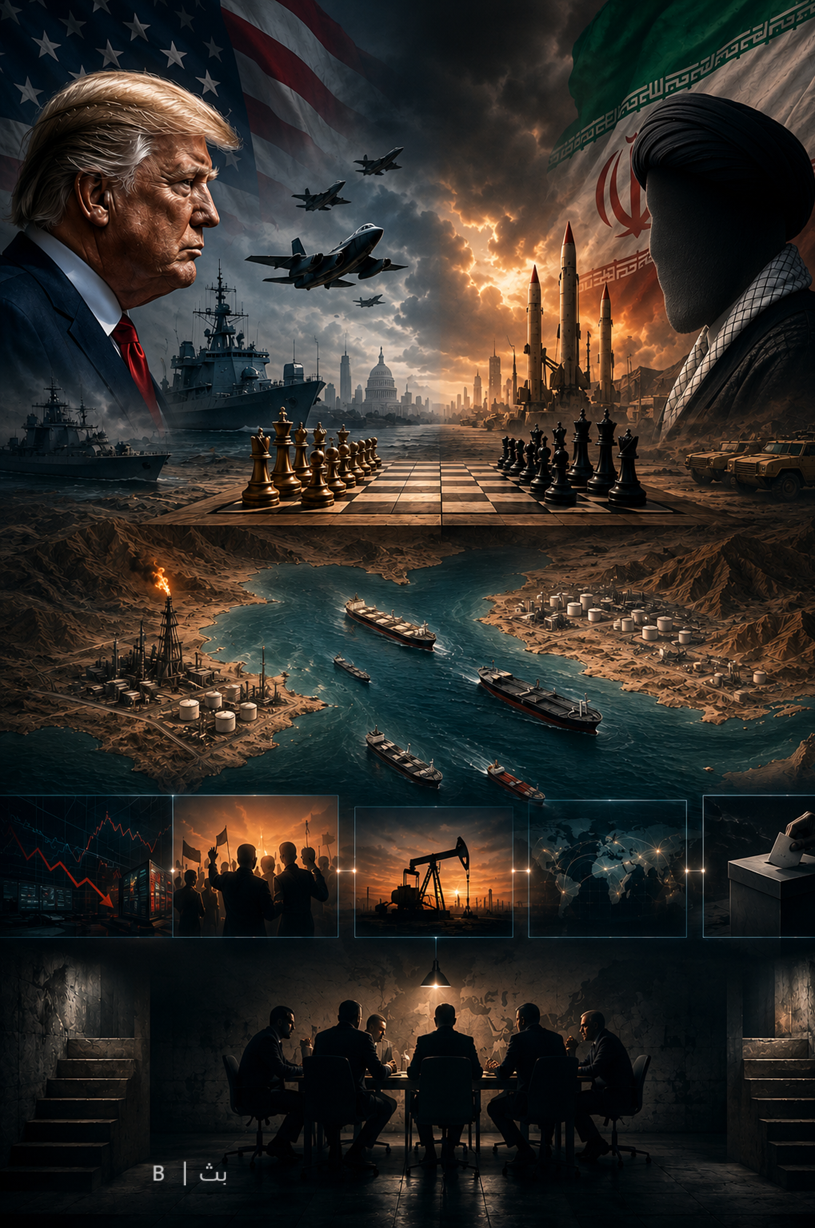
Prepared and Analyzed by | Strategic Media Department – BETH News Agency | B
The question repeated today across the street, the media, and even inside analytical circles is this:
If the United States possesses such overwhelming military superiority,
why has the confrontation not been resolved quickly?
Does the delay mean Iran is stronger than many assume?
Or is what is happening far bigger than a conventional military conflict?
First: America Does Not Operate with a “Battle Only” Mentality
A common mistake is believing that the United States is focused solely on achieving a military victory.
In reality, Washington calculates matters through a far more complex lens:
What happens after the strike?
What about oil?
What about China and Russia?
What about the global economy?
What about elections?
What about the Gulf region?
What about internal reactions inside Iran itself?
Sometimes, military power can eliminate a target within hours,
but the political consequences may ignite years of instability.
This is why delay does not always indicate weakness.
It may simply mean the final decision carries an extremely high cost.
Second: Iran Is Not an “Easy State”
Yes, the United States holds overwhelming military superiority,
but Iran is not a conventional opponent.
Iran relies on:
- Vast geography
- Indirect warfare
- Regional proxy networks
- Missiles and drones
- The ability to disrupt energy routes and maritime navigation
- Long-term strategic patience
Iran understands it cannot defeat the United States in a traditional military sense.
Instead, it is betting on something else:
“Raising the cost of decisive action.”
In other words, making any American victory politically, economically, and regionally expensive.
Third: Why Was the Strait of Hormuz Not Reopened by Force Immediately?
This is one of the most important questions.
Because reopening the Strait of Hormuz by force is not merely a naval operation.
It is a decision that could ignite the entire region.
Any large-scale confrontation inside the Strait could lead to:
- A dramatic surge in oil prices
- Severe disruption to global energy markets
- Mutual strikes on critical infrastructure
- Expansion of the war beyond Iran
- A prolonged regional conflict
Therefore, the United States is attempting to achieve:
“Effective freedom of navigation… without triggering a full-scale war.”
This explains the pattern we have seen:
Pressure,
threats,
military buildups,
sanctions,
and fiery rhetoric,
while simultaneously avoiding a total explosion.
Fourth: Why Do Trump’s Statements and Iranian Statements Appear Contradictory?
Because public statements are not always directed solely at the opposing side.
Each side is speaking to multiple audiences at the same time.
Trump Speaks To:
- The American public
- Financial markets
- Allies
- Voters
- The military establishment
- Political rivals
This is why he may say:
“A deal is close,”
then issue threats only hours later.
He is trying to combine:
The image of a strong leader,
with the image of a dealmaker.
Iran Speaks To:
- The Iranian public
- The Revolutionary Guard
- Regional allies
- The wider world
That is why Iran often escalates rhetorically,
while simultaneously sending calming messages through intermediaries.
It says:
“We will not retreat,”
then quietly enters indirect negotiations.
Fifth: Are There “Under-the-Table” Understandings?
Most likely, yes.
History shows that major wars are rarely managed entirely in front of cameras.
There are always:
- Mediators
- Secret messages
- Temporary understandings
- Unannounced red lines
- Partial deals
- Negotiations through third parties
This is why the scene can appear contradictory at times:
Escalation above the table…
and de-escalation beneath it.
Conclusion
What is happening does not resemble a traditional war aimed at “toppling the opponent within days.”
It is a conflict of wills,
a struggle over influence,
a test of endurance,
and an attempt to reach:
“The best possible agreement… with the least possible explosion.”
That is why delay may appear to some as a sign of weakness,
while in reality it reflects the complexity of the situation and the dangers of its consequences.
In wars like these,
sometimes the real fear is not starting the conflict…
but losing the ability to stop it once it begins.