


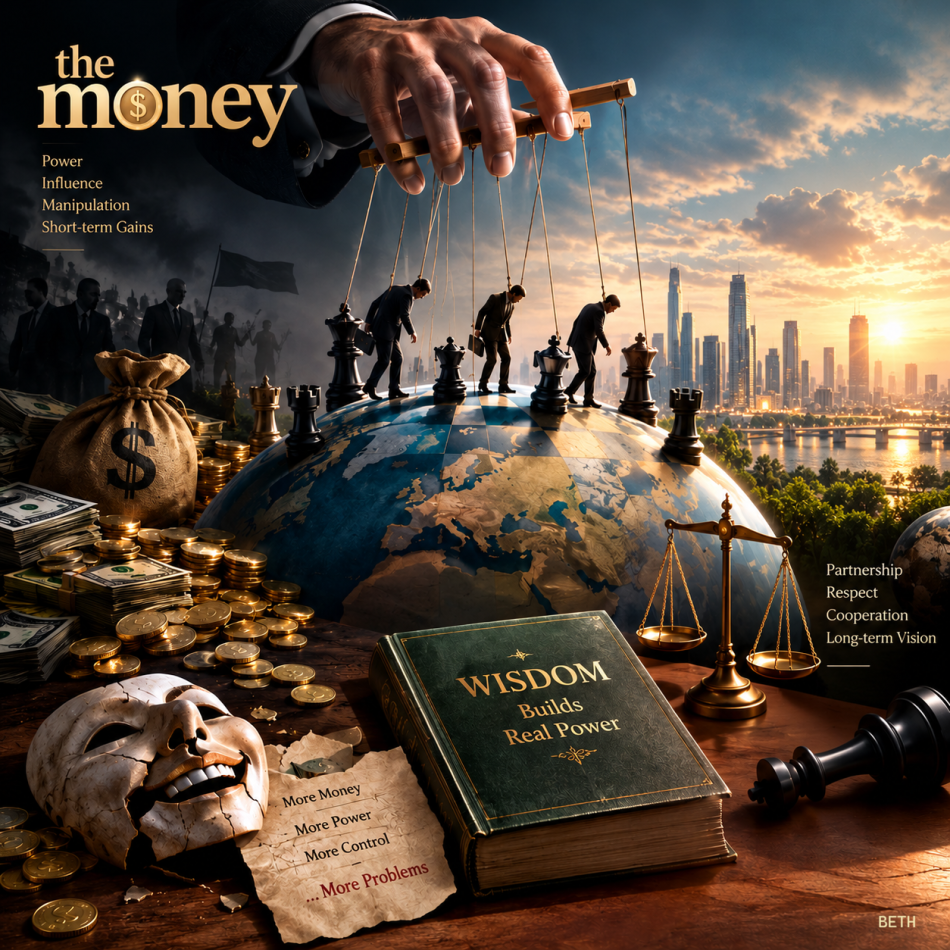
Saudi Spending +20% (Quarterly YoY)
Riyadh | B | B
May 6, 2026
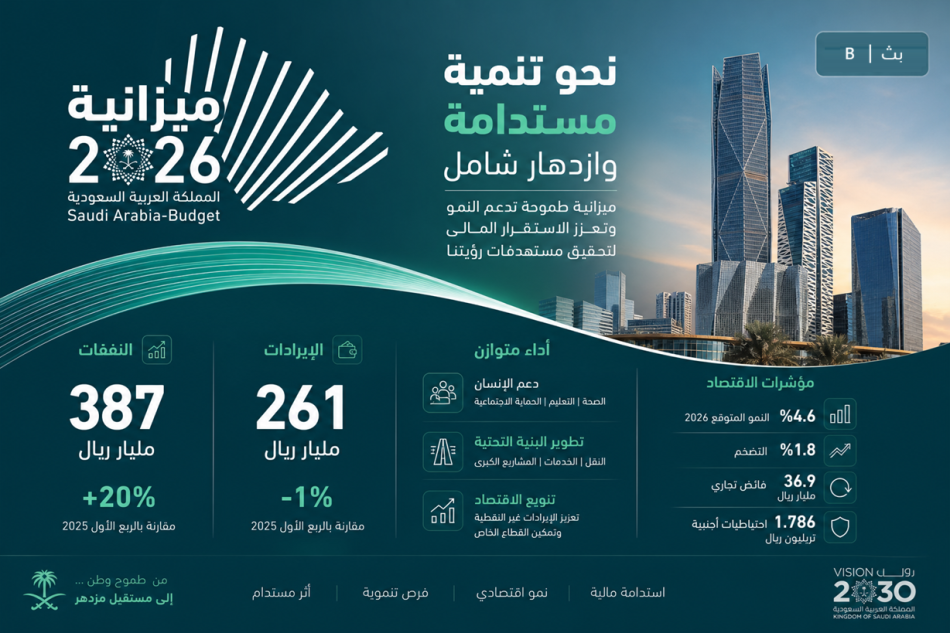
Saudi Arabia’s budget recorded total expenditures of SAR 387 billion in Q1 2026, marking a 20% increase compared to Q1 2025, while revenues reached SAR 261 billion, reflecting a slight 1% decline, within a framework that balances growth stimulation with fiscal sustainability.
The Framework
Spending
- Total expenditure: SAR 387 billion (+20% vs Q1 2025)
- Social benefits: SAR 31+ billion (+2%)
- Health & social development: SAR 81 billion (+12%)
- Infrastructure & transport: SAR 12 billion (+26%)
Revenues
- Total revenues: SAR 261 billion (-1%)
- Oil revenues: SAR 145 billion (-3%)
- Non-oil revenues: SAR 116 billion (+2%)
Economic Indicators
- GDP growth (2025): 4.5%
- 2026 forecast: 4.6%
- Inflation: 1.8% (moderate levels)
External Sector
- Trade surplus: SAR 36.9 billion (Jan–Feb)
- Non-oil exports: SAR 63.3 billion (+17.5%)
- Imports: SAR 160.6 billion (+8.7%)
Labor Market & Activity
- Increase in Saudi private-sector employment: +139.5k (+5.8%)
- POS sales: SAR 189.7 billion (+4.4%)
- E-commerce sales: +42.6%
- PMI: 53.7 (expansion)
Industry & Finance
- Industrial production: +9.8%
- Foreign reserves: SAR 1.786 trillion (+10%)
- Private sector credit: +8.8%
- Real estate prices: -1.6% (relative stability)
B Analysis | بث
The increase in spending is not a conventional expansion,
but a calibrated move toward accelerating growth:
- Direct investment in people (health & social sectors)
- Acceleration of infrastructure (transport & logistics)
- Continued strengthening of non-oil revenues
Meanwhile,
a slight decline in oil revenues is offset by overall stability,
reflecting a gradual shift toward a more balanced economy.
Conclusion
The figures reflect a clear equation:
Active spending
Balanced growth
B | B Tracks the Pulse of the World
Saudi Budget: Growth Spending Under Global Scrutiny
Monitoring & Analysis | B | بث
Foreign media outlets read Saudi Arabia’s quarterly budget primarily through the lens of deficit and rising spending, rather than as a tool for driving economic transformation.
Reuters focused on the first-quarter deficit of approximately SAR 125.7 billion, driven by an increase in spending to SAR 386.7 billion, alongside a 3% decline in oil revenues and a 2% rise in non-oil revenues.
In the same direction, Investing.com highlighted the direct financial headline: a $33.5 billion deficit in the first quarter, resulting from a 20% surge in spending compared to a slight decline in revenues.
Meanwhile, English-language regional outlets such as Arab News and Argaam offered a more balanced and detailed reading, linking higher spending to the execution of national strategies and projects supporting economic diversification, while noting the rise in non-oil revenues to SAR 116 billion.
B Analysis | بث
Foreign readings tend to begin with the deficit,
while a deeper reading begins with the question: Where is the spending going?
The figure does not merely reflect expanded spending,
but reveals continued state investment in transformation:
healthcare, infrastructure, transport, diversification, and the private sector.
The difference lies between those who see the budget as a financial gap,
and those who see it as a tool for economic restructuring.
Conclusion
The external headline:
A rising deficit
The strategic reading:
Spending that is building a new economy
B Perspective
The issue is not which headline is more accurate,
but which one reads the phase… not the moment.
The external headline:
“A rising deficit”
captures the number…
but stops there.
The strategic reading:
“Spending that is building a new economy”
captures the direction…
even if it is not yet complete.
The truth lies between them:
A transitional deficit… financing a long-term transformation
Deeper Interpretation
The deficit is not the result of imbalance,
but the result of a decision:
accelerating projects
supporting non-oil sectors
building a new economic infrastructure
In other words:
What appears today as financial pressure…
may be an investment in future independence
B Analysis | بث
Foreign media measures:
short-term fiscal balance
While the Saudi vision works toward:
long-term economic balance
And here lies the gap:
not in the numbers… but in the understanding
Final Conclusion
Not every deficit is a sign of weakness,
and sometimes it is:
the cost of transition…
from an economy that depends
to one that leads
Those who read the number.. see the deficit
Those who read the direction.. see the opportunity
B | BETH (بث B) – All rights reserved