


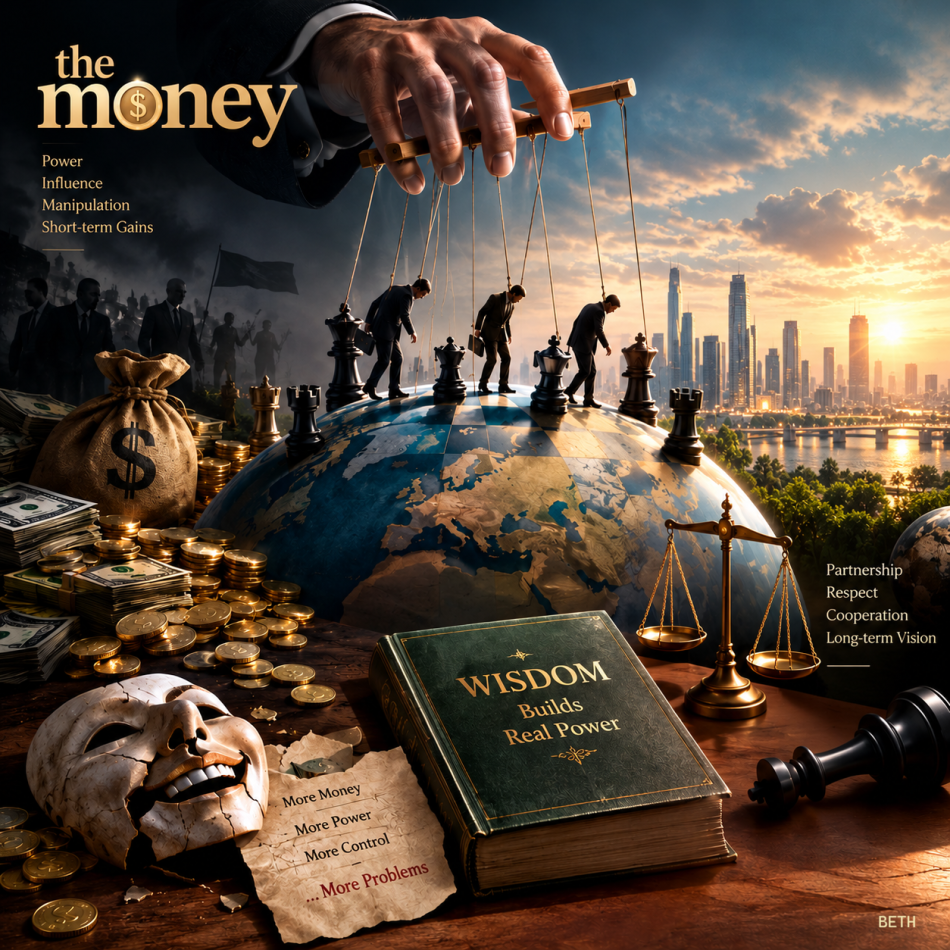
Who Controls Awareness? (1)
Prepared & Analyzed by | Strategic Media Department – B | B
Supervised by: Abdullah Al-Omira
Introduction
The question is no longer: who controls weapons?
Nor even: who controls wealth?
The real question today is:
Who controls what we believe to be the truth?
In a world where information flows faster than our ability to comprehend it,
awareness is no longer a result—it has become a battleground.
The Framework
1. Managed Awareness
The world is not left to be understood;
it is guided to be understood in a certain way.
The order of news, the timing of its release, the angle of its presentation—
these are not details, but instruments of direction.
When one event is amplified and another is marginalized,
you are not seeing reality—you are seeing a curated version of it.
2. The Attention Economy
Major platforms are not competing over truth;
they are competing over your time.
Companies like TikTok and Meta do not measure success by your awareness,
but by how long you stay.
Every second you spend…
is a decision you did not make alone.
3. The Undecided Audience (The Decisive Factor)
Not everyone is convinced, and not everyone is misled.
There is a grey zone:
the undecided audience.
This audience:
doubts… but does not investigate
listens… but does not verify
is influenced… without realizing it
Whoever wins them
does not need to convince the rest.
And here, precisely,
battles are decided.
4. Freedom… or Illusion?
We believe we choose…
but do we really?
Or do we choose from options carefully designed for us?
Modern freedom is not restriction—
it is the design of choices.
5. The Coming Breaking Point
When people begin to doubt everything…
They lose trust in media,
then in narratives,
then in facts,
and perhaps… in themselves.
At that moment, a new danger emerges:
the chaos of awareness.
6. Political Noise: The U.S.–Iran Case
Let us take a live example:
The exchange of statements between Donald Trump and Iran—
threats, responses, escalation, de-escalation… then renewed threats.
The question is not: who is stronger?
But: why all this noise in the first place?
7. When Media Works Against the State
What is most striking
is when programs emerge from within a state, yet move in contradiction to its own direction.
Programs targeting youth—
not to enlighten them, but to appeal to superficial minds and reinforce ignorance.
In media,
nothing is easier than provoking the uninformed and turning them into a ticking time bomb.
Here lies the paradox:
is it silence… or part of a more complex equation?
Content driven by ignorance and guided by agendas—
its lowest impact is fueling division,
its highest is undermining major national projects.
In the end,
a specialist does not read programs, but reads the state through them,
understanding where it is heading and how long it can endure if this path continues.
As often happens,
the snowball is left to grow,
under the illusion that it can be resolved with a single strike.
But reality suggests otherwise:
the larger the snowball becomes, the more complex the solution grows,
and the impact remains—accumulating over time in a cycle of negligence, delay, dependency, and inertia.
The only decisive and effective remedy
is to address the flaw at its inception.
Two Possible Readings
1. A Surface-Level Reading (For the Public)
Direct conflict
Real tension
On the brink of war
2. A Deeper Reading (Of Awareness)
Managing tempo
Controlling messages
Moving markets
Testing reactions
The Question
Is Iran in a position to confront the United States?
Or is what we see merely a “political stage”… while reality is different?
Analytical Answer
Militarily: the gap is clear
Economically: the gap is wider
Strategically: there is no balanced direct confrontation
So why does the scene appear as parity?
Because awareness needs a story… not a formula.
How Is This Illusion Created?
Amplifying statements
Selecting specific visuals
Repeating certain scenes
Ignoring other facts
In the end,
an awareness is formed that says:
“There is a balanced conflict”
While reality may be something entirely different.
B Analysis
The world today is not governed by power alone,
but by the management of the perception of power.
Noise is not always a sign of strength,
and sometimes it is a cover
for something quieter… and far more influential.
Conclusion
The battle is no longer:
who wins the war
But:
who determines how the war is told
Insight
The most dangerous thing today
is not to be misled…
but to be convinced
that you see everything.
Coming next:
Who Controls Awareness? (2)