



Day 64: Hormuz Under Pressure
Riyadh | B | B
May 4, 2026
—
Introduction
The U.S.–Iran conflict enters its sixty-fourth day amid simultaneous political and military escalation, as Pakistani mediation efforts intersect with on-the-ground movements in one of the world’s most critical waterways: the Strait of Hormuz.
The calm still holds—
but it is loaded with rising tension on the edge of confrontation.
—
Overview
Iranian Foreign Ministry spokesperson Esmail Baghaei stated that Tehran sees Washington as clinging to “hardline demands,” noting that the United States “finds it difficult to abandon them,” despite ongoing exchanges via the Pakistani mediator.
He added that U.S. positions “shift continuously,” introducing conditions that effectively hinder any diplomatic track, reflecting a persistent gap between the two sides.
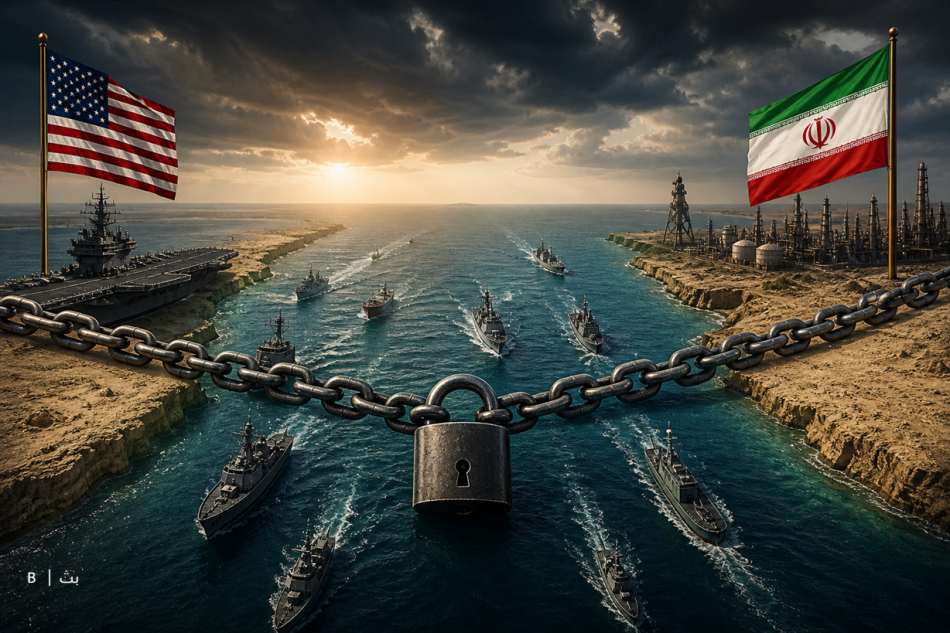
On the ground, Iran announced that navigation in the Strait of Hormuz would take place “only in coordination with it,” in direct response to U.S. President Donald Trump announcing a “Freedom Project” to escort commercial vessels and secure their passage.
Tehran also warned the U.S. Navy against approaching or entering the waterway, affirming it would “respond firmly to any threat,” in a notable escalation that coincides with Washington’s announcement of beginning vessel escorts as of today, in response to international requests to ensure safe navigation.
—
B Reading
This is no longer just negotiation—
it is a struggle for control over corridors.
What is unfolding in Hormuz reveals three realities:
1) Competing sovereignty
Washington acts as a guarantor of international navigation,
while Tehran asserts itself as the authority over the passage.
2) Diplomacy under pressure
Talks continue—
but under the shadow of direct field-level threats.
3) Economy at the core
Hormuz is not just a passage,
but a global energy artery—
any friction here extends far beyond the region.
The signals are not purely military—
they are profoundly economic and strategic.
—
Conclusion
Negotiations move slowly.
Escalation moves faster.
Between the two,
the Strait of Hormuz stands
as the most dangerous waiting point in the world.
The question now is:
Will agreement come before the spark—
or will the spark come first?
U.S. Launches “Freedom”
The U.S. military has launched today a new operation under the name “Freedom,” aimed at securing navigation through the Strait of Hormuz, in a move reflecting a direct escalation to safeguard global energy flows.
The Framework
This development comes amid ongoing tensions in the Gulf region, accompanied by repeated threats to maritime traffic, which have impacted the movement of oil tankers and global trade.
According to initial information, the operation focuses on:
- Strengthening naval presence around the Strait
- Escorting commercial vessels and oil tankers
- Monitoring suspicious maritime activities
- Securing vital supply routes
The Strait of Hormuz remains one of the world’s most strategic waterways, with nearly one-third of global seaborne oil trade passing through it, making it a critical node in the global security equation.
B Analysis
The name is not incidental.
“Freedom” is not merely a military label—
it is a political message:
- A reaffirmation of Washington’s role as guarantor of freedom of navigation
- A repositioning at a sensitive moment of tension
- A shift from reactive posture to proactive field initiative
More importantly,
this move is not only about the Strait—
it is about reshaping the rules of engagement in the region.
When power moves to secure “flow,”
it is in fact securing a global economic balance,
not just a maritime passage.
Conclusion
What is unfolding in Hormuz today
is not a routine security operation,
but part of a broader equation:
Who controls the corridors… controls the global rhythm.
Missiles and a Drone Toward the UAE .. Iran Breaches the Ceasefire
UAE Intercepts 19 Aerial Targets
The UAE Ministry of Defense announced that its air defenses today dealt with a wave of aerial attacks coming from Iran, including ballistic missiles, cruise missiles, and drones, resulting in limited injuries.
The ministry explained that air defenses intercepted 12 ballistic missiles, 3 cruise missiles, and 4 drones,
noting that 3 moderate injuries were recorded as a result of the attacks.
This comes amid escalating Iranian threats over the past hours,
including warnings against crossing the Strait of Hormuz without coordination with Iranian forces.
Meanwhile,
U.S. Central Command announced that two commercial vessels flying the American flag successfully transited the Strait,
confirming that U.S. forces are actively contributing to the resumption of commercial maritime traffic in this vital passage.
The targeting of missiles and drones,
against the continued passage of ships,
reveals that the battle is no longer about the “strike,”
but about who controls the rhythm.
What is happening today
is not merely a passing attack,
but part of a broader equation:
Calculated escalation
and uninterrupted navigation
Dual Targeting .. Has the Spark of War Reignited?
A U.S. military official revealed that Iran targeted both commercial vessels and U.S. military ships with cruise missiles, in a development that raises the level of tension in the الخليج and places the fragile ceasefire under a new test.
The official explained that the attacks included commercial ships alongside U.S. military vessels, using cruise missiles, without disclosing the extent of damage or potential losses.
This development comes amid escalating events over the past hours, which have witnessed reciprocal strikes in the region, including missile and drone attacks, alongside continued U.S. naval movements to secure navigation in the Strait of Hormuz.
Targeting U.S. military ships is considered a notable shift, as it moves the scene from indirect pressure into a calculated direct engagement.
B | بث
The scene goes beyond being a passing escalation
and enters the zone of testing red lines.
—
B (بث B) – All rights reserved