


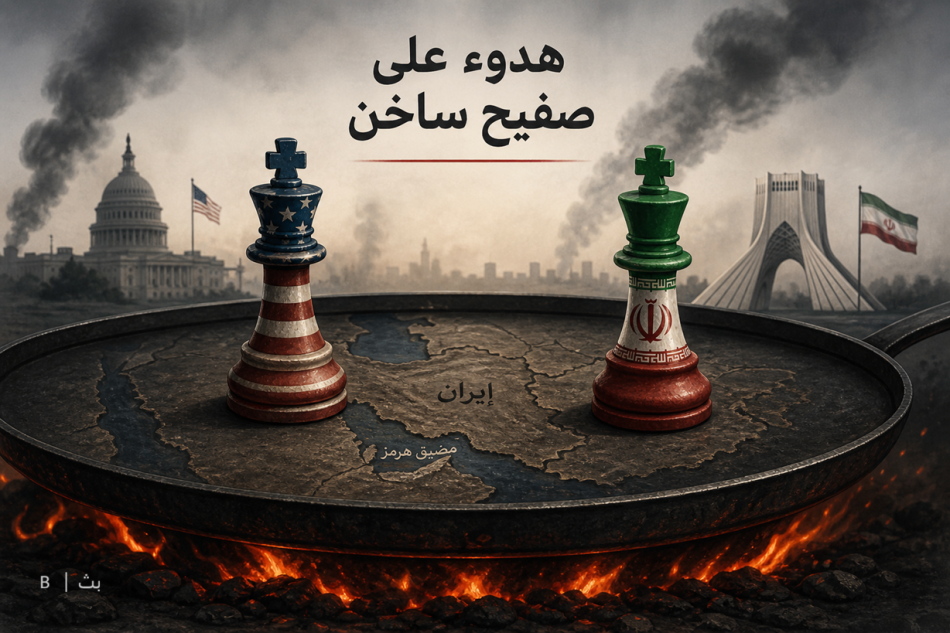
Day 63: Calm on a Hot Surface
Riyadh | B | B
May 3, 2026
—
Introduction
The U.S.–Iran conflict enters its sixty-third day in a scene that appears outwardly calm, yet remains loaded with open-ended possibilities for escalation.
This is not the calm of an ending, but of repositioning—forces recalibrating as both sides await a decision that could reignite the fire at any moment.
—
Overview
U.S. President Donald Trump announced that he will review Iran’s new proposal, while expressing clear skepticism about its chances of acceptance—an indication that the gap between the two sides remains intact.
According to Iran’s Tasnim News Agency and Fars News Agency, Tehran submitted a 14-point proposal via Pakistan, including a comprehensive ceasefire and a new framework for regulating navigation in the Strait of Hormuz.
The Iranian proposal, delivered through Islamabad as a mediator, places the decision squarely in Washington’s hands:
diplomacy… or continued escalation.
At the same time, Washington has not closed the military option.
Trump indicated that the possibility of new strikes remains on the table, stating: “That could happen… if they misbehave.”
—
B Reading
Today’s scene cannot be reduced to a proposal or a statement.
It reflects a deeper equation quietly taking shape:
Washington: negotiates from a position of strength… while keeping the stick ready
Tehran: maneuvers diplomatically… seeking a way out that preserves balance
What matters most is not only what is happening—but what this war has revealed:
- The decline of traditional powers once seen as central players
- The rise of new actors moving quietly toward influence
- The early formation of a different regional order, driven by interests rather than slogans
This is not a passing conflict.
It is a transitional chapter between an era ending… and another taking form.
—
Conclusion
The war has not ended.
It has merely paused… to reorganize itself.
The question is no longer: Will the fire return?
But: When… and in what form?
Trump Rejects Iran Proposal
U.S. President Donald Trump said Washington has reviewed Iran’s revised proposal, submitted via a Pakistani mediator, describing it as “not good” and “unacceptable,” signaling a stall in the negotiation track between the two sides.
—
Overview
In an interview with the Israeli Public Broadcasting Corporation, Trump stated that negotiations with Iran are “stuck,” noting that the latest proposal does not meet U.S. expectations.
The remarks come days after Tehran submitted an updated proposal through Islamabad in an attempt to revive diplomacy, amid a cautious calm across the region.
—
B Reading | What Next?
The U.S. rejection does not end negotiations.
It resets their terms.
Three parallel paths are now in motion:
1) Calibrated pressure
Washington raises the bar of rejection—not to close the door,
but to push Tehran toward a better offer.
2) Test of will
Iran faces two options:
revise the proposal… or probe the limits of escalation.
3) Time as leverage
The longer the stalemate,
the higher the cost for both sides.
What matters most:
the current “calm” is not stability—
it is a waiting space.
—
Conclusion
Talks have not collapsed.
They have paused at a decisive point.
The question is no longer: Will there be a deal?
But: Who will concede first—and at what cost?
—
B (بث B) – All rights reserved